The Smart School Prep – World Around Us, Beginners (Session 2027-28)
The Smart School (A Project of The City School)
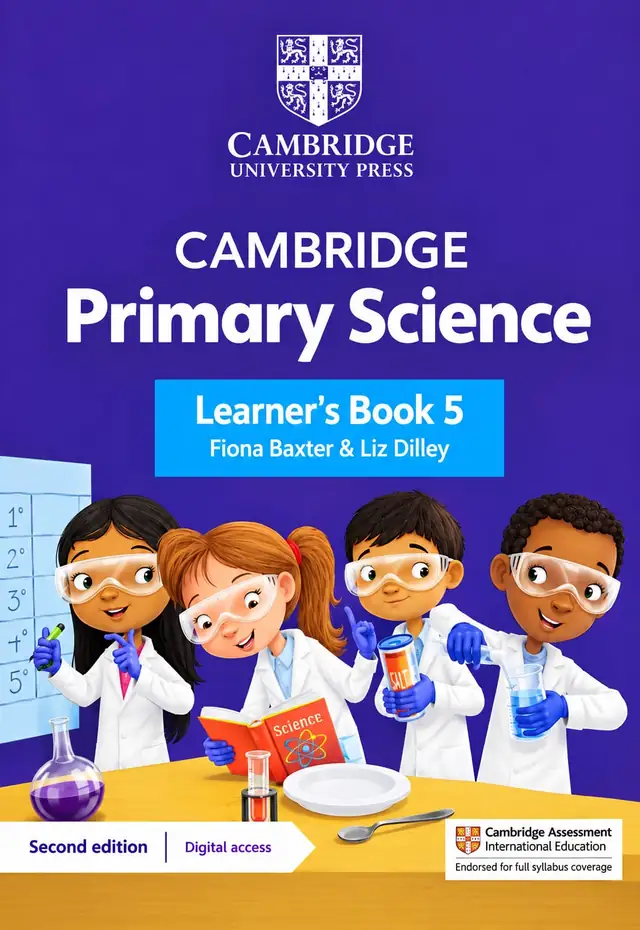
Cambridge Primary Science Learner's Book 5, Second edition, by Fiona Baxter and Liz Dilley, with digital access, for session 2027-28: flowering plants, sound, matter, digestion, forces and seasons, for Class 5.
Cambridge Primary Science Learner's Book 5 (Second edition) by Fiona Baxter and Liz Dilley is the main science coursebook for Class 5, which Cambridge calls Stage 5. Its purple cover shows four children in lab coats and goggles, and its six units cover flowering plants, sound, states and properties of matter, the digestive system, forces and magnetism, and seasons and adaptations. This page is written for parents and teachers planning for the 2027-28 session.
Exams Book House, Shop Number 4, Al Fazal Market, Urdu Bazar, Lahore, supplies it with cash on delivery across Pakistan and delivery to the Gulf countries.
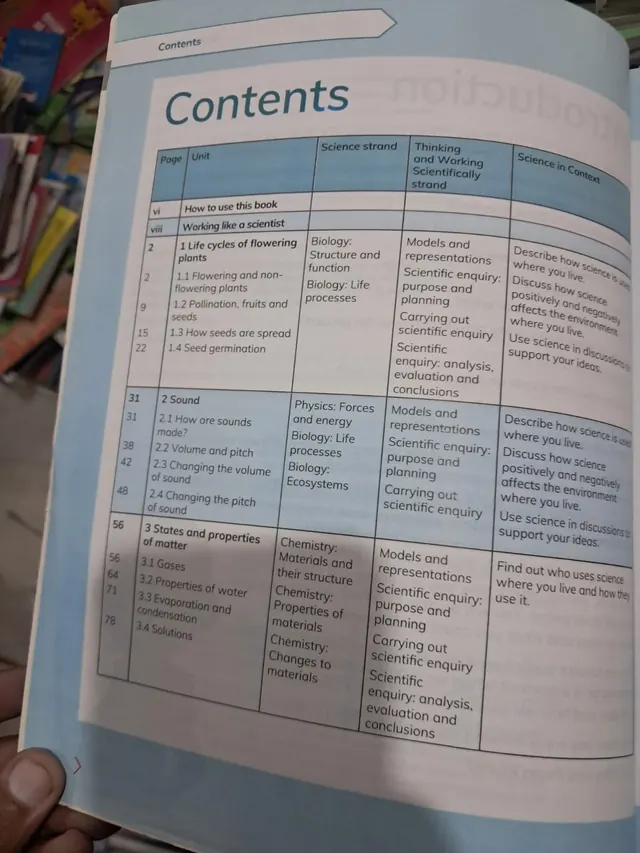
It is the student book for the fifth year of Cambridge Primary Science. Each unit has a clear set of lessons, plus the science strand, the enquiry skills (including "Models and representations") and a "Science in Context" idea. Class 5 expects children to plan investigations more independently, to use models and to explain results. The cover, with children wearing goggles and using a spoon, a beaker and a table of temperatures, reflects that practical side.
| Page | Unit and topics |
|---|---|
| vi | How to use this book |
| viii | Working like a scientist |
| 2 | 1 Life cycles of flowering plants: 1.1 Flowering and non-flowering plants (2); 1.2 Pollination, fruits and seeds (9); 1.3 How seeds are spread (15); 1.4 Seed germination (22) |
| 31 | 2 Sound: 2.1 How are sounds made? (31); 2.2 Volume and pitch (38); 2.3 Changing the volume of sound (42); 2.4 Changing the pitch of sound (48) |
| 56 | 3 States and properties of matter: 3.1 Gases (56); 3.2 Properties of water (64); 3.3 Evaporation and condensation (71); 3.4 Solutions (78) |
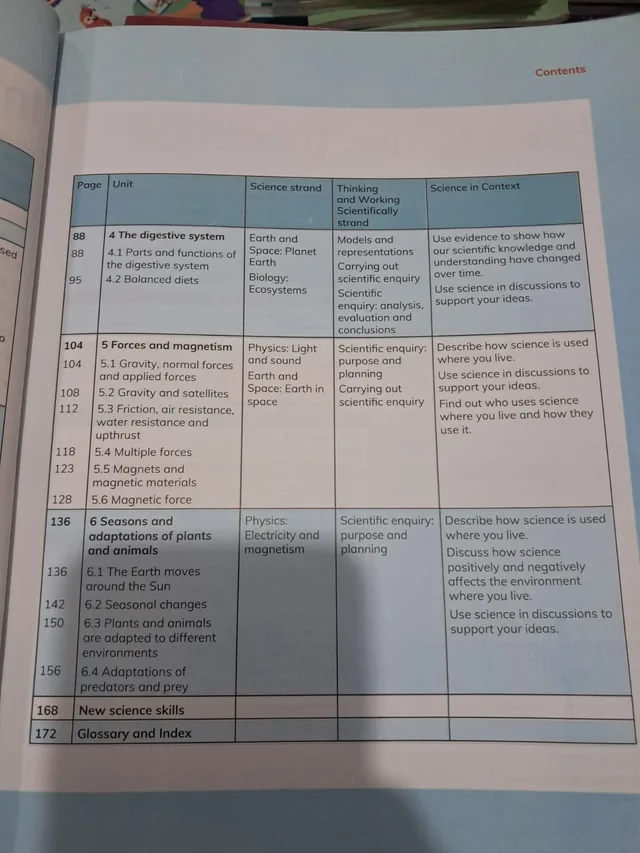
| 88 | 4 The digestive system: 4.1 Parts and functions of the digestive system (88); 4.2 Balanced diets (95) |
| 104 | 5 Forces and magnetism: 5.1 Gravity, normal forces and applied forces (104); 5.2 Gravity and satellites (108); 5.3 Friction, air resistance, water resistance and upthrust (112); 5.4 Multiple forces (118); 5.5 Magnets and magnetic materials (123); 5.6 Magnetic force (128) |
| 136 | 6 Seasons and adaptations of plants and animals: 6.1 The Earth moves around the Sun (136); 6.2 Seasonal changes (142); 6.3 Plants and animals are adapted to different environments (150); 6.4 Adaptations of predators and prey (156) |
| 168 | New science skills |
| 172 | Glossary and Index |
Unit 5 is a particularly full introduction to forces, with lessons on upthrust, air and water resistance, satellites and multiple forces. The seasons unit connects science with geography, and the digestive system unit links to health and nutrition. The page numbers above make it easy to follow what the class is doing at any time.
Schools usually follow the units in order across the year, with plants and sound in the first part, matter and digestion in the middle, and forces and seasons later. Ask your school for the plan.
If your school's 2027-28 list names Cambridge Primary Science Learner's Book 5 (Second edition), this is the book. We supply the newest printing we receive; send us your list on WhatsApp and we will tell you what we can get for you.
cambridge primary science learner's book 5 · cambridge science class 5 · stage 5 science baxter dilley · 9781108742955 · cambridge primary science second edition class 5 2027-28 · urdu bazar lahore cambridge books · کیمبرج پرائمری سائنس 5
Yes, if your school's 2027-28 list names the Cambridge Primary Science Learner's Book 5 (Second edition).
Class 5, which Cambridge calls Stage 5.
No. That is a different series. Check your school's list for the exact title.
Six units, plus a "New science skills" section, as listed above.
Yes, all over Pakistan with cash on delivery, and to the Gulf countries. WhatsApp 0317 4846676.