The Smart School Prep – World Around Us, Beginners (Session 2027-28)
The Smart School (A Project of The City School)
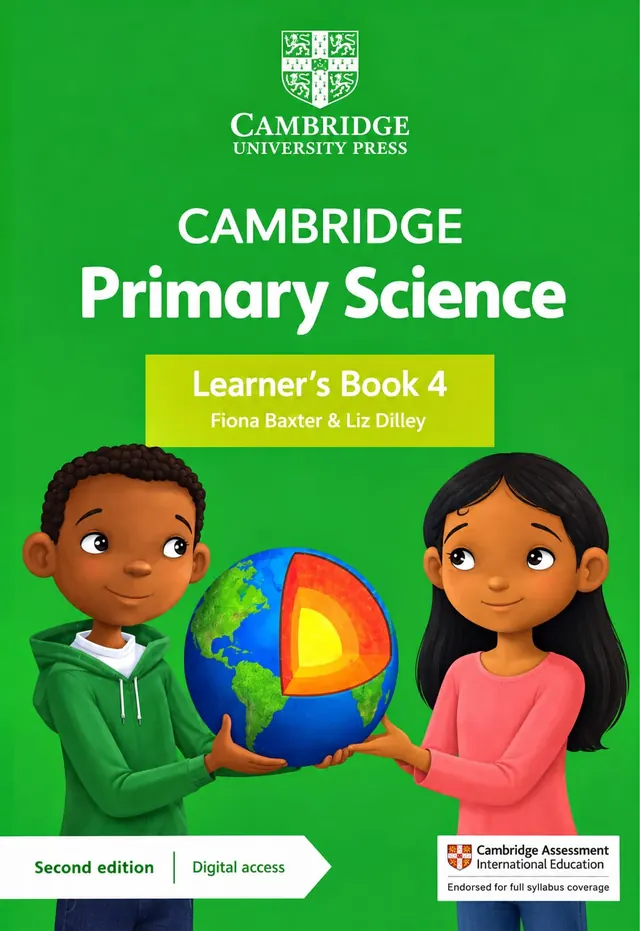
Cambridge Primary Science Learner's Book 4, Second edition, by Fiona Baxter and Liz Dilley, with digital access, for session 2027-28: skeletons, energy, materials, Earth and habitats, light and electricity, for Class 4.
Cambridge Primary Science Learner's Book 4 (Second edition) by Fiona Baxter and Liz Dilley is the main science coursebook for Class 4, which Cambridge calls Stage 4. Its green cover shows two children holding a globe cut open to show the Earth's layers, and its six units run from living things and energy to materials, Earth and its habitats, light and electricity. This page is written for parents and teachers planning for the 2027-28 session.
Exams Book House, Shop Number 4, Al Fazal Market, Urdu Bazar, Lahore, supplies it with cash on delivery across Pakistan and delivery to the Gulf countries.
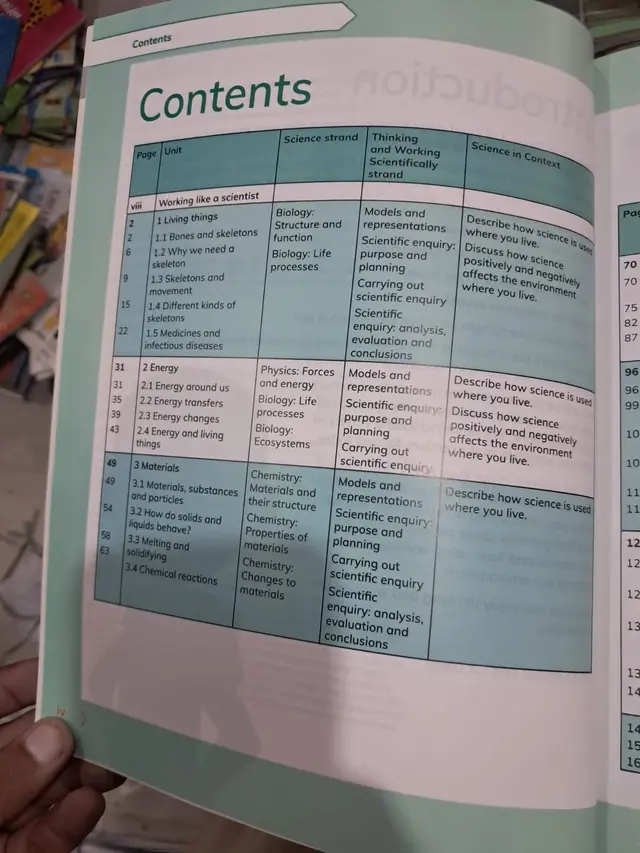
This is the student book for the fourth year of Cambridge Primary Science. It opens with a short section called "Working like a scientist", which explains how scientists observe, plan and test. Then the six units follow, each with a science strand, a Thinking and Working Scientifically strand (including "Models and representations" in this book) and a "Science in Context" idea.
Class 4 is a step up in depth. Units introduce topics such as energy transfers, particles, volcanoes and earthquakes, and electrical conductors, which prepare children for the more detailed science of Class 5 and 6.
| Page | Unit and topics | Science strand |
|---|---|---|
| viii | Working like a scientist | |
| 2 | 1 Living things: 1.1 Bones and skeletons (2); 1.2 Why we need a skeleton (6); 1.3 Skeletons and movement (9); 1.4 Different kinds of skeletons (15); 1.5 Medicines and infectious diseases (22) | Biology: Structure and function; Life processes |
| 31 | 2 Energy: 2.1 Energy around us (31); 2.2 Energy transfers (35); 2.3 Energy changes (39); 2.4 Energy and living things (43) | Physics: Forces and energy; Biology: Life processes; Ecosystems |
| 49 | 3 Materials: 3.1 Materials, substances and particles (49); 3.2 How do solids and liquids behave? (54); 3.3 Melting and solidifying (58); 3.4 Chemical reactions (63) | Chemistry: Materials and their structure; Properties of materials; Changes to materials |
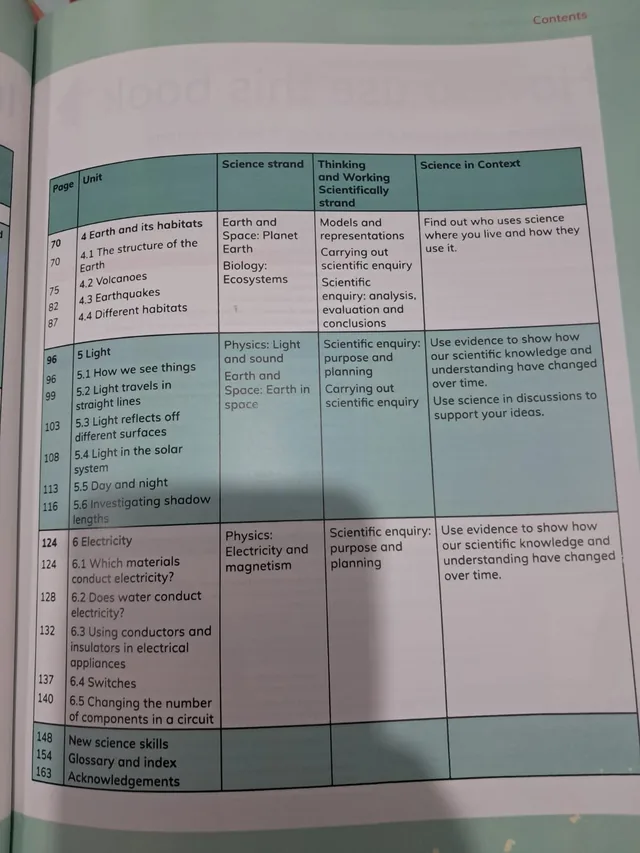
| 70 | 4 Earth and its habitats: 4.1 The structure of the Earth (70); 4.2 Volcanoes (75); 4.3 Earthquakes (82); 4.4 Different habitats (87) | Earth and Space: Planet Earth; Biology: Ecosystems |
| 96 | 5 Light: 5.1 How we see things (96); 5.2 Light travels in straight lines (99); 5.3 Light reflects off different surfaces (103); 5.4 Light in the solar system (108); 5.5 Day and night (113); 5.6 Investigating shadow lengths (116) | Physics: Light and sound; Earth and Space: Earth in space |
| 124 | 6 Electricity: 6.1 Which materials conduct electricity? (124); 6.2 Does water conduct electricity? (128); 6.3 Using conductors and insulators in electrical appliances (132); 6.4 Switches (137); 6.5 Changing the number of components in a circuit (140) | Physics: Electricity and magnetism |
| 148 | New science skills | |
| 154 | Glossary and index | |
| 163 | Acknowledgements |
The topics link to the real world: skeletons and medicine, energy in daily life, volcanoes and earthquakes, and household electricity. The fair-testing investigations, such as the shadow-length enquiry in unit 5, give children hands-on practice, and the "New science skills" section on page 148 gathers the main methods in one place.
Schools usually teach the units in order. Life science and energy come first, then materials, Earth, light and electricity. Ask your school for the term plan.
If your school's 2027-28 list names Cambridge Primary Science Learner's Book 4 (Second edition), this is the book. We supply the newest printing we receive; send us your list on WhatsApp and we will tell you what we can get for you.
cambridge primary science learner's book 4 · cambridge science class 4 · stage 4 science baxter dilley · 9781108742931 · cambridge primary science second edition class 4 2027-28 · urdu bazar lahore cambridge books · کیمبرج پرائمری سائنس 4
Yes, if your school's 2027-28 list names the Cambridge Primary Science Learner's Book 4 (Second edition).
Class 4, which Cambridge calls Stage 4.
Yes. Class 2 and 3 are by Jon Board and Alan Cross, and Class 4 and 5 are by Fiona Baxter and Liz Dilley.
Six units, plus a "New science skills" section, as listed above.
Yes, all over Pakistan with cash on delivery, and to the Gulf countries. WhatsApp 0317 4846676.