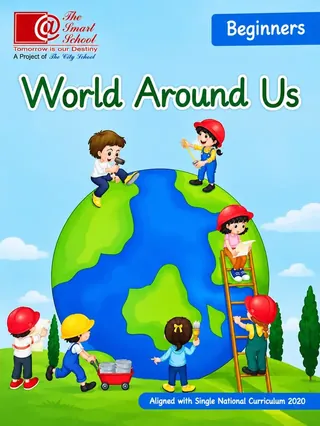
The Smart School Prep – World Around Us, Beginners (Session 2027-28)
The Smart School (A Project of The City School)

Cambridge Primary English Pakistan edition Learner's Book 5 by Sally Burt and Debbie Ridgard, based on the Single National Curriculum 2020, for Class 5, session 2027-28: nine units from fables and space to The Jungle Book and "Pakistan – Our country".
Cambridge Primary English Learner's Book 5, Pakistan edition by Sally Burt and Debbie Ridgard is the Class 5 English coursebook, with a dark blue hardback-style cover and the line "Based on Single National Curriculum 2020". Its nine units take children through fables, space, poems, The Jungle Book, instructions, narrative poetry, Cinderella tales, persuasive writing and a closing unit on Pakistan. This page is written for parents and teachers planning for the 2027-28 session.
Exams Book House, Shop Number 4, Al Fazal Market, Urdu Bazar, Lahore, supplies it with cash on delivery across Pakistan and delivery to the Gulf countries.
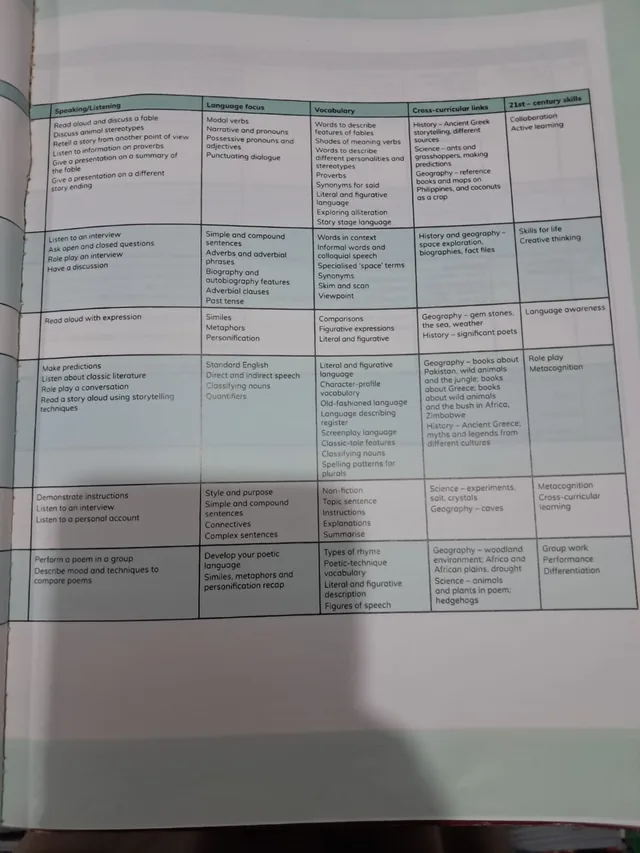
It is the main English coursebook for Class 5. Each unit is organised in the same way, and the contents table has columns for the text type, the reading texts, the writing tasks, the speaking and listening activities, the language focus, vocabulary, cross-curricular links and the "21st-century skills" that children practise. This means that the book trains reading, writing, speaking, listening and language knowledge together.
The Pakistan edition includes texts and settings that connect to Pakistani life, most visibly in the last unit, "Pakistan – Our country", which has a school calendar, a report card, a map, and a brochure about the Margalla Hills.
| Page | Unit | Text type | Reading | Writing |
|---|---|---|---|---|
| 10 | 1 There's a lesson in that | Fiction: fables and stories from different cultures; classic literature; stories developed into a play or film | The Ant and the Grasshopper; Auntie Anthea and Gentle Geoffrey; The Man with the Coconuts | Fable fact file; reading log; answer questions on a text; paragraphs on Ant's and Grasshopper's personalities; opinion paragraph; cartoon strip; dialogue; retell a fable |
| 47 | 2 Exploring space | Information texts; recounts: biography; letters | A brief history of space timeline; a blog entry from the ISS; a biography of an astronaut; a fact file | Multi-clause sentences; adverbials to order events; notes on a timeline; weekly diary; blog; interview questions; plan and write a biography |
| 80 | 3 Reflections | Poems by significant poets; classic poetry | Flint; The Sea; various haiku poems; Wind | Similes, metaphors and personification; haiku poems |
| 100 | 4 Telling timeless tales | Fiction: stories from different cultures; classic literature; stories developed into a play or film | The Jungle Book blurb; The Jungle Book (novel); The Jungle Book (play); Welcome to Olympus; The Cat Who Came Indoors | Character profile; part of a screenplay; reading log; retell a classic tale |
| 141 | 5 Tell me how | Information texts that also contain explanations | Instructions on Make a crystal star; information on The Giant Crystal Cave; information on how to wear protective gear | Instructions on how to do or make something; notes in different ways; explanation paragraph; leaflet |
| 173 | 6 A different type of story | Poems by significant poets, including classic poetry; narrative poetry | The Way Through the Woods; Bringing the Rain to Kapiti Plain; Once the Wind; At the End of a School Day | Answer questions on a poem; reading log to compare poems; narrative poem following a frame |
| 196 | 7 Tell it another way | Fiction: stories from different cultures; classic literature; stories developed into a play or film | The Salt Prince; Settareh synopsis; Cinderella in China; Cinderella in Kenya; Blackberry Blue; Blackberry Blue recount | Answer questions on a story; reading log; Cinderella synopsis; table; notes predicting how a story ends; paragraph comparing stories; a Cinderella tale with your changes |
| 226 | 8 Share your views | Persuasive texts: letters and reviews giving a personal opinion; information texts with explanations | Beach Clean-Up poster; advertisement for accommodation in Camps Bay; a map and a timetable; film posters and reviews; an informal email; a formal letter | Design a poster; film review notes; informal text; formal letter |
| 259 | 9 Pakistan – Our country | Non-fiction: school calendar, report card, maps, brochure, signs, fact files, reference book, charts and graphs | A school calendar; a school report card; a map; Margalla Hills brochure and Visitor Safety and Responsibilities; fact files; a reference book | Daily diary for your school week; mind map summary; cloze passages (including one on Pakistan); paragraph about Margalla Hills; table of a discussion; mind map of similarities and differences; schedule for a place to visit; paragraph describing an event |
| 282 | Spell and say activities | |||
| 292 | Toolkit | |||
| 302 | Key words | |||
| 306 | Acknowledgements |
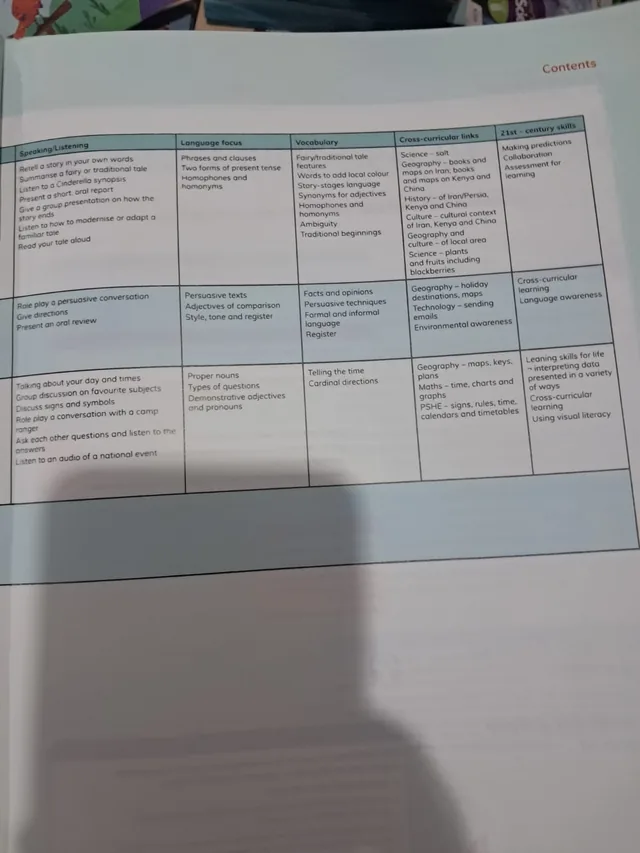
| Unit | Speaking and listening | Language focus | Vocabulary |
|---|---|---|---|
| 1 | Read aloud and discuss a fable; discuss animal stereotypes; retell from another point of view; listen to information on proverbs; presentations on a summary and on a different ending | Modal verbs; narrative and pronouns; possessive pronouns and adjectives; punctuating dialogue | Features of fables; shades of meaning verbs; personalities and stereotypes; proverbs; synonyms for "said"; literal and figurative language; alliteration; story-stage language |
| 2 | Listen to an interview; open and closed questions; role play an interview; have a discussion | Simple and compound sentences; adverbs and adverbial phrases; biography and autobiography features; adverbial clauses; past tense | Words in context; informal words and colloquial speech; specialised "space" terms; synonyms; skim and scan; viewpoint |
| 3 | Read aloud with expression | Similes; metaphors; personification | Comparisons; figurative expressions; literal and figurative |
| 4 | Make predictions; listen about classic literature; role play a conversation; read a story aloud with storytelling techniques | Standard English; direct and indirect speech; classifying nouns; quantifiers | Literal and figurative language; character-profile vocabulary; old-fashioned language; register; screenplay language; classic-tale features; plural spelling patterns |
| 5 | Demonstrate instructions; listen to an interview; listen to a personal account | Style and purpose; simple and compound sentences; connectives; complex sentences | Non-fiction; topic sentence; instructions; explanations; summarise |
| 6 | Perform a poem in a group; describe mood and techniques to compare poems | Develop your poetic language; similes, metaphors and personification recap | Types of rhyme; poetic-technique vocabulary; literal and figurative description; figures of speech |
| 7 | Retell a story in your own words; summarise a fairy tale; listen to a Cinderella synopsis; short oral report; group presentation; modernise a familiar tale; read your tale aloud | Phrases and clauses; two forms of present tense; homophones and homonyms | Fairy-tale features; words to add local colour; story stages; synonyms for adjectives; ambiguity; traditional beginnings |
| 8 | Role play a persuasive conversation; give directions; present an oral review | Persuasive texts; adjectives of comparison; style, tone and register | Facts and opinions; persuasive techniques; formal and informal language; register |
| 9 | Talk about your day and times; group discussion on favourite subjects; discuss signs and symbols; role play with a camp ranger; ask and answer questions; listen to an audio of a national event | Proper nouns; types of questions; demonstrative adjectives and pronouns | Telling the time; cardinal directions |
The contents table also lists links to other subjects: science (ants and grasshoppers, salt and crystals, blackberries), history (Ancient Greece, Persia, Kenya and China), geography (maps, caves, the Philippines and coconuts, woodland and African plains, books about Pakistan and wild animals) and maths (time, charts and graphs). This is useful for teachers who want to connect English with the wider curriculum.
The units give a balanced mix of stories, information texts, poems and persuasive writing, so children practise many kinds of English. The final unit on Pakistan is practical: reading a calendar, a report card and a map are real-life skills. The book's contents table also helps parents to follow what the class is working on and to prepare for tests.
Schools usually follow the units in order, from "There's a lesson in that" at page 10 to "Pakistan – Our country" at page 259. The Spell and say activities, Toolkit and Key words at the back are used throughout the year.
If your school's 2027-28 list names Cambridge Primary English Pakistan edition Learner's Book 5, this is the book. We supply the newest printing we receive; send us your list on WhatsApp and we will tell you what we can get for you.
cambridge primary english learner's book 5 pakistan edition · cambridge english class 5 · single national curriculum english class 5 · 9781009111492 · sally burt debbie ridgard english 5 · class 5 english book 2027-28 · urdu bazar lahore cambridge books · کیمبرج پرائمری انگلش 5 پاکستان ایڈیشن
Yes, if your school's 2027-28 list names the Cambridge Primary English Pakistan edition Learner's Book 5.
Class 5.
No. Ask your school whether a workbook is needed.
"Pakistan – Our country", which includes a school calendar, a report card, a map and a Margalla Hills brochure.
Yes, all over Pakistan with cash on delivery, and to the Gulf countries. WhatsApp 0317 4846676.