The Smart School Prep – World Around Us, Beginners (Session 2027-28)
The Smart School (A Project of The City School)
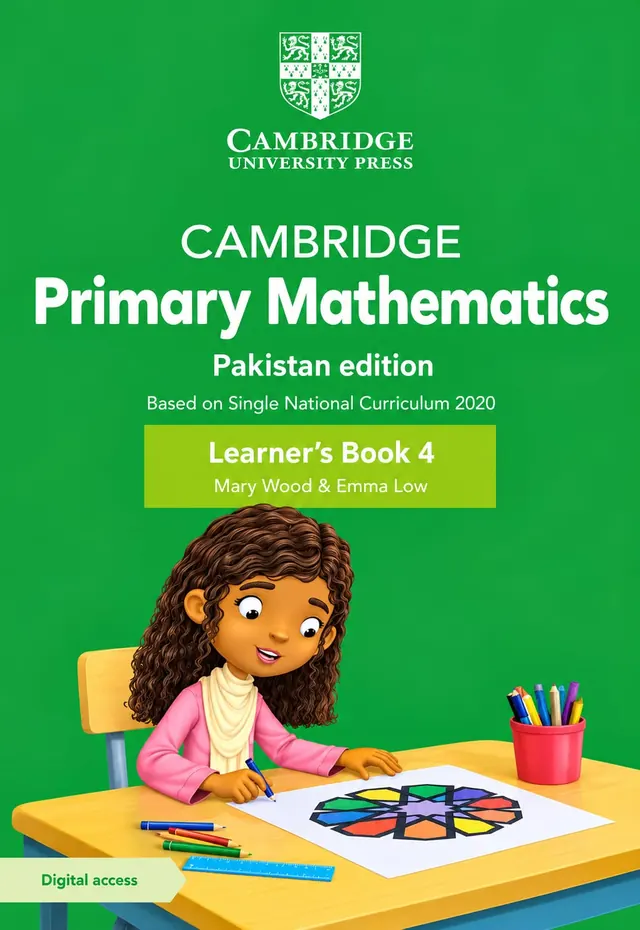
Cambridge Primary Mathematics Pakistan edition Learner's Book 4 by Mary Wood and Emma Low, based on the Single National Curriculum 2020, for session 2027-28: 17 units and 5 projects for Class 4.
Cambridge Primary Mathematics Learner's Book 4, Pakistan edition by Mary Wood and Emma Low is the Class 4 maths coursebook with a green cover, based on the Single National Curriculum 2020 as printed on the cover. It has 17 units that move from place value and time to angles, fractions, special numbers and long division, with five projects. This page is written for parents and teachers planning for the 2027-28 session.
Exams Book House, Shop Number 4, Al Fazal Market, Urdu Bazar, Lahore, supplies it with cash on delivery across Pakistan and delivery to the Gulf countries.
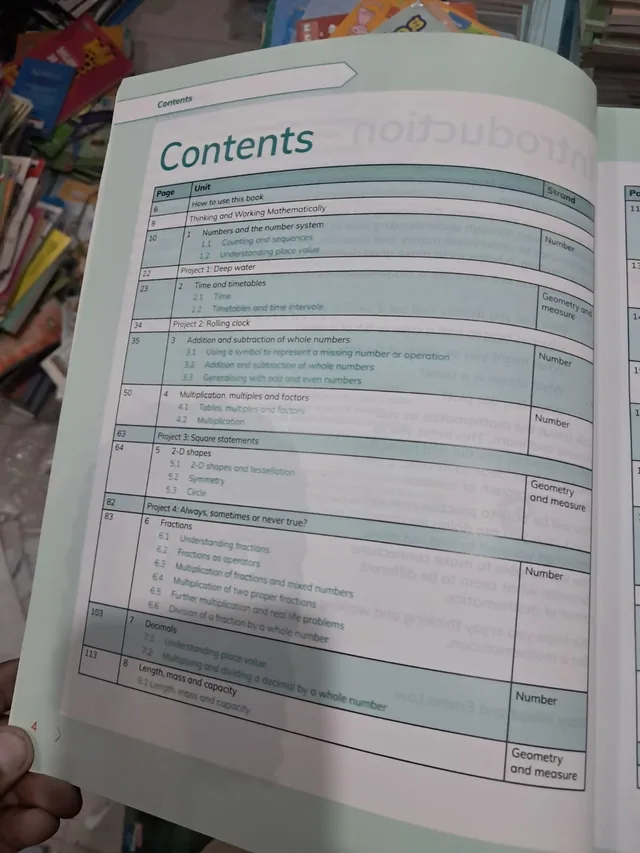
This is the main student book for the fourth year of the Pakistan edition of Cambridge Primary Mathematics. It builds on the Class 3 book and prepares children for the ideas of Class 5, such as decimals, percentages and bigger fractions. Page 8, "Thinking and Working Mathematically", sets out the habits of mind that the course wants to develop.
The units are grouped by strand (Number, Geometry and measure, and Statistics and probability). Between units there are projects, which are longer activities with a real-life flavour: Deep water, Rolling clock, Square statements, "Always, sometimes or never true?" and Special numbers.
| Page | Unit or section |
|---|---|
| 6 | How to use this book |
| 8 | Thinking and Working Mathematically |
| 10 | 1 Numbers and the number system: 1.1 Counting and sequences; 1.2 Understanding place value |
| 22 | Project 1: Deep water |
| 23 | 2 Time and timetables: 2.1 Time; 2.2 Timetables and time intervals |
| 34 | Project 2: Rolling clock |
| 35 | 3 Addition and subtraction of whole numbers: 3.1 Using a symbol to represent a missing number or operation; 3.2 Addition and subtraction of whole numbers; 3.3 Generalising with odd and even numbers |
| 50 | 4 Multiplication, multiples and factors: 4.1 Tables, multiples and factors; 4.2 Multiplication |
| 63 | Project 3: Square statements |
| 64 | 5 2-D shapes: 5.1 2-D shapes and tessellation; 5.2 Symmetry; 5.3 Circle |
| 82 | Project 4: Always, sometimes or never true? |
| 83 | 6 Fractions: 6.1 Understanding fractions; 6.2 Fractions as operators; 6.3 Multiplication of fractions and mixed numbers; 6.4 Multiplication of two proper fractions; 6.5 Further multiplication and real life problems; 6.6 Division of a fraction by a whole number |
| 103 | 7 Decimals: 7.1 Understanding place value; 7.2 Multiplying and dividing a decimal by a whole number |
| 113 | 8 Length, mass and capacity: 8.1 Length, mass and capacity |
| 119 | 9 Angles: 9.1 Comparing angles; 9.2 Acute and obtuse; 9.3 Estimating angles; 9.4 Measuring and drawing angles |
| 137 | 10 Rounding, comparing and ordering: 10.1 Rounding whole numbers; 10.2 Rounding decimals; 10.3 Comparing and ordering whole numbers |
| 146 | 11 Fractions and decimals: 11.1 Equivalence, comparing and ordering fractions; 11.2 Simplifying fractions; 11.3 Converting between fractions and decimals |
| 156 | 12 Investigating 3-D shapes and nets: 12.1 The properties of 3-D shapes; 12.2 Nets of 3-D shapes |
| 168 | 13 Addition and subtraction: 13.1 Adding and subtracting efficiently; 13.2 Adding and subtracting fractions with the same denominator; 13.3 Adding and subtracting decimals |
| 182 | 14 Area and perimeter: 14.1 Estimating and measuring area and perimeter; 14.2 Area and perimeter of rectangles |
| 195 | 15 Special numbers: 15.1 Working with special numbers; 15.2 Tests of divisibility; 15.3 Prime and composite numbers; 15.4 Common multiples and common factors |
| 211 | Project 5: Special numbers |
| 212 | 16 A data unit (statistics and probability strand) that includes 16.3 Bar charts |
| 237 | 17 Multiplication and division: 17.1 Multiplication; 17.2 Division by a 1-digit number; 17.3 Division by a 2-digit number |
| 249 | Glossary |
| 257 | Acknowledgements |
Number and the number system. The book begins with counting and sequences and understanding place value, then moves through addition and subtraction with missing numbers and odd and even patterns. Multiplication, multiples and factors form a strong thread, and unit 17 finishes the book with multiplication and division by one-digit and two-digit numbers.
Fractions and decimals. Units 6, 7, 11 and 13 cover fractions and decimals in more detail than many parents expect for this class: understanding fractions, fractions as operators, equivalence, simplifying, converting between fractions and decimals, and adding and subtracting them. Unit 10 shows how to round whole numbers and decimals.
Shape, angle and measure. Pupils meet 2-D shapes and tessellation, symmetry and the circle, then angles (acute, obtuse, estimating and measuring), 3-D shapes and their nets, and area and perimeter of rectangles. Unit 8 covers length, mass and capacity.
Time and special numbers. Unit 2 is about time and timetables. Unit 15 introduces special numbers: tests of divisibility, prime and composite numbers, common multiples and factors.
Data. Unit 16 on page 212 is the data unit and includes bar charts.
It has many real-life tasks, such as timetables and area problems, and the projects give a break from ordinary exercises. The fraction and decimal units are especially thorough, which gives children a solid base for Class 5. The glossary on page 249 helps with maths vocabulary.
Schools usually follow the order of the units and cover them over the year. Units 1 to 8 tend to be taught first; angles, rounding, fractions and decimals, nets, area and special numbers follow, and data and long division often come near the end. Ask your school for its plan.
If your school's 2027-28 list names Cambridge Primary Mathematics Pakistan edition Learner's Book 4, this is the book. We supply the newest printing we receive; send us your list on WhatsApp and we will tell you what we can get for you.
cambridge primary mathematics learner's book 4 pakistan edition · cambridge maths class 4 · single national curriculum maths class 4 · 9781009111799 · mary wood emma low maths 4 · class 4 maths book 2027-28 · urdu bazar lahore cambridge books · کیمبرج پرائمری میتھس 4 پاکستان ایڈیشن
Yes, if your school's 2027-28 list names the Cambridge Primary Mathematics Pakistan edition Learner's Book 4.
Class 4, the fourth year of Cambridge Primary Mathematics.
No. A workbook is a separate book. Ask your school whether one is needed.
Seventeen units and five projects, as listed above.
Yes, all over Pakistan with cash on delivery, and to the Gulf countries. WhatsApp 0317 4846676.