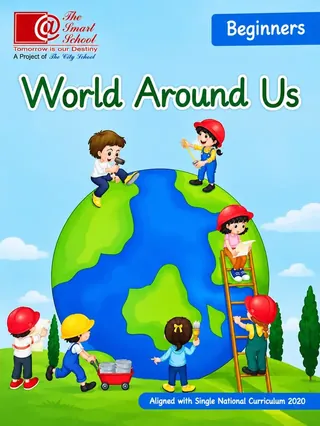
The Smart School Prep – World Around Us, Beginners (Session 2027-28)
The Smart School (A Project of The City School)
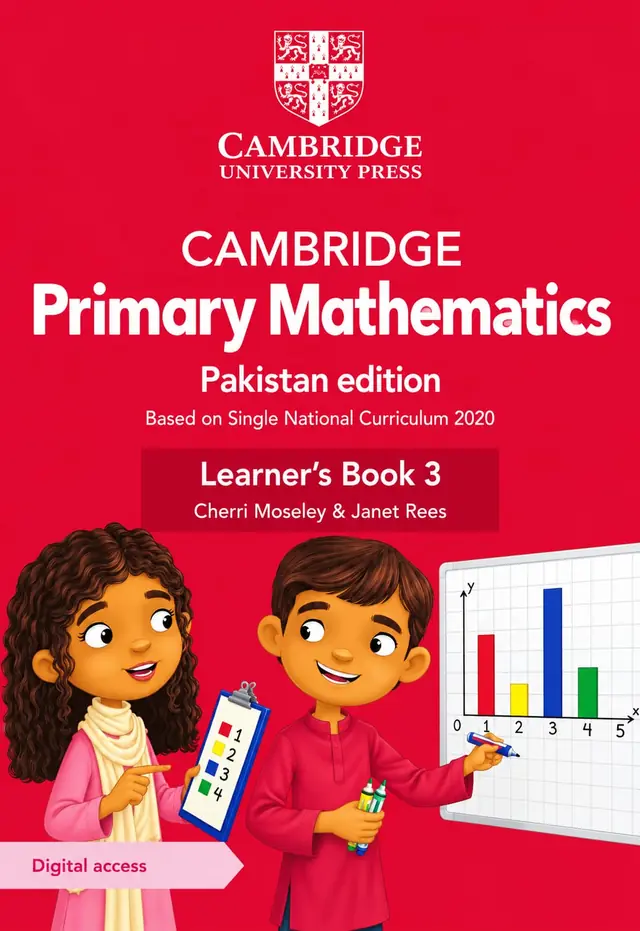
Cambridge Primary Mathematics Pakistan edition Learner's Book 3 by Cherri Moseley and Janet Rees, based on the Single National Curriculum 2020, for session 2027-28: 17 units and 5 projects for Class 3.
Cambridge Primary Mathematics Learner's Book 3, Pakistan edition by Cherri Moseley and Janet Rees is the Class 3 maths coursebook with a red cover, based on the Single National Curriculum 2020 as printed on the cover. It has 17 units that run from numbers to 1000 to four-digit numbers, with five projects in between. This page helps parents and teachers decide what to buy for the 2027-28 session.
Exams Book House, Shop Number 4, Al Fazal Market, Urdu Bazar, Lahore, supplies it with cash on delivery across Pakistan and delivery to the Gulf countries.
It is the student book for Class 3 in the Pakistan edition of the Cambridge Primary Mathematics series. "Pakistan edition" means that the book has been adapted for Pakistani classrooms and is based on the Single National Curriculum 2020, which is stated on the cover. The page "Thinking and working mathematically" (page 8) introduces the way the book wants children to learn: question, test, explain and check.
Each unit has short lessons, and the units are grouped by strand: Number, Geometry and measure, and Statistics and probability. The projects (Surprising sums, Prism to pyramid, Chalky shapes, Dicey fractions and How likely?) are practical tasks that bring skills together.
| Page | Unit or section | Strand |
|---|---|---|
| 6 | How to use this book | |
| 8 | Thinking and working mathematically | |
| 10 | 1 Numbers to 1000: 1.1 Hundreds, tens and ones; 1.2 Comparing and ordering; 1.3 Estimating and rounding | Number |
| 22 | 2 Addition and subtraction: 2.1 Addition; 2.2 Subtraction; 2.3 Roman numbers | Number |
| 37 | Project 1: Surprising sums | |
| 39 | 3 Multiplication and division: 3.1 Exploring multiplication and division; 3.2 Connecting 2×, 4× and 8×; 3.3 Connecting 3×, 6× and 9× | Number |
| 56 | 4 3D shapes: 4.1 3D shapes | Geometry and measure |
| 64 | Project 2: Prism to pyramid | |
| 66 | 5 Measurement, area and perimeter: 5.1 Measurement; 5.2 2D shapes and perimeter; 5.3 Introducing area | Geometry and measure |
| 83 | Project 3: Chalky shapes | |
| 85 | 6 Fractions of shapes: 6.1 Fractions and equivalence of shapes; 6.2 Proper and improper fractions | Number |
| 95 | 7 Statistics: Tally charts and frequency tables: 7.1 Tally charts and frequency tables | Statistics and probability |
| 104 | 8 Time: 8.1 Time | Geometry and measure |
| 111 | 9 More addition and subtraction: 9.1 Addition: regrouping tens and reordering; 9.2 Subtraction: regrouping tens; 9.3 Complements | Number |
| 127 | 10 More multiplication and division: 10.1 Revisiting multiplication and division; 10.2 Playing with multiplication and division; 10.3 Extending multiplication and division | Number |
| 141 | 11 More fractions: 11.1 Fractions of numbers; 11.2 Ordering and comparing fractions; 11.3 Calculating with fractions | Number |
| 156 | Project 4: Dicey fractions | |
| 157 | 12 Measure: 12.1 Mass; 12.2 Capacity; 12.3 Temperature | Geometry and measure |
| 175 | 13 Time (2): 13.1 Time; 13.2 Timetables | Geometry and measure |
| 187 | 14 Angles and movement: 14.1 Angles, direction, position and movement | Geometry and measure |
| 197 | 15 Graphs: 15.1 Pictograms and bar charts; 15.2 Carroll diagrams | Statistics and probability |
| 212 | 16 Pattern and symmetry: 16.1 Shape and symmetry; 16.2 Pattern and symmetry | Geometry and measure |
| 223 | Project 5: How likely? | |
| 225 | 17 Looking forward: 4-digit numbers: 17.1 Numbers to 10,000; 17.2 Addition and subtraction with 4-digit numbers | Number |
| 243 | Glossary | |
| 259 | Acknowledgements |
Number. The book builds place value with hundreds, tens and ones, and moves into comparing, ordering, estimating and rounding. Addition and subtraction come next, with Roman numbers as an interesting extra, and are revisited in unit 9 with regrouping tens. Multiplication and division start with tables (2, 4 and 8 first, then 3, 6 and 9), and unit 10 revisits them through games and extension tasks. Fractions appear first as parts of shapes, then as parts of numbers, in order and compared, with some simple calculation. The final unit looks ahead to four-digit numbers and numbers to 10,000.
Geometry and measure. Pupils study 3D shapes, build up measuring skills, work on perimeter and begin to understand area. Later they measure mass, capacity and temperature, study time and timetables, and learn about angles, direction, position and movement. The last geometry unit is about pattern and symmetry.
Statistics and probability. Tally charts and frequency tables first, then pictograms, bar charts and Carroll diagrams. The project "How likely?" introduces chance in a practical way.
The units are clearly organised, and the strand labels help adults see what each section is for. The projects give variety, and the long unit on number, which runs through the book in different forms, builds the confidence that children need for Class 4. Because it is the Pakistan edition, the examples and wording are chosen for local classrooms.
Most schools work through the units in order, from page 10 to page 242, over the school year. The first eight units cover the basics and usually take up the first part of the year, and units 9 to 17 build on them. Ask your school for the unit plan.
If your school's 2027-28 list names Cambridge Primary Mathematics Pakistan edition Learner's Book 3, this is the book. We supply the newest printing we receive; send us your list on WhatsApp and we will tell you what we can get for you.
cambridge primary mathematics learner's book 3 pakistan edition · cambridge maths class 3 · single national curriculum maths class 3 · 9781009111768 · moseley rees maths book 3 · class 3 maths book 2027-28 · urdu bazar lahore cambridge books · کیمبرج پرائمری میتھس 3 پاکستان ایڈیشن
Yes, if your school's 2027-28 list names the Cambridge Primary Mathematics Pakistan edition Learner's Book 3.
The cover says the book is a Pakistan edition based on the Single National Curriculum 2020.
No. The workbook is a separate book. Please check the pairing with your school.
Seventeen units and five projects, listed above with page numbers.
Yes, all over Pakistan with cash on delivery, and to the Gulf countries. WhatsApp 0317 4846676.