The Cambridge Lower Secondary English Learner's Book Grade 6 (Pakistan edition) by Sally Burt and Debbie Ridgard is the main English coursebook for Class 6 in Cambridge-system schools. Its 9 units mix fiction, news articles, biographies, poetry and Shakespeare, and include Pakistani content such as Samina Baig's climb of Everest, the poet Zehra Nigah and performing at a mushaira. It suits the 2027-28 session when your school list names this Grade 6 book.
Exams Book House, Shop Number 4, Al Fazal Market, Urdu Bazar, Lahore, supplies Cambridge Lower Secondary books to students across Pakistan, with cash on delivery.
Quick facts about this book
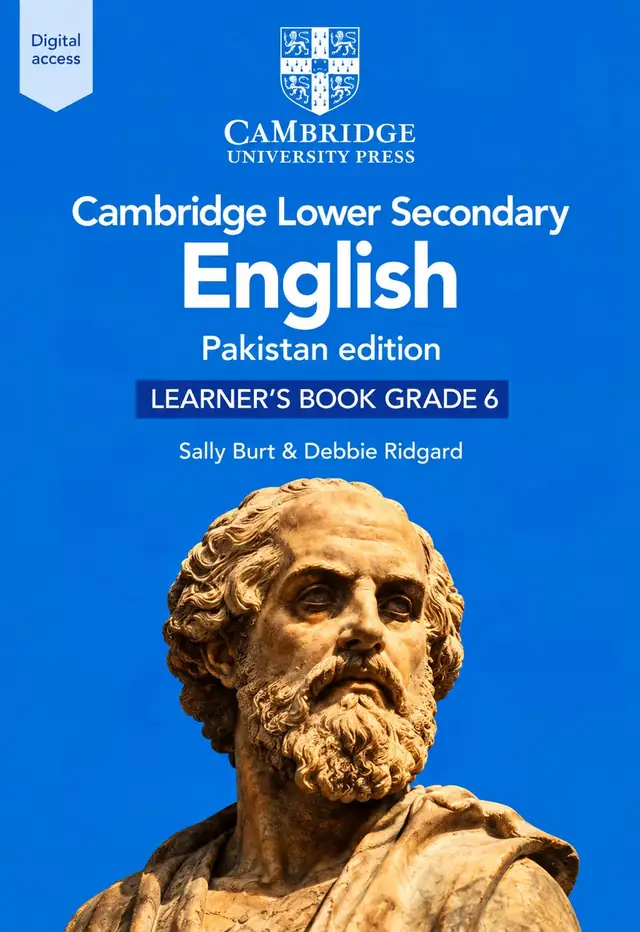
- Title on the cover: Cambridge Lower Secondary English — Pakistan edition — LEARNER'S BOOK GRADE 6
- Authors: Sally Burt & Debbie Ridgard
- Publisher: Cambridge University Press · "Digital access" tab on the cover
- Cover: bright blue, with a stone statue of a bearded classical figure
- Level: Grade 6 (Class 6), Cambridge Lower Secondary English
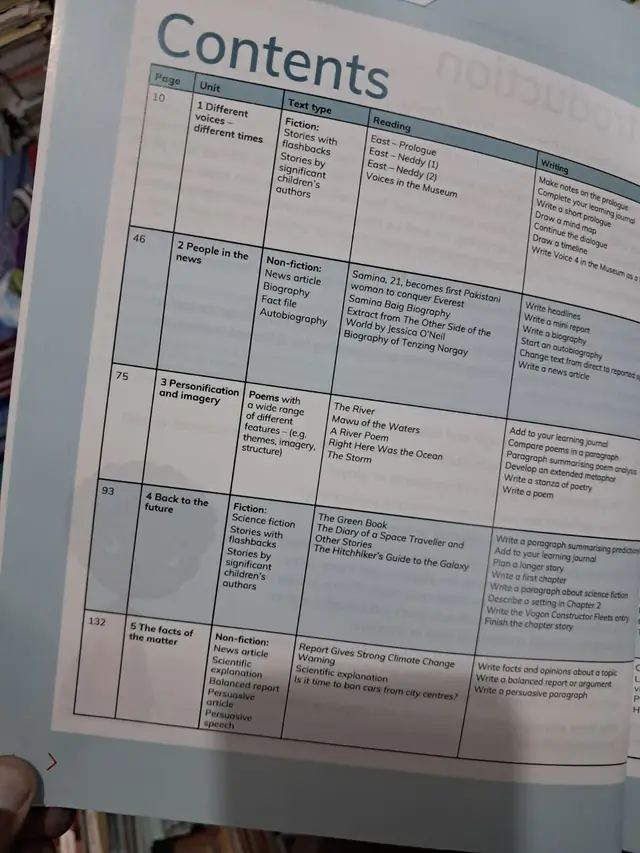
- Units: 9, starting on pages 10, 46, 75, 93, 132, 162, 179, 213 and 240
- Back of the book: Spelling activities (258), Toolkit (270), Key words (281), Acknowledgements (284)
- Session: suitable for 2027-28 (check your school's list)
What is in the Grade 6 Learner's Book?
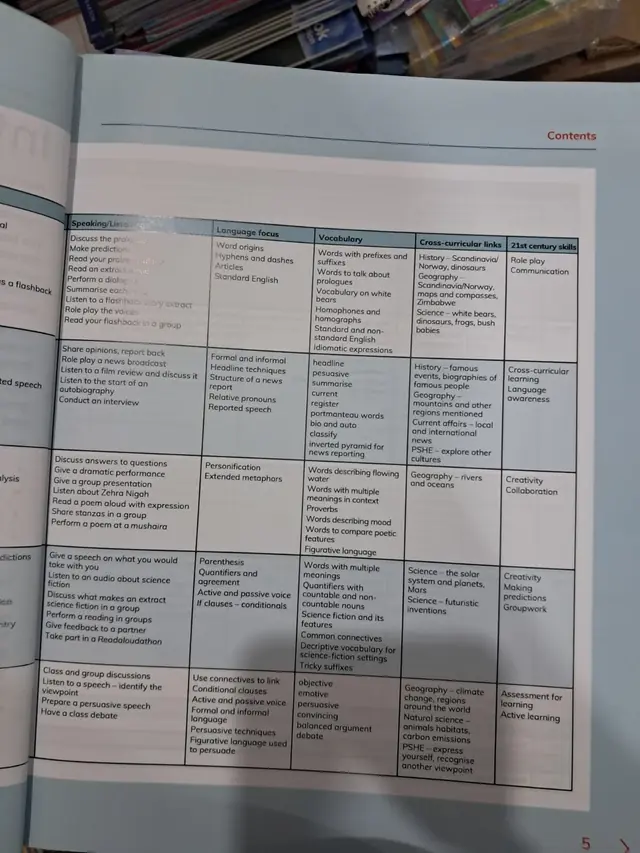
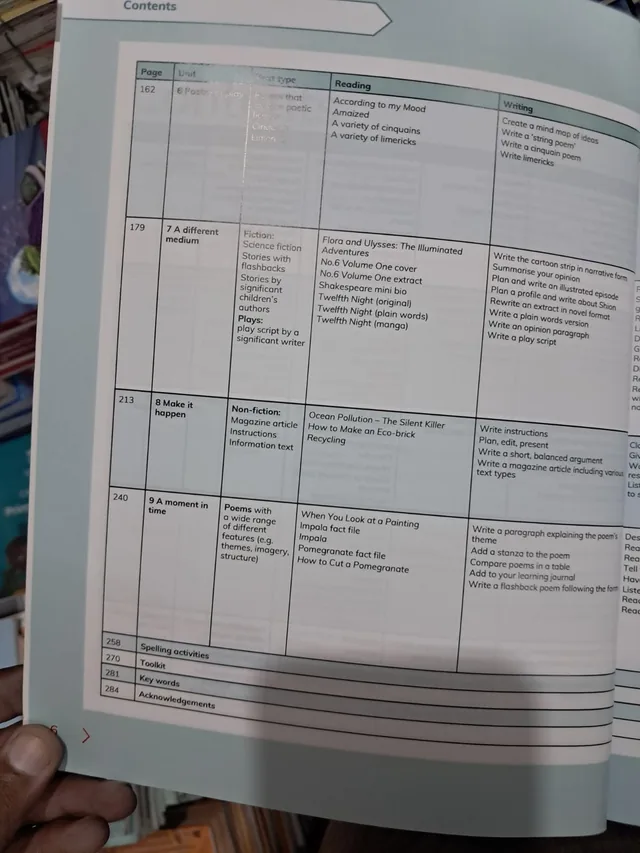
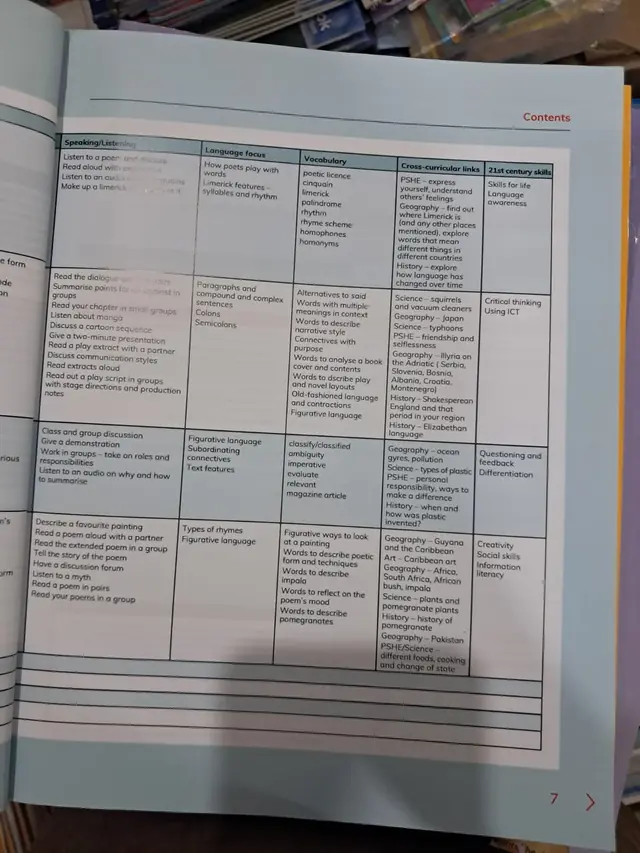
The contents table shows, for every unit, the text types, the reading texts, the writing tasks, the speaking and listening activities, the language focus, the vocabulary, the cross-curricular links and the 21st century skills. So one unit is a full English programme: read, talk, learn the grammar, then write.
Complete contents — units, texts and tasks
Unit 1 — Different voices – different times (page 10)
- Text type: fiction — stories with flashbacks; stories by significant children's authors.
- Reading: East – Prologue; East – Neddy (1) and (2); Voices in the Museum.
- Writing: notes on the prologue; learning journal; a short prologue; a mind map; continue the dialogue; a timeline; Voice 4 in the Museum.
- Speaking/listening: discuss the prologue, make predictions, read aloud, perform a dialogue, summarise each verse, listen to a flashback extract, role play the voices.
- Language focus: word origins; hyphens and dashes; articles; Standard English. Vocabulary: prefixes and suffixes; homophones and homographs; standard and non-standard English; idiomatic expressions.
- Cross-curricular: Scandinavia/Norway, dinosaurs, maps and compasses, Zimbabwe; white bears, frogs and bush babies. Skills: role play, communication.
Unit 2 — People in the news (page 46)
- Text type: non-fiction — news article, biography, fact file, autobiography.
- Reading: Samina, 21, becomes first Pakistani woman to conquer Everest; Samina Baig Biography; extract from The Other Side of the World by Jessica O'Neil; Biography of Tenzing Norgay.
- Writing: headlines; a mini report; a biography; start an autobiography; change direct to reported speech; a news article.
- Speaking/listening: share opinions; role play a news broadcast; listen to a film review; listen to the start of an autobiography; conduct an interview.
- Language focus: formal and informal; headline techniques; structure of a news report; relative pronouns; reported speech. Vocabulary: headline, persuasive, summarise, register, portmanteau words, bio and auto, the inverted pyramid of news reporting.
- Cross-curricular: famous events and biographies, mountains, local and international news, other cultures.
Unit 3 — Personification and imagery (page 75)
- Text type: poems with a wide range of features (themes, imagery, structure).
- Reading: The River; Mawu of the Waters; A River Poem; Right Here Was the Ocean; The Storm.
- Writing: compare poems in a paragraph; summarise a poem analysis; develop an extended metaphor; write a stanza and a poem.
- Speaking/listening: a dramatic performance; a group presentation; listen about Zehra Nigah; read a poem with expression; share stanzas; perform a poem at a mushaira.
- Language focus: personification; extended metaphors. Vocabulary: words for flowing water, proverbs, mood words, figurative language. Cross-curricular: rivers and oceans.
Unit 4 — Back to the future (page 93)
- Text type: fiction — science fiction; stories with flashbacks.
- Reading: The Green Book; The Diary of a Space Traveller and Other Stories; The Hitchhiker's Guide to the Galaxy.
- Writing: summarise predictions; plan a longer story; write a first chapter; a paragraph about science fiction; describe a setting; the Vogon Constructor Fleets entry; finish the chapter.
- Speaking/listening: a speech on what you would take with you; an audio about science fiction; a Readaloudathon.
- Language focus: parenthesis; quantifiers and agreement; active and passive voice; if clauses (conditionals). Cross-curricular: the solar system, Mars, futuristic inventions.
Unit 5 — The facts of the matter (page 132)
- Text type: non-fiction — news article, scientific explanation, balanced report, persuasive article and speech.
- Reading: Report Gives Strong Climate Change Warning; a scientific explanation; Is it time to ban cars from city centres?
- Writing: facts and opinions; a balanced report or argument; a persuasive paragraph.
- Speaking/listening: identify a speaker's viewpoint; prepare a persuasive speech; a class debate.
- Language focus: connectives; conditional clauses; active and passive voice; formal and informal language; persuasive techniques. Cross-curricular: climate change, habitats, carbon emissions.
Unit 6 — poems, cinquains and limericks (page 162)
- Text type: poems that use poetic licence; cinquains; limericks. Reading: According to my Mood; Amaized; a variety of cinquains and limericks.
- Writing: a mind map; a "string poem"; a cinquain; limericks. Language focus: how poets play with words; limerick syllables and rhythm.
Unit 7 — A different medium (page 179)
- Text type: science fiction; stories by significant children's authors; a play script by a significant writer.
- Reading: Flora and Ulysses: The Illuminated Adventures; No.6 Volume One (cover and extract); a Shakespeare mini bio; Twelfth Night (original, plain words and manga versions).
- Writing: cartoon strip into narrative; an illustrated episode; a profile of Shion; a plain words version; a play script.
- Language focus: compound and complex sentences; colons; semicolons. Cross-curricular: Japan, typhoons, Illyria on the Adriatic, Shakespearean England and Elizabethan language.
Unit 8 — Make it happen (page 213)
- Text type: magazine article; instructions; information text. Reading: Ocean Pollution – The Silent Killer; How to Make an Eco-brick; Recycling.
- Writing: instructions; a short balanced argument; a magazine article. Language focus: figurative language; subordinating connectives; text features. Cross-curricular: ocean gyres, types of plastic, personal responsibility.
Unit 9 — A moment in time (page 240)
- Reading: When You Look at a Painting; Impala and an impala fact file; a pomegranate fact file; How to Cut a Pomegranate.
- Writing: explain a poem's theme; add a stanza; compare poems in a table; a flashback poem. Cross-curricular: the Caribbean, Africa, plants and the pomegranate, and Pakistan.
Then: Spelling activities (p. 258), Toolkit (p. 270), Key words (p. 281), Acknowledgements (p. 284).
Who should buy it?
- Class 6 / Grade 6 students in Cambridge-system schools whose list names this Pakistan edition.
- Parents who want to follow each unit's reading texts and grammar at home.
- Tutors preparing students for Lower Secondary English with real texts and clear grammar targets.
Don't confuse it with these Grade 6 and Lower Secondary books
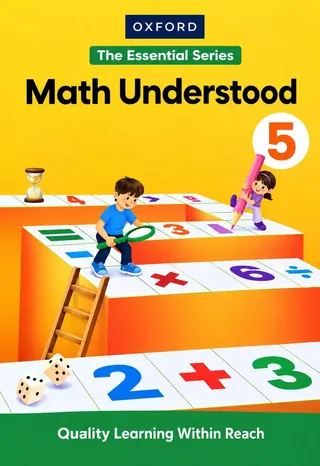
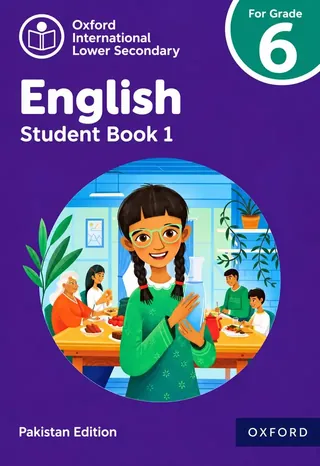
- Oxford International Lower Secondary English Student Book 1 for Grade 6 (purple, Oxford). Same class, different publisher and different units (Cultural heritage, Water, Climate…). Buy only the one your school lists.
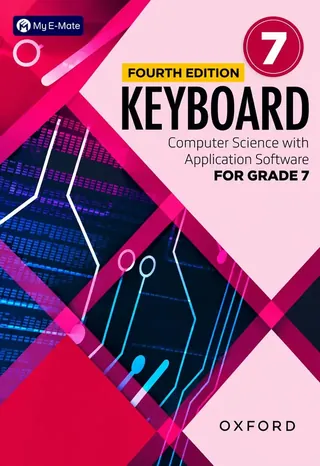
- Cambridge English Learner's Book 7 — the next Cambridge book, Learner's Book 7 (yellow, Graham Elsdon with Esther Menon).
- Learner's Book 8 (purple) for the year after.
Is this the Grade 6 English book for session 2027-28?
If your school's 2027-28 list names Cambridge Lower Secondary English, Pakistan edition, Learner's Book Grade 6 (Sally Burt & Debbie Ridgard, blue cover), this is it. We supply the newest printing we receive — ask us which edition is in stock today.
Buy it in Urdu Bazar, Lahore
- Shop: Exams Book House, Shop Number 4, Al Fazal Market, Urdu Bazar, Lahore 54000
- Urdu Bazar Lahore book shop number: 0317 4846676 (call or WhatsApp)
- Open: Monday to Saturday, 9 AM – 9 PM; closed on Sunday
- Delivery: all over Pakistan, cash on delivery
People also search for this book as
cambridge lower secondary english grade 6 pakistan edition · learner's book grade 6 sally burt debbie ridgard · class 6 cambridge english book 2027-28 · cambridge english grade 6 samina baig unit · کیمبرج انگلش کلاس 6 کتاب · book shops in urdu bazar lahore
Frequently asked questions
Is this the right Grade 6 English book for 2027-28?
Yes, if your school's 2027-28 list names the Cambridge Lower Secondary English Pakistan edition Learner's Book Grade 6. If the list says Oxford Student Book 1, you need the Oxford book instead.
Is there a workbook?
This page is for the Learner's Book only. Ask us on WhatsApp for the matching workbook if your school list includes one.
What Pakistani content is inside?
Unit 2 has news and a biography of Samina Baig, the first Pakistani woman to climb Everest; Unit 3 includes listening about Zehra Nigah and a mushaira; Unit 9 links to the geography of Pakistan.
How long is the book?
The contents go up to page 284 (Acknowledgements), with spelling activities, a toolkit and key words at the back.
Do you deliver?
Yes, all over Pakistan with cash on delivery. WhatsApp 0317 4846676.