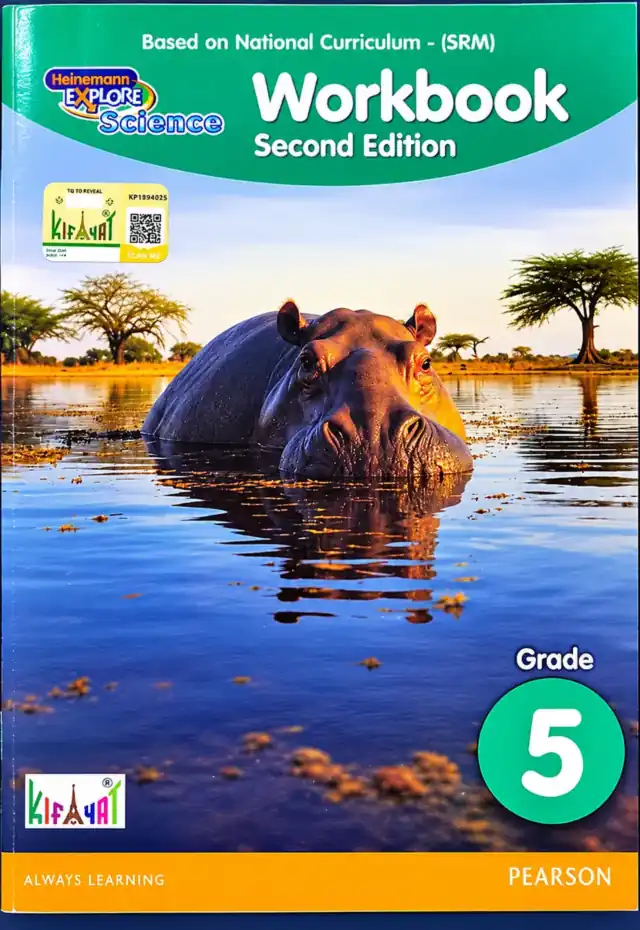
Class 5 Heinemann Explore Science Workbook 5, 2nd Ed. (2027-28)
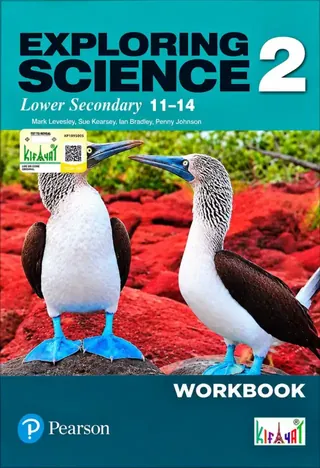
Heinemann Explore Science Workbook, Grade 5, Second Edition (Pearson, with the Kifayat logo) for Class 5 in session 2027-28: 54 worksheets in five units on microbes, keeping healthy, life cycles, light and shadows, and changing state.
Key details
- Class 5 · Science workbook
- Pearson · Second Edition
- 54 worksheets · 5 units
- Session 2027-28
Heinemann Explore Science Workbook 5 (Second Edition) is the Grade 5 science workbook from Pearson, printed with the line "Based on National Curriculum – (SRM)" and the Kifayat logo. Its contents list 54 worksheets, one on each page, in five units: Microbes, Keeping healthy, Life cycles, Light and Changing state. This page is for the 2027-28 session and for Class 5. Exam Book House, Shop Number 4, Al Fazal Market, Urdu Bazar, Lahore, supplies it with cash on delivery across Pakistan and delivery to the Gulf countries.
Quick facts
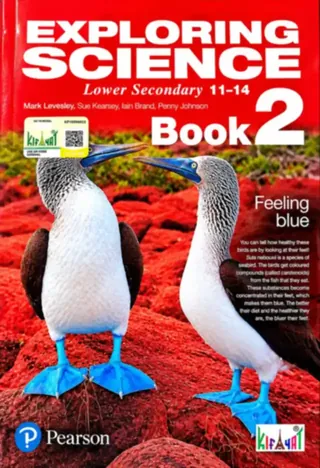
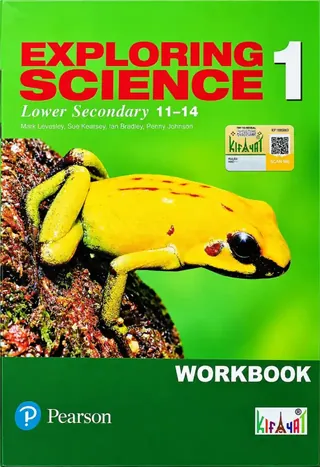
- Title on the cover: Heinemann Explore Science, Workbook, Second Edition, Grade 5
- Publisher: Pearson ("Always learning" on the cover); the Kifayat logo is at the bottom left, and a Kifayat sticker is at the top
- Curriculum line on the cover: Based on National Curriculum – (SRM)
- Worksheets: 54, numbered WS 1 to WS 54, one per page
- Units: 5; units 2 to 5 end with two assessment worksheets each, and unit 1 ends with one
- Largest unit: Unit 5, Changing state, 13 worksheets (pages 42 to 54)
- Cover picture: a hippopotamus in a calm lake at sunset
- Shown on: School Books → Class 5
- Session: 2027-28
What the Grade 5 workbook asks a child to do
In Grade 5 the units are about processes that a child cannot see easily: microbes, the pulse of a heart, the way a shadow changes through the day and water changing from liquid to gas and back. Each unit has several worksheets where a child collects results, so the workbook trains the habit of writing a conclusion from numbers.
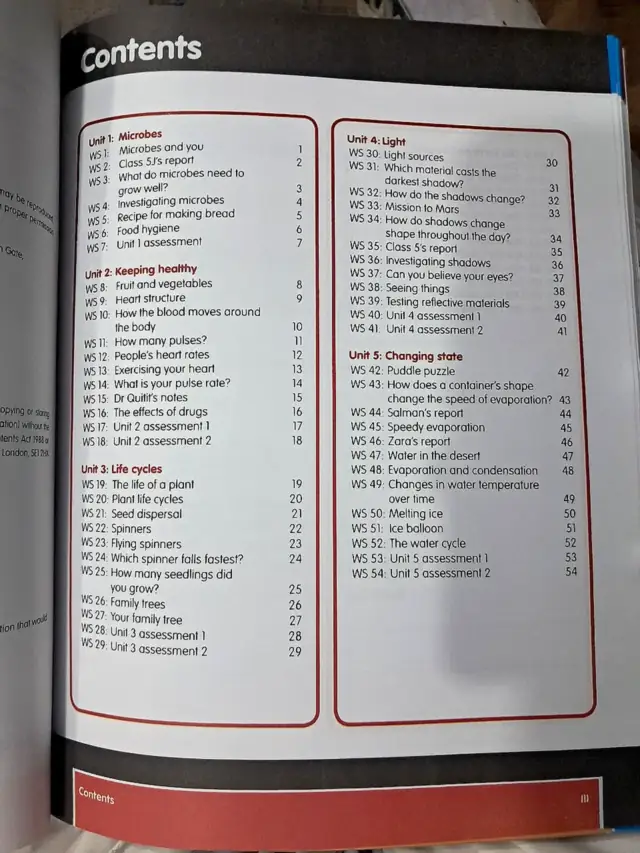
You can see this in the titles. Several are real investigations with a question, such as What do microbes need to grow well? (WS 3), How many pulses? (WS 11), Which material casts the darkest shadow? (WS 31), How does a container's shape change the speed of evaporation? (WS 43) and Changes in water temperature over time (WS 49). Others are named reports and notes, for example Class 5J's report (WS 2), Dr Quitit's notes (WS 15), Class 5's report (WS 35), Salman's report (WS 44) and Zara's report (WS 46). Units 2 to 5 each end with two assessment worksheets, so teachers have a choice for tests.
All 54 worksheets, with their pages
| Unit | Worksheet | Page |
|---|---|---|
| Unit 1: Microbes | ||
| WS 1: Microbes and you | 1 | |
| WS 2: Class 5J's report | 2 | |
| WS 3: What do microbes need to grow well? | 3 | |
| WS 4: Investigating microbes | 4 | |
| WS 5: Recipe for making bread | 5 | |
| WS 6: Food hygiene | 6 | |
| WS 7: Unit 1 assessment | 7 | |
| Unit 2: Keeping healthy | ||
| WS 8: Fruit and vegetables | 8 | |
| WS 9: Heart structure | 9 | |
| WS 10: How the blood moves around the body | 10 | |
| WS 11: How many pulses? | 11 | |
| WS 12: People's heart rates | 12 | |
| WS 13: Exercising your heart | 13 | |
| WS 14: What is your pulse rate? | 14 | |
| WS 15: Dr Quitit's notes | 15 | |
| WS 16: The effects of drugs | 16 | |
| WS 17: Unit 2 assessment 1 | 17 | |
| WS 18: Unit 2 assessment 2 | 18 | |
| Unit 3: Life cycles | ||
| WS 19: The life of a plant | 19 | |
| WS 20: Plant life cycles | 20 | |
| WS 21: Seed dispersal | 21 | |
| WS 22: Spinners | 22 | |
| WS 23: Flying spinners | 23 | |
| WS 24: Which spinner falls fastest? | 24 | |
| WS 25: How many seedlings did you grow? | 25 | |
| WS 26: Family trees | 26 | |
| WS 27: Your family tree | 27 | |
| WS 28: Unit 3 assessment 1 | 28 | |
| WS 29: Unit 3 assessment 2 | 29 | |
| Unit 4: Light | ||
| WS 30: Light sources | 30 | |
| WS 31: Which material casts the darkest shadow? | 31 | |
| WS 32: How do the shadows change? | 32 | |
| WS 33: Mission to Mars | 33 | |
| WS 34: How do shadows change shape throughout the day? | 34 | |
| WS 35: Class 5's report | 35 | |
| WS 36: Investigating shadows | 36 | |
| WS 37: Can you believe your eyes? | 37 | |
| WS 38: Seeing things | 38 | |
| WS 39: Testing reflective materials | 39 | |
| WS 40: Unit 4 assessment 1 | 40 | |
| WS 41: Unit 4 assessment 2 | 41 | |
| Unit 5: Changing state | ||
| WS 42: Puddle puzzle | 42 | |
| WS 43: How does a container's shape change the speed of evaporation? | 43 | |
| WS 44: Salman's report | 44 | |
| WS 45: Speedy evaporation | 45 | |
| WS 46: Zara's report | 46 | |
| WS 47: Water in the desert | 47 | |
| WS 48: Evaporation and condensation | 48 | |
| WS 49: Changes in water temperature over time | 49 | |
| WS 50: Melting ice | 50 | |
| WS 51: Ice balloon | 51 | |
| WS 52: The water cycle | 52 | |
| WS 53: Unit 5 assessment 1 | 53 | |
| WS 54: Unit 5 assessment 2 | 54 |
The five units at a glance
| Unit | Worksheets | Pages | Number of worksheets |
|---|---|---|---|
| Unit 1: Microbes | WS 1 to 7 | 1–7 | 7 |
| Unit 2: Keeping healthy | WS 8 to 18 | 8–18 | 11 |
| Unit 3: Life cycles | WS 19 to 29 | 19–29 | 11 |
| Unit 4: Light | WS 30 to 41 | 30–41 | 12 |
| Unit 5: Changing state | WS 42 to 54 | 42–54 | 13 |
Reading the contents
- Microbes (unit 1, 7 worksheets). Microbes and you, what they need to grow, how to investigate them, a bread recipe and food hygiene. Bread making (WS 5) is a good kitchen link.
- Keeping healthy (unit 2, 11 worksheets). Fruit and vegetables, then six worksheets on the heart: its structure (WS 9), how blood moves around the body (WS 10), counting pulses (WS 11), people's heart rates (WS 12), exercise (WS 13) and your own pulse rate (WS 14). The unit closes with The effects of drugs (WS 16) and two assessments.
- Life cycles (unit 3, 11 worksheets). Plant life cycles, seed dispersal and flying spinners, then a "family trees" pair (WS 26 and 27) that moves from plants to people.
- Light (unit 4, 12 worksheets). Light sources, shadows (WS 31, 32, 34 and 36), a "Mission to Mars" worksheet (WS 33), eyesight (WS 37 and 38) and testing reflective materials (WS 39).
- Changing state (unit 5, 13 worksheets). Evaporation (WS 43 to 48), temperature changes of water (WS 49), melting ice (WS 50), an ice balloon (WS 51) and the water cycle (WS 52).
How to use the workbook
- One worksheet at a time. Allow 20 minutes. Some investigation sheets need materials, so prepare them beforehand.
- Record numbers neatly. The heart-rate and temperature worksheets work best when the results are written in a table with units.
- Write one sentence of conclusion. After each investigation ask: "What did we find out?"
- Use the two assessments in each unit (WS 17 and 18, 28 and 29, 40 and 41, 53 and 54) as a first and second test, and WS 7 for unit 1.
- Safety first. For pulse and exercise work, no child should push themselves beyond what is comfortable.
Home ideas (not part of the book)
- Make bread together and talk about what the yeast does.
- Measure a family member's pulse for 30 seconds at rest and after a short walk.
- Use a torch and a toy to cast shadows at three distances from the wall.
- Leave the same amount of water in a wide dish and a narrow glass and see which dries first.
For session 2027-28
With 54 worksheets, two a week covers the workbook in about 27 weeks. Your teacher will choose the order and which worksheets to do in class. Lists can change from year to year, so check your school's 2027-28 Class 5 list, and send it on WhatsApp if you want us to match it. We supply the newest edition we can get.
Matching and similar books
- Class 4 Heinemann Explore Science Workbook 4 is the previous year of the same series, and Class 3 Heinemann Explore Science Workbook 3 the year before.
- Class 5 Cambridge Primary Science Learner's Book 5 and Class 5 New Oxford Primary Science Level 5 are Class 5 science books from other publishers; use the one on your child's list.
Buy it in Urdu Bazar, Lahore
- Shop: Exam Book House, Shop Number 4, Al Fazal Market, Urdu Bazar, Lahore 54000
- Urdu Bazar Lahore book shop number: 0317 4846676 (call or WhatsApp)
- Open: Monday to Saturday, 9 AM – 9 PM; closed on Sunday
- Delivery: all over Pakistan with cash on delivery, and to the Gulf countries
People also search for this book as
heinemann explore science workbook 5 · explore science grade 5 workbook second edition · pearson science workbook class 5 · kifayat explore science grade 5 · class 5 science workbook lahore · heinemann science class 5 · urdu bazar lahore school books · session 2027-28
Frequently asked questions
Is this the Class 5 science workbook for session 2027-28?
It is the Heinemann Explore Science Workbook for Grade 5, Second Edition from Pearson. If your school's 2027-28 Class 5 list names it, this is the right book. Send the list on WhatsApp and we will check it.
How many worksheets and units does it have?
Fifty-four worksheets in five units, one per page.
Which unit has the most worksheets?
Unit 5, Changing state, with 13 worksheets (pages 42 to 54).
Does it cover the water cycle?
Yes. WS 52 is The water cycle, and unit 5 also covers evaporation, condensation and melting.
Do you deliver outside Lahore?
Yes. We deliver all over Pakistan with cash on delivery, and to the Gulf countries. Send your name, address and the book name on WhatsApp at 0317 4846676, or call the shop in Urdu Bazar, Lahore (Monday to Saturday, 9 AM – 9 PM).
Inside the book — contents and sample pages