Class 8 Pearson Discover History Student Book 3 (2027-28)
Pearson Discover History Student Book 3 (with the Kifayat sticker) for Class 8 in session 2027-28: three depth studies on the Indian subcontinent, the world wars and India, and Pakistan and the world, with 36 units, inquiry tasks, a glossary and an index.
Key details
- Class 8 · History student book
- Pearson · Kifayat
- 3 depth studies · 8 topics · 36 units
- Session 2027-28
ISBN: 9789696772033
Pearson Discover History – Student Book 3 (with the Kifayat sticker on the cover) is a history textbook for Class 8. Its contents list three depth studies: The Indian Subcontinent, World Wars and India and Pakistan and the World. They are divided into eight topics and 36 units, each with a "Snapshot" opening and "Inquiry Tasks" at the end, followed by a glossary (page 147) and an index (page 152). This page is for the 2027-28 session. Exam Book House, Shop Number 4, Al Fazal Market, Urdu Bazar, Lahore, supplies it with cash on delivery across Pakistan and delivery to the Gulf countries.
Quick facts
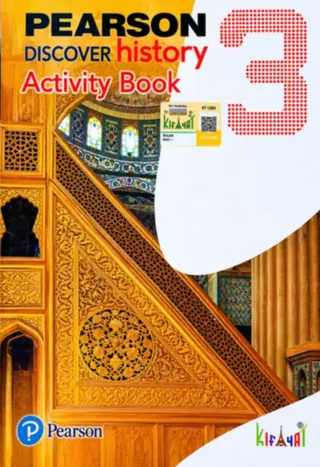
- Title on the cover: Pearson Discover History, Student Book, with a large "3" made of red dots
- Publisher: Pearson; the cover has the Kifayat sticker and logo (the page footer reads "Pearson history Book 3")
- Structure: 3 depth studies, 8 topics, 36 numbered units, glossary (page 147) and index (page 152)
- Pages covered by the contents: page 2 to page 146 of teaching content
- Features in the contents: a "Snapshot" at the start of each topic and "Inquiry Tasks" pages
- Cover picture: the carved pulpit and tiled domes of a mosque interior in gold and blue
- Shown on: School Books → Class 8
- Session: 2027-28
How the book is organised
A history course can be arranged by date, or it can pick a few big stories and go deep. This book does the second. Each depth study takes one big theme and follows it through several topics:
| Depth study | Topics | Pages | Number of pages |
|---|---|---|---|
| 1. The Indian Subcontinent | India and the World; Muslim Renaissance in the Subcontinent | 2–37 | 36 |
| 2. World Wars and India | World War I; Political Awareness in Subcontinent; World War II | 38–101 | 64 |
| 3. Pakistan and the World | Making a Nation; The Modern World; The Birth and Development of Pakistan | 102–146 | 45 |
Depth study 2 is the largest at 64 pages. It also does something unusual: it breaks the story of the two world wars with a topic on the subcontinent, Political Awareness in Subcontinent, which puts events in India alongside events in Europe.
Each topic starts with a Snapshot unit (a quick overview) and most end with Inquiry Tasks, where a student is asked to investigate, compare or write about what they have learned.
Complete table of contents (as printed)
| Part | Page |
|---|---|
| Depth Study 1: The Indian Subcontinent | |
| India and the World | 02 |
| Unit 1: Snapshot | 04 |
| Unit 2: Introducing India | 06 |
| Unit 3: The East India Company | 11 |
| Unit 4: War of Independence 1857 – The Great Rebellion | 16 |
| Unit 5: The British Raj | 19 |
| Unit 6: A key event in Indian society: Response to British rule | 21 |
| Inquiry Tasks | 22 |
| Muslim Renaissance in the Subcontinent | 24 |
| Unit 1: Snapshot | 26 |
| Unit 2: The Aligarh Movement | 28 |
| Unit 3: Muslim revivalist movements in the subcontinent | 31 |
| Unit 4: Rise of Muslim and Hindu nationalism | 33 |
| Inquiry Tasks | 37 |
| Depth Study 2: World Wars and India | |
| World War I | 38 |
| Unit 1: Snapshot | 40 |
| Unit 2: Causes of the War | 42 |
| Unit 3: The War in Europe | 47 |
| Unit 4: Ending and counting the cost of the War | 52 |
| Unit 5: Fighting and recording the War | 55 |
| Inquiry Tasks | 58 |
| Political Awareness in Subcontinent | 60 |
| Unit 1: Snapshot | 62 |
| Unit 2: The Hindu-Muslim unity | 64 |
| Unit 3: Communal and political awakening | 68 |
| Unit 4: Conferences, reforms and elections | 71 |
| Unit 5: Significant people | 75 |
| Inquiry Tasks | 77 |
| World War II | 78 |
| Unit 1: Snapshot | 80 |
| Unit 2: The world on the brink of War | 82 |
| Unit 3: War in Europe | 88 |
| Unit 4: War in the Asia-Pacific | 94 |
| Unit 5: Impact of the War on India and the World | 98 |
| Inquiry Tasks | 100 |
| Depth Study 3: Pakistan and the World | |
| Making a Nation | 102 |
| Unit 1: Snapshot | 104 |
| Unit 2: Resolving for independence | 106 |
| Unit 3: The partition | 110 |
| Inquiry Tasks | 113 |
| The Modern World | 114 |
| Unit 1: Snapshot | 116 |
| Unit 2: The Cold War | 118 |
| Unit 3: Post-Cold War conflicts | 122 |
| Unit 4: Efforts to achieve lasting peace | 128 |
| The Birth and Development of Pakistan | 132 |
| Unit 1: Snapshot | 134 |
| Unit 2: The Early years | 136 |
| Unit 3: Government policies and key legislation that shaped Pakistan | 138 |
| Unit 4: Global relations of Pakistan | 142 |
| Inquiry Tasks | 145 |
| Glossary | 147 |
| Index | 152 |
The eight topics and their size
| Topic | Pages | Length |
|---|---|---|
| India and the World | 2–23 | 22 |
| Muslim Renaissance in the Subcontinent | 24–37 | 14 |
| World War I | 38–59 | 22 |
| Political Awareness in Subcontinent | 60–77 | 18 |
| World War II | 78–101 | 24 |
| Making a Nation | 102–113 | 12 |
| The Modern World | 114–131 | 18 |
| The Birth and Development of Pakistan | 132–146 | 15 |
World War II (24 pages) and India and the World and World War I (22 pages each) are the three longest topics. Making a Nation (12 pages) is the shortest, but it holds the units on independence and the partition, which are central to a Pakistani student's picture of history.
A timeline of the stories in the book
The contents let a student make a simple timeline. These are well-known dates.
| Period | Event named in the units |
|---|---|
| 1857 | War of Independence, "The Great Rebellion" |
| After 1857 | The British Raj (unit 5) |
| Late 1800s | The Aligarh Movement, Muslim revivalist movements, Muslim and Hindu nationalism |
| 1914 to 1918 | World War I |
| 1939 to 1945 | World War II |
| 1947 | The partition and the making of Pakistan |
| After 1945 | The Cold War, post-Cold War conflicts and efforts at lasting peace |
How to study history from this book
- Read the Snapshot first. It gives the big picture so that the units that follow make sense.
- Make a timeline for each topic with five dates and five names.
- Do the Inquiry Tasks. They ask a student to use evidence, which is what history exams reward.
- Use the glossary (page 147). Learn five terms every week.
- Link the three depth studies. The British Raj, the political awareness chapter and the partition are one long story; draw them as a single arrow across three pages.
For session 2027-28
A school year of about 30 teaching weeks gives roughly four weeks to each of the eight topics. Your teacher will decide the order and which units to study in class. Lists can change from year to year, and we supply the newest edition we can get.
Matching and similar books
- Class 7 Oxford Secondary History for Pakistan 2 and Class 6 Oxford Secondary History for Pakistan 1 are history books for the earlier years from a different publisher. They are different books; use the one on your school's list.
- Class 8 Pearson Discover Geography Activity Book 3 is the geography book from the same Pearson / Kifayat series for Class 8.
Buy it in Urdu Bazar, Lahore
- Shop: Exam Book House, Shop Number 4, Al Fazal Market, Urdu Bazar, Lahore 54000
- Urdu Bazar Lahore book shop number: 0317 4846676 (call or WhatsApp)
- Open: Monday to Saturday, 9 AM – 9 PM; closed on Sunday
- Delivery: all over Pakistan with cash on delivery, and to the Gulf countries
People also search for this book as
pearson discover history student book 3 · discover history class 8 · kifayat history student book 3 · pearson history class 8 · world war i world war ii partition class 8 · class 8 history lahore · urdu bazar lahore school books · session 2027-28
Frequently asked questions
Is this the Class 8 history book for session 2027-28?
It is Pearson Discover History Student Book 3. If your school's 2027-28 Class 8 list names it, this is the right book. Send the list on WhatsApp and we will check it.
What does it cover?
Three depth studies: the Indian subcontinent (the East India Company, 1857, the Raj and the Aligarh Movement), the world wars and India, and Pakistan and the world (the partition, the Cold War and the birth and development of Pakistan).
Does it include a glossary?
Yes, the glossary is on page 147 and the index on page 152.
Do you deliver outside Lahore?
Yes. We deliver all over Pakistan with cash on delivery, and to the Gulf countries. Send your name, address and the book name on WhatsApp at 0317 4846676, or call the shop in Urdu Bazar, Lahore (Monday to Saturday, 9 AM – 9 PM).
Inside the book — contents and sample pages