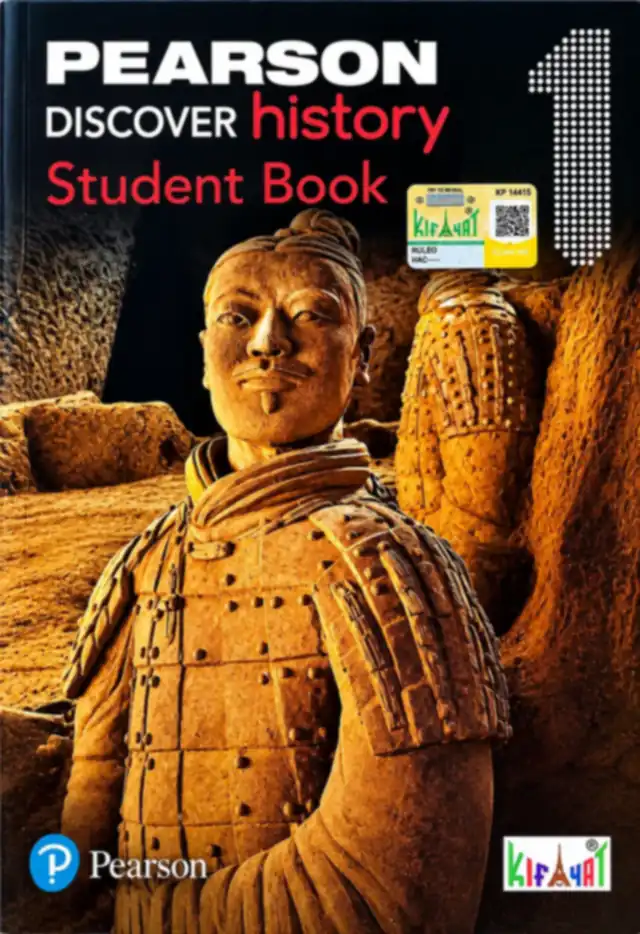
Class 6 Pearson Discover History Student Book 1 (2027-28)
Pearson Discover History Student Book 1 (with the Kifayat sticker) for Class 6 in session 2027-28: three depth studies on the ancient past, the Mediterranean world and the Asian world, with 46 units from Sumer and Ancient Egypt to Ancient China, Ancient India and the dawn of Islam.
Key details
- Class 6 · History student book
- Pearson · Kifayat
- 3 depth studies · 7 topics · 46 units
- Session 2027-28
ISBN: 9789696771999
Pearson Discover History – Student Book 1 (with the Kifayat sticker on the cover) is a history textbook for Class 6. Its contents list three depth studies, seven topics and 46 units: Investigating the Ancient Past (First civilisation: Sumer), The Mediterranean World (Ancient Egypt, Ancient Greece and Ancient Rome) and The Asian World (Ancient China, Ancient India and The Dawn of Islam), followed by an index on page 175. This page is for the 2027-28 session. Exam Book House, Shop Number 4, Al Fazal Market, Urdu Bazar, Lahore, supplies it with cash on delivery across Pakistan and delivery to the Gulf countries.
Quick facts
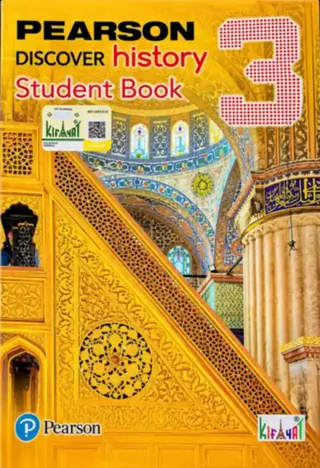
- Title on the cover: Pearson Discover History, Student Book, with a large "1" made of white dots
- Publisher: Pearson; the cover has the Kifayat sticker and logo (the page footer reads "Pearson history")
- Structure: 3 depth studies, 7 topics, 46 numbered units, inquiry tasks, index (page 175)
- Pages covered by the contents: page 2 to page 174
- Features in the contents: a "Snapshot" at the start of each topic, "Legacies and connections to ..." units and "Inquiry Tasks"
- Cover picture: a terracotta warrior statue in an excavation pit
- Shown on: School Books → Class 6
- Session: 2027-28
The journey through the ancient world
The book is a tour of ancient civilisations, from the first cities to the beginning of Islam. It starts with how historians work (History is..., Primary & Secondary Sources), then moves around the world:
| Depth study | Topic | Pages | Number of pages |
|---|---|---|---|
| 1. Investigating the Ancient Past | First civilisation: Sumer | 2–21 | 20 |
| 2. The Mediterranean World | Ancient Egypt | 22–51 | 30 |
| Ancient Greece | 52–77 | 26 | |
| Ancient Rome | 78–103 | 26 | |
| 3. The Asian World | Ancient China | 104–123 | 20 |
| Ancient India | 124–147 | 24 | |
| The Dawn of Islam | 148–174 | 27 |
Ancient Egypt (30 pages) is the longest topic, followed by The Dawn of Islam (27 pages), and Ancient Greece and Ancient Rome (26 pages each). The Mediterranean block (Egypt, Greece, Rome) takes 82 pages and the Asian block (China, India, the dawn of Islam) 71 pages.
Complete table of contents (as printed)
| Part | Page |
|---|---|
| Depth Study 1: Investigating the Ancient Past | |
| First Civilisation: Sumer | 02 |
| Unit 1: History is... | 04 |
| Unit 2: Primary & Secondary Sources | 06 |
| Unit 3: Snapshot | 10 |
| Unit 4: Cities, wealth and kings | 12 |
| Unit 5: Daily life and religion | 14 |
| Unit 6: Legacies and connections to ... Why was Sumer significant? | 17 |
| Inquiry Tasks | 20 |
| Depth Study 2: The Mediterranean World | |
| Ancient Egypt | 22 |
| Unit 1: Snapshot | 24 |
| Unit 2: The gifts of the Nile | 26 |
| Unit 3: The pharaohs | 32 |
| Unit 4: How did the Egyptians live? | 36 |
| Unit 5: Egyptians and the belief in the afterlife | 39 |
| Unit 6: Legacies and connections to ... Why was Ancient Egypt significant? | 46 |
| Inquiry Tasks | 49 |
| Ancient Greece | 52 |
| Unit 1: Snapshot | 54 |
| Unit 2: Aegean civilisations | 56 |
| Unit 3: Athens and Sparta | 58 |
| Unit 4: Governance in Athens | 62 |
| Unit 5: Religion | 65 |
| Unit 6: The Persian Empire | 67 |
| Unit 7: Greece at war | 69 |
| Unit 8: Legacies and connections to ... Why was Ancient Greece significant? | 73 |
| Inquiry Tasks | 76 |
| Ancient Rome | 78 |
| Unit 1: Snapshot | 80 |
| Unit 2: The emergence of Rome | 82 |
| Unit 3: Republic | 87 |
| Unit 4: Empire | 90 |
| Unit 5: Daily Life | 96 |
| Unit 6: Legacies and connections to ... Legacies of Ancient Roman civilisation? | 99 |
| Inquiry Tasks | 102 |
| Depth Study 3: The Asian World | |
| Ancient China | 104 |
| Unit 1: Snapshot | 106 |
| Unit 2: The Shang dynasty | 108 |
| Unit 3: The Zhou dynasty | 110 |
| Unit 4: Emperor Shi Huangdi and the Qin dynasty | 112 |
| Unit 5: Ancient China during the Han dynasty | 115 |
| Unit 6: Legacies and connections to ... Technology in Ancient China | 119 |
| Inquiry Tasks | 122 |
| Ancient India | 124 |
| Unit 1: Snapshot | 126 |
| Unit 2: Indus Valley civilisation | 128 |
| Unit 3: The early Vedic period | 132 |
| Unit 4: Conquest and unification | 135 |
| Unit 5: The Mauryan kings | 138 |
| Unit 6: India in the Common Era | 140 |
| Unit 7: Legacies and connections to ... Why was Ancient India significant? | 143 |
| Inquiry Tasks | 146 |
| The Dawn of Islam | 148 |
| Unit 1: Snapshot | 150 |
| Unit 2: Pre-Islamic Arabia | 152 |
| Unit 3: The Rise of Islam | 155 |
| Unit 4: Life in Madina | 158 |
| Unit 5: The Conquest of Makkah | 162 |
| Unit 6: The Rashidun Caliphate | 164 |
| Unit 7: Legacies and connections to ... Legacies of Islam | 170 |
| Inquiry Tasks | 173 |
| Index | 175 |
A pattern that helps study
Every topic in this book follows the same recipe, so a student only has to learn it once:
- Snapshot. A one-page-or-two overview that sets the scene.
- Units on the main story, such as cities and kings, the pharaohs, Athens and Sparta, the Republic and the Empire, the dynasties of China, the Maurya kings, the rise of Islam.
- "Legacies and connections to ...". The last unit of every topic asks "why was this civilisation significant?" or shows what it left behind.
- Inquiry Tasks. Activities that ask the student to find evidence and give reasons.
Depth Study 1 also teaches how historians work: History is... (page 4) and Primary & Secondary Sources (page 6). Learn these two units first, since every other chapter depends on them.
A simple timeline for the book
The topics are arranged in an order that students can place on a rough timeline:
| Order in the book | Topic |
|---|---|
| 1 | Sumer, one of the first civilisations, with cities, wealth and kings |
| 2 | Ancient Egypt, the gifts of the Nile and the pharaohs |
| 3 | Ancient Greece, from Aegean civilisations to Athens, Sparta and the Persian Empire |
| 4 | Ancient Rome, from the Republic to the Empire |
| 5 | Ancient China, from the Shang to the Han dynasty |
| 6 | Ancient India, from the Indus Valley to the Mauryan kings and the Common Era |
| 7 | The Dawn of Islam, from pre-Islamic Arabia to the Rashidun Caliphate |
How to study history from this book
- Learn the sources units first (pages 4 to 9). Sources are how we know anything about the past.
- Make a map. Draw a simple world map and mark Sumer, Egypt, Greece, Rome, China, India and Arabia.
- Make one card per topic with three people, three places and three things the civilisation gave the world.
- Do the Inquiry Tasks at the end of every topic, not only before tests.
- Compare. Use the "Legacies" units to compare what each civilisation left behind.
For session 2027-28
With seven topics, about four to five weeks for each fits a school year. Your teacher will decide the order and which units to study in class. Lists can change from year to year, and we supply the newest edition we can get.
Matching and similar books
- Class 6 Pearson Discover History Activity Book 1 is the activity book with the same eight chapter headings.
- Class 7 Pearson Discover History Student Book 2 is the next year of the same series.
- Class 6 Oxford Secondary History for Pakistan 1 is a Class 6 history book from another publisher. It is a different book; use the one on your school's list.
Buy it in Urdu Bazar, Lahore
- Shop: Exam Book House, Shop Number 4, Al Fazal Market, Urdu Bazar, Lahore 54000
- Urdu Bazar Lahore book shop number: 0317 4846676 (call or WhatsApp)
- Open: Monday to Saturday, 9 AM – 9 PM; closed on Sunday
- Delivery: all over Pakistan with cash on delivery, and to the Gulf countries
People also search for this book as
pearson discover history student book 1 · discover history class 6 · kifayat history student book 1 · pearson history class 6 · sumer ancient egypt greece rome class 6 · ancient china ancient india class 6 · urdu bazar lahore school books · session 2027-28
Frequently asked questions
Is this the Class 6 history book for session 2027-28?
It is Pearson Discover History Student Book 1. If your school's 2027-28 Class 6 list names it, this is the right book. Send the list on WhatsApp and we will check it.
What does it cover?
Sumer, Ancient Egypt, Ancient Greece, Ancient Rome, Ancient China, Ancient India and the dawn of Islam, with a section on how historians use sources.
Is it the same as the activity book?
No. This is the student book with the lessons. The activity book is a separate title with activities for the same chapters.
Do you deliver outside Lahore?
Yes. We deliver all over Pakistan with cash on delivery, and to the Gulf countries. Send your name, address and the book name on WhatsApp at 0317 4846676, or call the shop in Urdu Bazar, Lahore (Monday to Saturday, 9 AM – 9 PM).
Inside the book — contents and sample pages