Class 6 Pearson Exploring Science 1 Student Book (2027-28)
Exploring Science Book 1, Lower Secondary 11–14, by Mark Levesley, Sue Kearsey, Ian Brand and Penny Johnson (Pearson, with the Kifayat sticker) for Class 6 in session 2027-28: 11 chapters and 99 lessons in biology, chemistry and physics, with 11 STEM lessons, 11 working-scientifically lessons, a glossary and a periodic table.
Key details
- Class 6 · Science student book
- Pearson · Lower Secondary 11–14
- 11 chapters · 99 lessons
- Session 2027-28
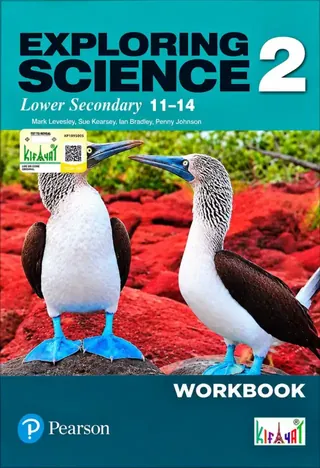
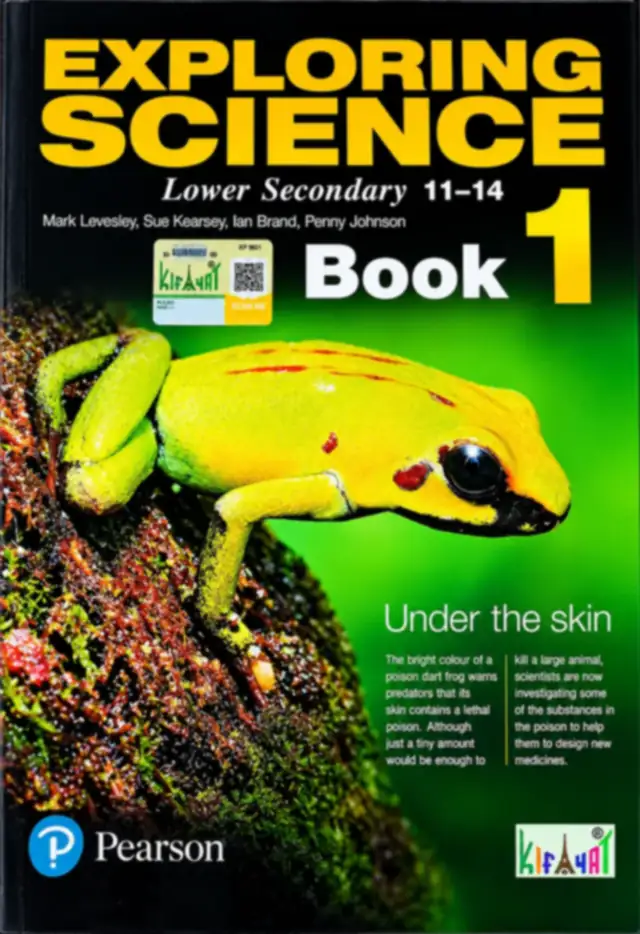
Exploring Science – Book 1 (Lower Secondary 11–14), by Mark Levesley, Sue Kearsey, Ian Brand and Penny Johnson, is published by Pearson and carries the Kifayat sticker on the cover. It is the Class 6 science student book in this series. Its contents list eleven chapters and 99 lessons: three chapters in biology, four in chemistry and four in physics, with a glossary, a periodic table and an index. This page is for the 2027-28 session. Exam Book House, Shop Number 4, Al Fazal Market, Urdu Bazar, Lahore, supplies it with cash on delivery across Pakistan and delivery to the Gulf countries.
Quick facts
- Title on the cover: Exploring Science, Lower Secondary 11–14, Book 1
- Authors on the cover: Mark Levesley, Sue Kearsey, Ian Brand, Penny Johnson
- Publisher: Pearson; the cover has the Kifayat sticker and logo
- Structure: 11 chapters, 9 lessons in each, 99 lessons in all, and "How to use this book" on page 4
- Special lessons: 11 "STEM" lessons and 11 "WS" (working scientifically) lessons
- Back matter: Glossary (page 181), Periodic table (page 189), Index (page 190)
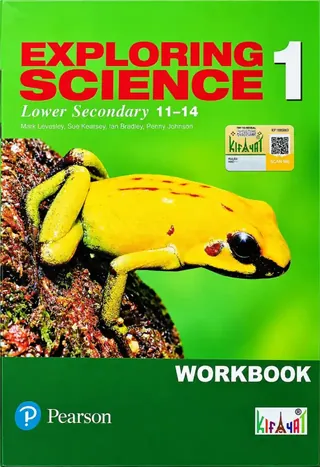
- Cover picture: a yellow poison dart frog on a mossy log, with a caption "Under the skin" about the frog's poison and medicine research
- Shown on: School Books → Class 6
- Session: 2027-28
How the book is built
Every chapter has nine lessons and takes 16 pages, so the eleven chapters run from page 5 to page 180. Lessons are labelled with a number and a letter (1.1a and 1.1b are the two lessons of topic 1.1). Two kinds of lesson are marked in brackets:
- (WS) – Working Scientifically. One in each chapter, from Microscopes (WS) (1.3b) and Scientific questions (WS) (2.2b) to Safety when heating (WS) (4.3a), Controlling risk (WS) (5.1c), SI units (WS) (10.4b) and Line graphs and scatter graphs (WS) (11.2b). They teach skills such as measuring, safety, graphs and judging evidence.
- (STEM). One in each chapter, linking the science to technology, engineering and mathematics, for example Medical doctors (STEM) (1.2b), Forensic science (STEM) (4.1b), Forecasting the weather (STEM) (6.5b), Building robots (STEM) (9.4b) and Designing structures (STEM) (10.5b).
The book's own title for the cover story, "Under the skin", sets the tone: the cover tells how scientists study the poison of a bright frog to design new medicines. That is a good example of what the series tries to do, which is to connect a science idea to something real.
The eleven chapters
| Subject | Chapter | Starts on page | Lessons |
|---|---|---|---|
| Biology | 1. Cells, tissues, organs and systems | 5 | 9 |
| Biology | 2. Muscles and bones | 21 | 9 |
| Biology | 3. Ecosystems | 37 | 9 |
| Chemistry | 4. Mixtures and separation | 53 | 9 |
| Chemistry | 5. Acids and alkalis | 69 | 9 |
| Chemistry | 6. The particle model | 85 | 9 |
| Chemistry | 7. Atoms, elements and molecules | 101 | 9 |
| Physics | 8. Energy | 117 | 9 |
| Physics | 9. Current electricity | 133 | 9 |
| Physics | 10. Forces | 149 | 9 |
| Physics | 11. Sound | 165 | 9 |
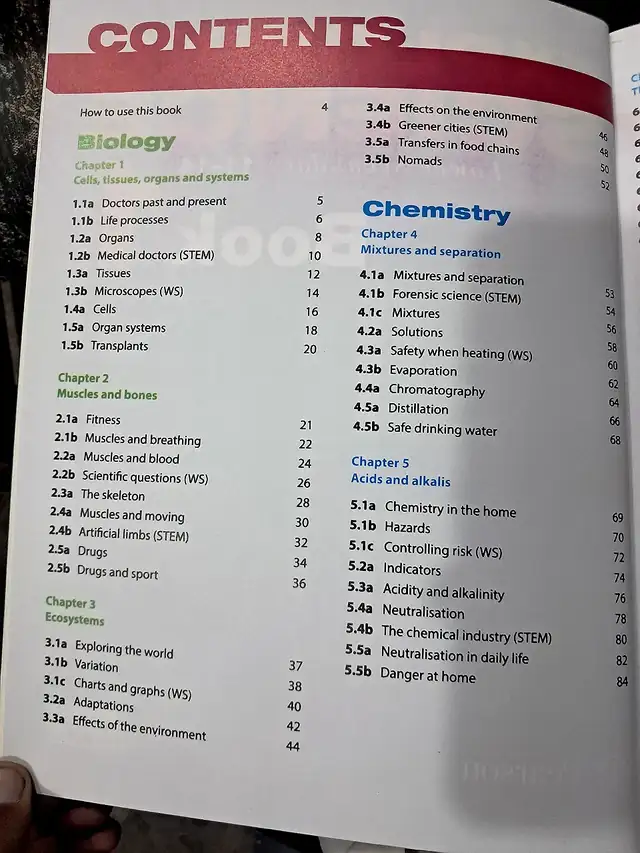
Complete table of contents (as printed)
| Lesson | Title | Page |
|---|---|---|
| How to use this book | 4 | |
| Biology | ||
| Chapter 1 | Cells, tissues, organs and systems | |
| 1.1a | Doctors past and present | 5 |
| 1.1b | Life processes | 6 |
| 1.2a | Organs | 8 |
| 1.2b | Medical doctors (STEM) | 10 |
| 1.3a | Tissues | 12 |
| 1.3b | Microscopes (WS) | 14 |
| 1.4a | Cells | 16 |
| 1.5a | Organ systems | 18 |
| 1.5b | Transplants | 20 |
| Chapter 2 | Muscles and bones | |
| 2.1a | Fitness | 21 |
| 2.1b | Muscles and breathing | 22 |
| 2.2a | Muscles and blood | 24 |
| 2.2b | Scientific questions (WS) | 26 |
| 2.3a | The skeleton | 28 |
| 2.4a | Muscles and moving | 30 |
| 2.4b | Artificial limbs (STEM) | 32 |
| 2.5a | Drugs | 34 |
| 2.5b | Drugs and sport | 36 |
| Chapter 3 | Ecosystems | |
| 3.1a | Exploring the world | 37 |
| 3.1b | Variation | 38 |
| 3.1c | Charts and graphs (WS) | 40 |
| 3.2a | Adaptations | 42 |
| 3.3a | Effects of the environment | 44 |
| 3.4a | Effects on the environment | 46 |
| 3.4b | Greener cities (STEM) | 48 |
| 3.5a | Transfers in food chains | 50 |
| 3.5b | Nomads | 52 |
| Chemistry | ||
| Chapter 4 | Mixtures and separation | |
| 4.1a | Mixtures and separation | 53 |
| 4.1b | Forensic science (STEM) | 54 |
| 4.1c | Mixtures | 56 |
| 4.2a | Solutions | 58 |
| 4.3a | Safety when heating (WS) | 60 |
| 4.3b | Evaporation | 62 |
| 4.4a | Chromatography | 64 |
| 4.5a | Distillation | 66 |
| 4.5b | Safe drinking water | 68 |
| Chapter 5 | Acids and alkalis | |
| 5.1a | Chemistry in the home | 69 |
| 5.1b | Hazards | 70 |
| 5.1c | Controlling risk (WS) | 72 |
| 5.2a | Indicators | 74 |
| 5.3a | Acidity and alkalinity | 76 |
| 5.4a | Neutralisation | 78 |
| 5.4b | The chemical industry (STEM) | 80 |
| 5.5a | Neutralisation in daily life | 82 |
| 5.5b | Danger at home | 84 |
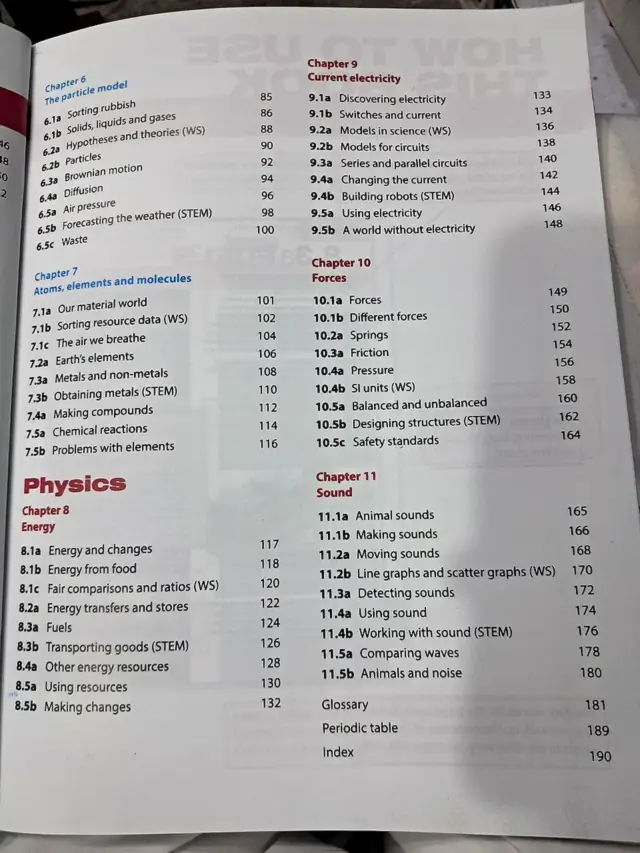
| Chapter 6 | The particle model | |
| 6.1a | Sorting rubbish | 85 |
| 6.1b | Solids, liquids and gases | 86 |
| 6.2a | Hypotheses and theories (WS) | 88 |
| 6.2b | Particles | 90 |
| 6.3a | Brownian motion | 92 |
| 6.4a | Diffusion | 94 |
| 6.5a | Air pressure | 96 |
| 6.5b | Forecasting the weather (STEM) | 98 |
| 6.5c | Waste | 100 |
| Chapter 7 | Atoms, elements and molecules | |
| 7.1a | Our material world | 101 |
| 7.1b | Sorting resource data (WS) | 102 |
| 7.1c | The air we breathe | 104 |
| 7.2a | Earth's elements | 106 |
| 7.3a | Metals and non-metals | 108 |
| 7.3b | Obtaining metals (STEM) | 110 |
| 7.4a | Making compounds | 112 |
| 7.5a | Chemical reactions | 114 |
| 7.5b | Problems with elements | 116 |
| Physics | ||
| Chapter 8 | Energy | |
| 8.1a | Energy and changes | 117 |
| 8.1b | Energy from food | 118 |
| 8.1c | Fair comparisons and ratios (WS) | 120 |
| 8.2a | Energy transfers and stores | 122 |
| 8.3a | Fuels | 124 |
| 8.3b | Transporting goods (STEM) | 126 |
| 8.4a | Other energy resources | 128 |
| 8.5a | Using resources | 130 |
| 8.5b | Making changes | 132 |
| Chapter 9 | Current electricity | |
| 9.1a | Discovering electricity | 133 |
| 9.1b | Switches and current | 134 |
| 9.2a | Models in science (WS) | 136 |
| 9.2b | Models for circuits | 138 |
| 9.3a | Series and parallel circuits | 140 |
| 9.4a | Changing the current | 142 |
| 9.4b | Building robots (STEM) | 144 |
| 9.5a | Using electricity | 146 |
| 9.5b | A world without electricity | 148 |
| Chapter 10 | Forces | |
| 10.1a | Forces | 149 |
| 10.1b | Different forces | 150 |
| 10.2a | Springs | 152 |
| 10.3a | Friction | 154 |
| 10.4a | Pressure | 156 |
| 10.4b | SI units (WS) | 158 |
| 10.5a | Balanced and unbalanced | 160 |
| 10.5b | Designing structures (STEM) | 162 |
| 10.5c | Safety standards | 164 |
| Chapter 11 | Sound | |
| 11.1a | Animal sounds | 165 |
| 11.1b | Making sounds | 166 |
| 11.2a | Moving sounds | 168 |
| 11.2b | Line graphs and scatter graphs (WS) | 170 |
| 11.3a | Detecting sounds | 172 |
| 11.4a | Using sound | 174 |
| 11.4b | Working with sound (STEM) | 176 |
| 11.5a | Comparing waves | 178 |
| 11.5b | Animals and noise | 180 |
| Glossary | 181 | |
| Periodic table | 189 | |
| Index | 190 |
Biology, chemistry, physics: how the chapters link
- Biology (chapters 1 to 3, pages 5–52). From the cell to the whole body (cells, tissues, organs, organ systems), then muscles and bones, then ecosystems. The medical lessons (Doctors past and present, Transplants, Artificial limbs, Drugs and sport) connect with the body chapters.
- Chemistry (chapters 4 to 7, pages 53–116). Mixtures and separation come first, with Chromatography, Distillation and Safe drinking water. Acids and alkalis follow, with safety lessons (Hazards, Controlling risk, Danger at home). Then the particle model explains why mixtures and gases behave as they do, and the last chapter introduces atoms, elements and molecules.
- Physics (chapters 8 to 11, pages 117–180). Energy, current electricity, forces and sound. The energy chapter has lessons on food, fuels and other resources, and the electricity chapter ends with A world without electricity.
How to use the student book
- Read lesson by lesson. Each lesson is a short block. Take one lesson, write three sentences about it and answer any questions your teacher sets.
- Do the WS lessons with a pencil and ruler. They teach graphs, safety and fair tests that practical work needs.
- Treat the STEM lessons as extension, a way to see science at work.
- Keep the glossary (page 181) open and add every new term to your own list.
- Use the periodic table (page 189) in chapter 7.
A plan for the 2027-28 session
| Term | Chapters | Pages |
|---|---|---|
| First | Biology: chapters 1 to 3 | 5–52 |
| Second | Chemistry: chapters 4 to 7 | 53–116 |
| Third | Physics: chapters 8 to 11 | 117–180 |
Each chapter is 16 pages, so a chapter every two weeks finishes the book in about 22 weeks and leaves time for revision and tests. Your teacher will decide the exact order.
For session 2027-28
Lists can change from year to year, so check your school's 2027-28 Class 6 list, and send it on WhatsApp if you want us to match it. We supply the newest edition we can get.
Matching and similar books
- Class 6 Pearson Exploring Science 1 Workbook is the workbook that goes with this student book.
- Class 7 Pearson Exploring Science 2 Student Book is the next year of the same series.
- Class 6 Pearson Big Science 6 Student Book and Class 6 Cambridge Primary Science Learner's Book 6 are other Class 6 science books. They are different books; use the one on your school's list.
Buy it in Urdu Bazar, Lahore
- Shop: Exam Book House, Shop Number 4, Al Fazal Market, Urdu Bazar, Lahore 54000
- Urdu Bazar Lahore book shop number: 0317 4846676 (call or WhatsApp)
- Open: Monday to Saturday, 9 AM – 9 PM; closed on Sunday
- Delivery: all over Pakistan with cash on delivery, and to the Gulf countries
People also search for this book as
exploring science book 1 · pearson exploring science lower secondary 11-14 student book · levesley kearsey brand johnson science · class 6 science book lahore · kifayat exploring science 1 · biology chemistry physics class 6 · urdu bazar lahore school books · session 2027-28
Frequently asked questions
Is this the Class 6 science book for session 2027-28?
It is Exploring Science Book 1 (Lower Secondary 11–14) from Pearson. If your school's 2027-28 Class 6 list names it, this is the right book. Send the list on WhatsApp and we will check it.
How many chapters and lessons does it have?
Eleven chapters and 99 lessons: three chapters in biology, four in chemistry and four in physics.
What are the STEM and WS lessons?
STEM lessons link science to technology, engineering and mathematics. WS lessons teach working scientifically skills such as measuring, safety and graphs. There are 11 of each.
Is it the same as the workbook?
No. This is the student book. The workbook is a separate title with practice pages.
Do you deliver outside Lahore?
Yes. We deliver all over Pakistan with cash on delivery, and to the Gulf countries. Send your name, address and the book name on WhatsApp at 0317 4846676, or call the shop in Urdu Bazar, Lahore (Monday to Saturday, 9 AM – 9 PM).
Inside the book — contents and sample pages