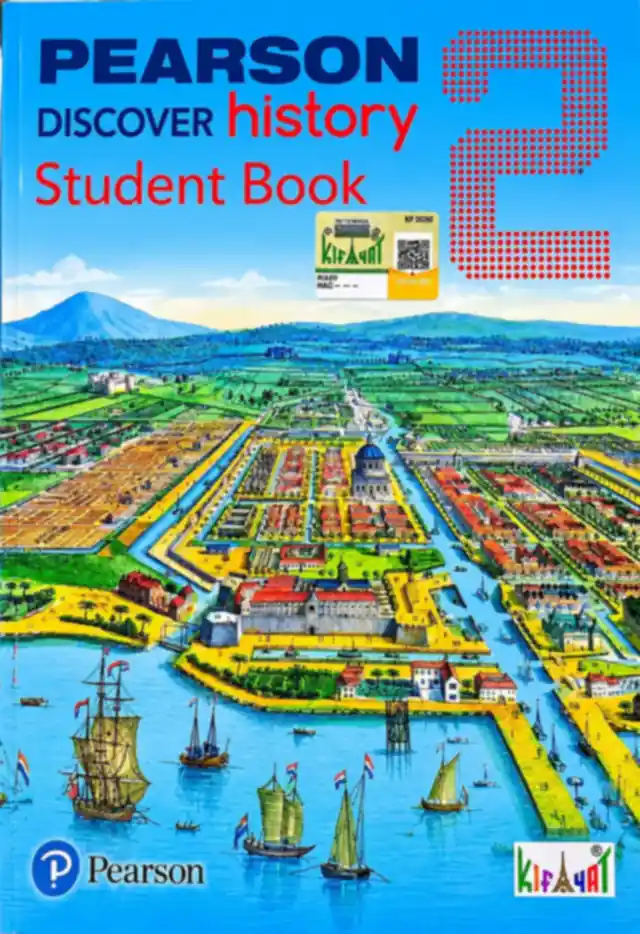
Class 7 Pearson Discover History Student Book 2 (2027-28)
Pearson Discover History Student Book 2 (with the Kifayat sticker) for Class 7 in session 2027-28: an overview, two depth studies and 39 units on medieval Europe, Islamic civilisation, Renaissance Italy, the Ottoman Empire, Muslims in the subcontinent, the Mughal Empire and the making of the modern world.
Key details
- Class 7 · History student book
- Pearson · Kifayat
- 2 depth studies · 39 units
- Session 2027-28
ISBN: 9789696772019
Pearson Discover History – Student Book 2 (with the Kifayat sticker on the cover) is a history textbook for Class 7. Its contents list an overview, two depth studies and eight topics divided into 39 units: Overview: From the Ancient to the Modern World, then The Western and Islamic Worlds (medieval Europe, Islamic civilisation, Renaissance Italy and the Ottoman Empire) and The South Asia (Muslims in the subcontinent, the Mughal Empire and the making of a modern world). This page is for the 2027-28 session. Exam Book House, Shop Number 4, Al Fazal Market, Urdu Bazar, Lahore, supplies it with cash on delivery across Pakistan and delivery to the Gulf countries.
Quick facts
- Title on the cover: Pearson Discover History, Student Book, with a large "2" made of red dots
- Publisher: Pearson; the cover has the Kifayat sticker and logo (the page footer reads "Pearson history")
- Structure: overview and 2 depth studies, 8 topics, 39 numbered units, inquiry tasks, index (page 145)
- Pages covered by the contents: page 2 to page 144 of teaching content
- Features in the contents: a "Snapshot" at the start of each topic, "Connections to ..." units and "Inquiry Tasks"
- Cover picture: a painted view of a harbour town with ships under Dutch flags
- Shown on: School Books → Class 7
- Session: 2027-28
How the book is organised
| Part | Topics | Pages | Number of pages |
|---|---|---|---|
| Overview: From the Ancient to the Modern World | (three units) | 2–15 | 14 |
| Depth Study 1: The Western and Islamic Worlds | Medieval Europe; Islamic Civilisation; Renaissance Italy; The Ottoman Empire | 16–99 | 84 |
| Depth Study 2: The South Asia | Muslims in the Subcontinent; Mughal Empire; The Making of a Modern World | 100–144 | 45 |
Depth Study 1 is the larger part of the book (84 pages). The three topics of Depth Study 2 take 45 pages and lead from the arrival of Islam in South Asia through the Delhi Sultanate and the Mughals to the modern world.
Complete table of contents (as printed)
| Part | Page |
|---|---|
| Overview: From the Ancient to the Modern World | 02 |
| Unit 1: Snapshot | 04 |
| Unit 2: Europe and Asia Minor between ancient and modern times | 06 |
| Unit 3: New Worlds | 12 |
| Depth Study 1: The Western and Islamic Worlds | |
| Medieval Europe | 16 |
| Unit 1: Snapshot | 18 |
| Unit 2: Medieval society | 20 |
| Unit 3: West meets East | 25 |
| Unit 4: Connections to ... The development of parliamentary democracy | 29 |
| Inquiry Tasks | 31 |
| Islamic Civilisation | 32 |
| Unit 1: Snapshot | 34 |
| Unit 2: Who were the Umayyads? | 36 |
| Unit 3: Rise of the Umayyads | 38 |
| Unit 4: Islam and the subcontinent | 40 |
| Unit 5: Who were the Abbasids? | 43 |
| Unit 6: The Muslim inventors and scholars | 47 |
| Unit 7: Muslim dynasties | 50 |
| Inquiry Tasks | 53 |
| Renaissance Italy | 54 |
| Unit 1: Snapshot | 56 |
| Unit 2: Italy in the fifteenth and sixteenth centuries | 58 |
| Unit 3: The arts flourish | 64 |
| Unit 4: Achievements in science | 69 |
| Unit 5: The Renaissance spreads in Europe | 71 |
| Unit 6: Connections to ... Movements shaping the modern world | 74 |
| Inquiry Tasks | 76 |
| The Ottoman Empire | 78 |
| Unit 1: Snapshot | 80 |
| Unit 2: Rise of an empire | 82 |
| Unit 3: Life in the Ottoman Empire | 86 |
| Unit 4: A tolerant society? | 88 |
| Unit 5: Cultural achievements | 90 |
| Unit 6: Significant people | 92 |
| Unit 7: Rivals of the Ottomans – the Safavids | 94 |
| Unit 8: Connections to ... The Age of Discovery | 96 |
| Inquiry Tasks | 98 |
| Depth Study 2: The South Asia | |
| Muslims in the Subcontinent | 100 |
| Unit 1: Snapshot | 102 |
| Unit 2: The Ghaznavid and Ghurid Empires | 104 |
| Unit 3: Delhi Sultanate | 106 |
| Unit 4: Sufism in the subcontinent | 109 |
| Inquiry Tasks | 110 |
| Mughal Empire | 112 |
| Unit 1: Snapshot | 114 |
| Unit 2: The Mughal dynasty begins | 116 |
| Unit 3: The empire at its peak | 119 |
| Unit 4: Life and culture | 126 |
| Inquiry Tasks | 130 |
| The Making of a Modern World | 132 |
| Unit 1: Introducing the birth of a modern world | 134 |
| Unit 2: The industrial age | 137 |
| Unit 3: Emergence of economic, social and political ideas | 142 |
| Index | 145 |
The eight topics and their size
| Topic | Pages | Length |
|---|---|---|
| Overview: From the Ancient to the Modern World | 2–15 | 14 |
| Medieval Europe | 16–31 | 16 |
| Islamic Civilisation | 32–53 | 22 |
| Renaissance Italy | 54–77 | 24 |
| The Ottoman Empire | 78–99 | 22 |
| Muslims in the Subcontinent | 100–111 | 12 |
| Mughal Empire | 112–131 | 20 |
| The Making of a Modern World | 132–144 | 13 |
Renaissance Italy (24 pages) is the longest topic, with Islamic Civilisation and the Ottoman Empire (22 pages each) close behind. The Ottoman chapter has the most units (eight), followed by Islamic Civilisation (seven).
Things to notice in the unit titles
- "Connections to ..." units. Three units begin with "Connections to ...": The development of parliamentary democracy (page 29), Movements shaping the modern world (page 74) and The Age of Discovery (page 96). They link each topic to a later development.
- Questions in titles. Who were the Umayyads?, Who were the Abbasids? and A tolerant society? are posed as questions, an invitation to investigate rather than to memorise.
- Rivals and neighbours. West meets East (page 25), Islam and the subcontinent (page 40) and Rivals of the Ottomans – the Safavids (page 94) are about contacts between regions.
- South Asia in the second half. The Ghaznavid and Ghurid Empires, the Delhi Sultanate, Sufism and the Mughal dynasty are all in Depth Study 2.
How to study history from this book
- Read the Snapshot first. It gives the outline of the topic.
- Make a timeline for each topic with five dates and five names. Use the Mughal Empire pages (112 onward) to practise.
- Compare empires. Draw a table comparing the Ottoman and Mughal empires: when they began, where they ruled and what they are remembered for.
- Do the Inquiry Tasks. They ask a student to use evidence, which is what history exams reward.
- Link to the activity book. A class that uses the activity book can match its eight chapters to the eight topics here.
For session 2027-28
With eight topics, about four weeks for each fits a school year. Your teacher will decide the order and which units to study in class. Lists can change from year to year, and we supply the newest edition we can get.
Matching and similar books
- Class 7 Pearson Discover History Activity Book 2 is the activity book with the same eight topics.
- Class 8 Pearson Discover History Student Book 3 continues the same series in the next year.
- Class 7 Oxford Secondary History for Pakistan 2 is a Class 7 history book from another publisher. It is a different book; use the one on your school's list.
Buy it in Urdu Bazar, Lahore
- Shop: Exam Book House, Shop Number 4, Al Fazal Market, Urdu Bazar, Lahore 54000
- Urdu Bazar Lahore book shop number: 0317 4846676 (call or WhatsApp)
- Open: Monday to Saturday, 9 AM – 9 PM; closed on Sunday
- Delivery: all over Pakistan with cash on delivery, and to the Gulf countries
People also search for this book as
pearson discover history student book 2 · discover history class 7 · kifayat history student book 2 · pearson history class 7 · medieval europe islamic civilisation class 7 · mughal empire ottoman empire class 7 · urdu bazar lahore school books · session 2027-28
Frequently asked questions
Is this the Class 7 history book for session 2027-28?
It is Pearson Discover History Student Book 2. If your school's 2027-28 Class 7 list names it, this is the right book. Send the list on WhatsApp and we will check it.
What does it cover?
An overview from the ancient to the modern world, then medieval Europe, Islamic civilisation, Renaissance Italy and the Ottoman Empire, then Muslims in the subcontinent, the Mughal Empire and the making of a modern world.
Is it the same as the activity book?
No. This is the student book with the lessons. The activity book is a separate title with activities for the same eight topics.
Do you deliver outside Lahore?
Yes. We deliver all over Pakistan with cash on delivery, and to the Gulf countries. Send your name, address and the book name on WhatsApp at 0317 4846676, or call the shop in Urdu Bazar, Lahore (Monday to Saturday, 9 AM – 9 PM).
Inside the book — contents and sample pages