Class 8 Pearson Discover Geography Student Book 3 (2027-28)
Pearson Discover Geography Student Book 3 (with the Kifayat sticker) for Class 8 in session 2027-28: three parts and six chapters, 36 topics, on marine life and oceans, climate and pollution, and industrialisation, trade, transport and development, with Pakistan topics and two review pages.
Key details
- Class 8 · Geography student book
- Pearson · Kifayat
- 3 parts · 6 chapters · 36 topics
- Session 2027-28
ISBN: 9789696771975
Pearson Discover Geography – Student Book 3 (with the Kifayat sticker on the cover and "© Kifayat Publishers" on the contents page) is a geography textbook for Class 8. Its contents list three parts and six chapters with 36 numbered topics: Marine life and oceans, Climate and pollution and Transport, trade and development, plus two "Review and reflect" pages, a "How to use this book" page, a list of directive terms and an index. This page is for the 2027-28 session. Exam Book House, Shop Number 4, Al Fazal Market, Urdu Bazar, Lahore, supplies it with cash on delivery across Pakistan and delivery to the Gulf countries.
Quick facts
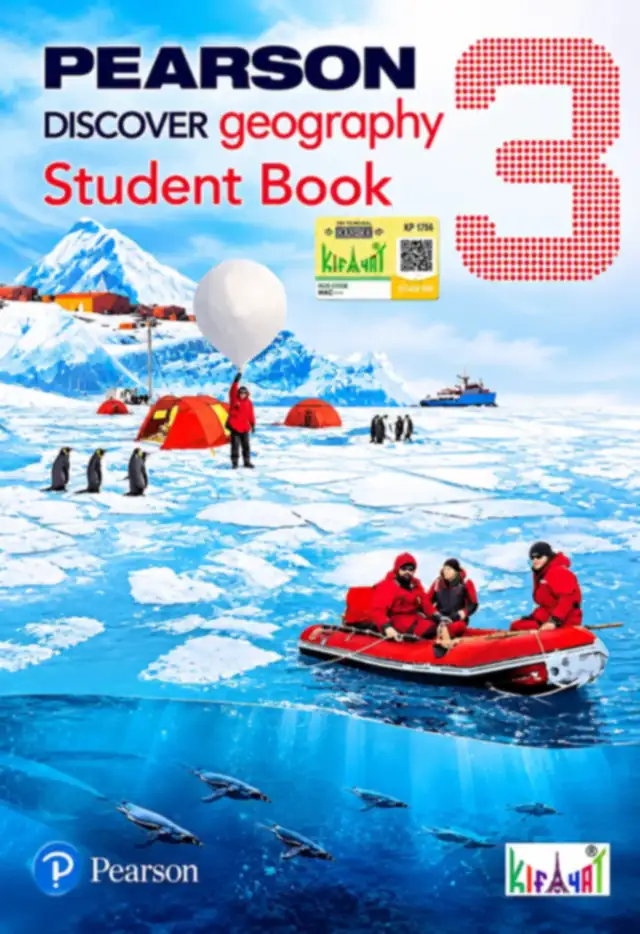
- Title on the cover: Pearson Discover Geography, Student Book, with a large "3" made of red dots
- Publisher: Pearson; the contents page carries "© Kifayat Publishers" and the cover has the Kifayat sticker and logo
- Structure: 3 parts, 6 chapters, 36 topics, "Directive terms" (page vi), two "Review and reflect" pages (40 and 116), index (118)
- Pakistan topics: Climate patterns: Karachi and New York City; Main industries of Pakistan; Major imports and exports of Pakistan; Case study: Cotton; Transportation in Pakistan; Social and economic development in Pakistan
- Geoskills: Mental maps (page 38) and Photograph interpretation: Agriculture (page 114), and a fieldwork topic, Investigating soils (page 58)
- Cover picture: polar explorers, penguins and a research ship
- Shown on: School Books → Class 8
- Session: 2027-28
Complete table of contents (as printed)
| Part / chapter | Topic | Page |
|---|---|---|
| How to use this book | iv | |
| Directive terms | vi | |
| Part I: Marine life and oceans | ||
| Chapter 1: Oceans and Seas | 2 | |
| 1.1 | Introduction to oceans and seas | 4 |
| 1.2 | The marine environment | 8 |
| 1.3 | The importance of coastal environments | 12 |
| 1.4 | Importance of marine environments | 16 |
| 1.5 | Human impacts on marine environments | 18 |
| Part II: Climate and pollution | ||
| Chapter 2: Living with the Climate | 22 | |
| 2.1 | Hazards and disasters | 24 |
| 2.2 | People and climate change | 26 |
| 2.3 | Impacts of global warming | 28 |
| 2.4 | Climate patterns: Karachi and New York City | 33 |
| 2.5 | A water-based conflict | 34 |
| 2.6 | Climate and lifestyle | 36 |
| 2.7 | Geoskills: Mental maps | 38 |
| Review and reflect 1 | 40 | |
| Chapter 3: Environmental Pollution | 42 | |
| 3.1 | Pollution | 44 |
| 3.2 | Environmental worldviews | 47 |
| 3.3 | Global warming and the Ozone | 50 |
| 3.4 | Habitat loss | 52 |
| 3.5 | Towards a sustainable future | 56 |
| 3.6 | In the field: Investigating soils | 58 |
| Part III: Transport, trade and development | ||
| Chapter 4: Industrialisation and International Trade | 60 | |
| 4.1 | Technology transforming production | 62 |
| 4.2 | World cities | 64 |
| 4.3 | Main industries of Pakistan | 68 |
| 4.4 | Major imports and exports of Pakistan | 71 |
| 4.5 | Case study: Cotton | 74 |
| Chapter 5: Transport and its Importance | 76 | |
| 5.1 | Key theme: Transforming technologies | 78 |
| 5.2 | Staying connected via transport | 80 |
| 5.3 | Accessing goods and services | 82 |
| 5.4 | The changing geography of production | 84 |
| 5.5 | Transportation in Pakistan | 87 |
| Chapter 6: Social and Economic Development | 92 | |
| 6.1 | Human wellbeing | 94 |
| 6.2 | Development and human wellbeing | 96 |
| 6.3 | Measuring and mapping human wellbeing | 98 |
| 6.4 | Global production and consumption | 102 |
| 6.5 | Causes of spatial inequality: Internal factors | 106 |
| 6.6 | Social and economic development in Pakistan | 110 |
| 6.7 | Measuring wellbeing in Australia | 112 |
| 6.8 | Geoskills: Photograph interpretation: Agriculture | 114 |
| Review and reflect 2 | 116 | |
| Index | 118 |
The six chapters in numbers
| Chapter | Topics | Pages | About how many pages |
|---|---|---|---|
| 1 Oceans and Seas | 5 | 2–21 | 20 |
| 2 Living with the Climate | 7 | 22–41 | 20 |
| 3 Environmental Pollution | 6 | 42–59 | 18 |
| 4 Industrialisation and International Trade | 5 | 60–75 | 16 |
| 5 Transport and its Importance | 5 | 76–91 | 16 |
| 6 Social and Economic Development | 8 | 92–115 | 24 |
Chapter 6 (24 pages, eight topics) is the largest. It asks "what is development, and how do we measure it?", with a comparison between Pakistan (6.6) and Australia (6.7) and a photograph-interpretation skills page (6.8). Chapters 1 and 2 follow with 20 pages each.
How the student book relates to the activity book
The Activity Book 3 in the same series (Class 8) follows almost the same chapters, so a school may use both. Compare the contents: the student book has five topics in the oceans chapter (the activity book has four), and it adds geoskills pages, review pages and a fieldwork topic. The student book carries the explanations; the activity book carries the practice.
What is distinctive about this book
- Directive terms (page vi). Before the first chapter, a page explains the words that exam questions start with, such as "describe", "explain" and "compare". Learn them before you begin.
- Skills pages. Geoskills: Mental maps (page 38) and Geoskills: Photograph interpretation: Agriculture (page 114) teach a method rather than a fact.
- Fieldwork. In the field: Investigating soils (page 58) is a practical investigation that students can do around school.
- Local comparisons. Climate patterns: Karachi and New York City (page 33), Case study: Cotton (page 74) and Measuring wellbeing in Australia (page 112) place Pakistan beside other countries.
- Review pages. Two Review and reflect pages (40 and 116) give a stop-and-think point in the middle and at the end of the book.
How to use the student book
- Read the directive terms page first and keep it open when you answer questions.
- Read a topic, then make a sketch or a one-line summary.
- Do the geoskills pages with real photographs and maps. A newspaper photo works well for photograph interpretation.
- Link the chapters. Pollution (chapter 3), industry (4), transport (5) and development (6) are all connected; draw a mind map.
- Use the review pages before the mid-year and final tests.
For session 2027-28
With six chapters, about five weeks for each fits a school year. Your teacher will set the order and tell you which topics to read at home. Lists can change from year to year, and we supply the newest edition we can get.
Matching and similar books
- Class 8 Pearson Discover Geography Activity Book 3 is the activity book with the same chapters.
- Class 8 Pearson Discover History Student Book 3 is the history textbook from the same series for Class 8.
- Army Public School Class 8 – Window to World Geography 8 is another Class 8 geography book. It is a different book; use the one on your school's list.
Buy it in Urdu Bazar, Lahore
- Shop: Exam Book House, Shop Number 4, Al Fazal Market, Urdu Bazar, Lahore 54000
- Urdu Bazar Lahore book shop number: 0317 4846676 (call or WhatsApp)
- Open: Monday to Saturday, 9 AM – 9 PM; closed on Sunday
- Delivery: all over Pakistan with cash on delivery, and to the Gulf countries
People also search for this book as
pearson discover geography student book 3 · discover geography class 8 · kifayat geography student book 3 · pearson geography class 8 · oceans climate pollution trade transport class 8 · class 8 geography lahore · urdu bazar lahore school books · session 2027-28
Frequently asked questions
Is this the Class 8 geography book for session 2027-28?
It is Pearson Discover Geography Student Book 3. If your school's 2027-28 Class 8 list names it, this is the right book. Send the list on WhatsApp and we will check it.
How many chapters and topics does it have?
Six chapters in three parts, with 36 numbered topics, two review pages and an index.
Does it cover Pakistan?
Yes. Several topics name Pakistan or Karachi: main industries, imports and exports, the cotton case study, transportation and social and economic development in Pakistan.
Is it the same as the activity book?
No. This is the student book. The activity book is a separate title with practice pages for the same chapters.
Do you deliver outside Lahore?
Yes. We deliver all over Pakistan with cash on delivery, and to the Gulf countries. Send your name, address and the book name on WhatsApp at 0317 4846676, or call the shop in Urdu Bazar, Lahore (Monday to Saturday, 9 AM – 9 PM).
Inside the book — contents and sample pages