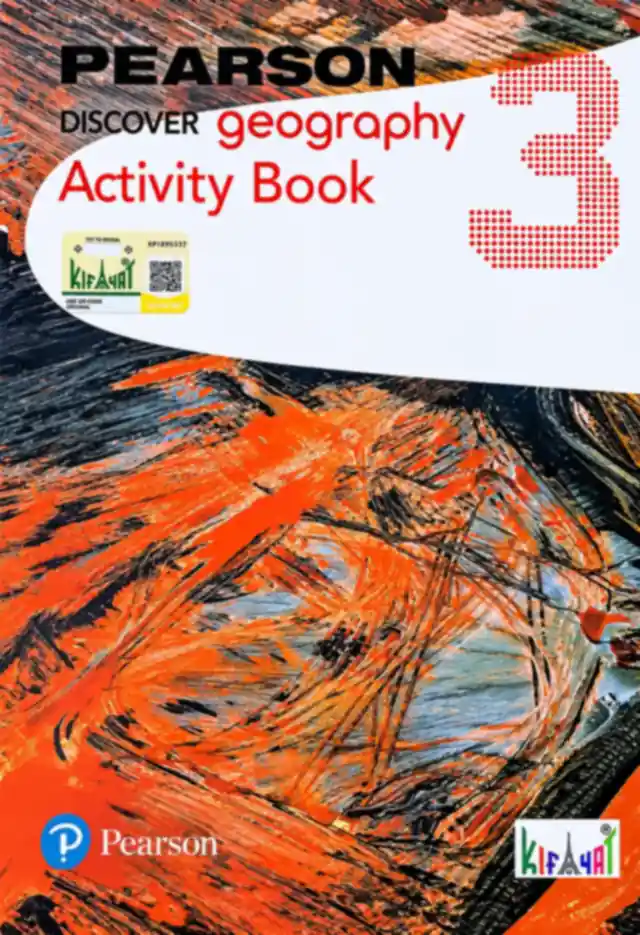
Class 8 Pearson Discover Geography Activity Book 3 (2027-28)
Pearson Discover Geography Activity Book 3 (with the Kifayat Publishers mark) for Class 8 in session 2027-28: six chapters and 27 topics on oceans and seas, climate, pollution, industry and trade, transport, and social and economic development.
Key details
- Class 8 · Geography activity book
- Pearson · Kifayat Publishers
- 6 chapters · pages 5 to 46
- Session 2027-28
ISBN: 9789696771982
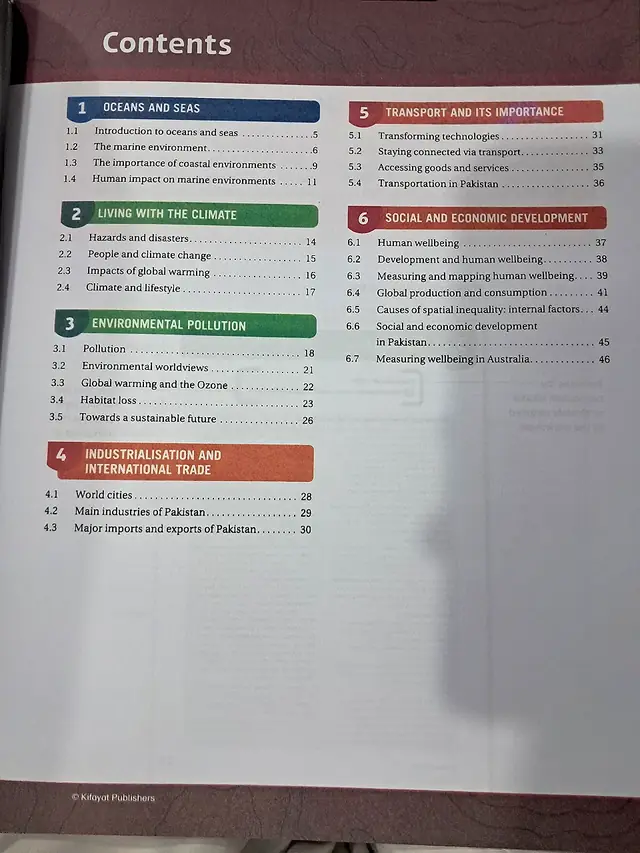
Pearson Discover Geography – Activity Book 3 (with the Kifayat sticker and the line "© Kifayat Publishers" on the contents page) is a geography workbook for Class 8. Its contents list six chapters and 27 numbered topics: oceans and seas, living with the climate, environmental pollution, industrialisation and international trade, transport, and social and economic development. This page is for the 2027-28 session. Exam Book House, Shop Number 4, Al Fazal Market, Urdu Bazar, Lahore, supplies it with cash on delivery across Pakistan and delivery to the Gulf countries.
Quick facts
- Title on the cover: Pearson Discover Geography, Activity Book, with a large "3" made of red dots
- Publisher: Pearson; the contents page carries "© Kifayat Publishers" and the cover has the Kifayat sticker and logo
- Chapters: 6, with topics numbered 1.1 to 6.7
- Pages: the contents run from page 5 to page 46
- Pakistan topics: Main industries of Pakistan, Major imports and exports of Pakistan, Transportation in Pakistan, Social and economic development in Pakistan
- Cover picture: an orange, black and grey abstract painting under a white curved panel
- Shown on: School Books → Class 8
- Session: 2027-28
From landforms to global issues
Activity Book 1 (Class 6) begins with maps and landforms. By Activity Book 3 the subject has moved from describing places to asking questions about people and the planet: What does pollution do to a coast? Why do some countries develop faster than others? How is wellbeing measured? The contents are a good guide: chapters 1 to 3 are about the natural environment and our impact on it, and chapters 4 to 6 are about the human world of industry, trade, transport and development.
Complete table of contents (as printed)
| Topic | Title | Page |
|---|---|---|
| 1 | Oceans and Seas | |
| 1.1 | Introduction to oceans and seas | 5 |
| 1.2 | The marine environment | 6 |
| 1.3 | The importance of coastal environments | 9 |
| 1.4 | Human impact on marine environments | 11 |
| 2 | Living with the Climate | |
| 2.1 | Hazards and disasters | 14 |
| 2.2 | People and climate change | 15 |
| 2.3 | Impacts of global warming | 16 |
| 2.4 | Climate and lifestyle | 17 |
| 3 | Environmental Pollution | |
| 3.1 | Pollution | 18 |
| 3.2 | Environmental worldviews | 21 |
| 3.3 | Global warming and the Ozone | 22 |
| 3.4 | Habitat loss | 23 |
| 3.5 | Towards a sustainable future | 26 |
| 4 | Industrialisation and International Trade | |
| 4.1 | World cities | 28 |
| 4.2 | Main industries of Pakistan | 29 |
| 4.3 | Major imports and exports of Pakistan | 30 |
| 5 | Transport and its Importance | |
| 5.1 | Transforming technologies | 31 |
| 5.2 | Staying connected via transport | 33 |
| 5.3 | Accessing goods and services | 35 |
| 5.4 | Transportation in Pakistan | 36 |
| 6 | Social and Economic Development | |
| 6.1 | Human wellbeing | 37 |
| 6.2 | Development and human wellbeing | 38 |
| 6.3 | Measuring and mapping human wellbeing | 39 |
| 6.4 | Global production and consumption | 41 |
| 6.5 | Causes of spatial inequality: internal factors | 44 |
| 6.6 | Social and economic development in Pakistan | 45 |
| 6.7 | Measuring wellbeing in Australia | 46 |
The six chapters in numbers
| Chapter | Topics | Pages (start to the next chapter) | About how many pages |
|---|---|---|---|
| 1 Oceans and Seas | 4 | 5–13 | 9 |
| 2 Living with the Climate | 4 | 14–17 | 4 |
| 3 Environmental Pollution | 5 | 18–27 | 10 |
| 4 Industrialisation and International Trade | 3 | 28–30 | 3 |
| 5 Transport and its Importance | 4 | 31–36 | 6 |
| 6 Social and Economic Development | 7 | 37–46 | 10 (listed) |
The two largest chapters are Environmental Pollution (10 pages) and Social and Economic Development (about 10 pages as listed). In the pollution chapter, Pollution (3.1, pages 18 to 20) and Habitat loss (3.4, pages 23 to 25) take three pages each, and Towards a sustainable future (3.5) takes two. In the development chapter, Global production and consumption (6.4, pages 41 to 43) is the longest topic at three pages. Industrialisation and International Trade is the shortest chapter, with three topics of one page each.
Topics to tie to Pakistan
Four topics name Pakistan and make good discussion points at home:
- Main industries of Pakistan (4.2, page 29) and Major imports and exports of Pakistan (4.3, page 30). Look at the labels on things at home to find where they were made.
- Transportation in Pakistan (5.4, page 36). Roads, rail, air and ports: what did your family use on the last long journey?
- Social and economic development in Pakistan (6.6, page 45). It sits next to Measuring wellbeing in Australia (6.7, page 46), so the two pages form a comparison of two countries.
How to use the activity book
- Pair each topic with news. Pollution, flooding, trade figures and transport projects appear in the news often.
- Draw before you write. Cause-and-effect diagrams are a good way to answer questions about pollution and global warming.
- Use maps. For topics 4.1 (World cities) and 6.3 (Measuring and mapping human wellbeing), keep an atlas open.
- Compare countries. Make a two-column table for Pakistan and Australia, using the pages 45 and 46 as a guide.
- Write one sustainable action at the end of each chapter, such as walking to school or saving water.
For session 2027-28
With six chapters, about one chapter every five weeks fits a school year, with the larger chapters taking a little longer. Your teacher will set the order, and your school's 2027-28 list shows whether this activity book is used with a student book. Lists can change from year to year, and we supply the newest edition we can get.
Matching and similar books
- Class 6 Pearson Discover Geography Activity Book 1 is the first book of the same series.
- Class 7 Oxford Secondary Geography for Pakistan 2 and Army Public School Class 8 – Window to World Geography 8 are other geography books for the upper primary and lower secondary years. They are different books; use the one on your school's list.
Buy it in Urdu Bazar, Lahore
- Shop: Exam Book House, Shop Number 4, Al Fazal Market, Urdu Bazar, Lahore 54000
- Urdu Bazar Lahore book shop number: 0317 4846676 (call or WhatsApp)
- Open: Monday to Saturday, 9 AM – 9 PM; closed on Sunday
- Delivery: all over Pakistan with cash on delivery, and to the Gulf countries
People also search for this book as
pearson discover geography activity book 3 · discover geography class 8 · kifayat geography activity book 3 · pearson geography workbook class 8 · oceans pollution trade transport class 8 · class 8 geography lahore · urdu bazar lahore school books · session 2027-28
Frequently asked questions
Is this the Class 8 geography activity book for session 2027-28?
It is Pearson Discover Geography Activity Book 3. If your school's 2027-28 Class 8 list names it, this is the right book. Send the list on WhatsApp and we will check it.
How many chapters and topics does it have?
Six chapters and 27 numbered topics, from page 5 to page 46.
Does it cover Pakistan?
Yes. Four topics name Pakistan: main industries (4.2), imports and exports (4.3), transportation (5.4) and social and economic development (6.6).
Is it the same as Activity Book 1?
No. Book 1 is for Class 6 and covers maps, landforms, weather, disasters and forests. Book 3 covers oceans, climate, pollution, trade, transport and development.
Do you deliver outside Lahore?
Yes. We deliver all over Pakistan with cash on delivery, and to the Gulf countries. Send your name, address and the book name on WhatsApp at 0317 4846676, or call the shop in Urdu Bazar, Lahore (Monday to Saturday, 9 AM – 9 PM).
Inside the book — contents and sample pages