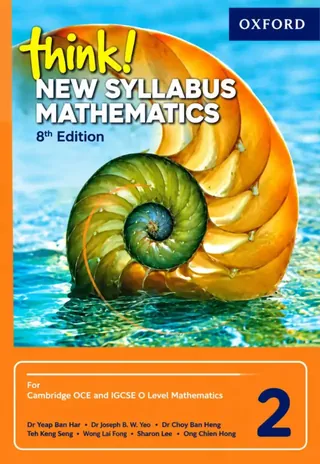
Class 7 Think! New Syllabus Mathematics 2, 8th Ed. (2027-28)
Oxford University Press
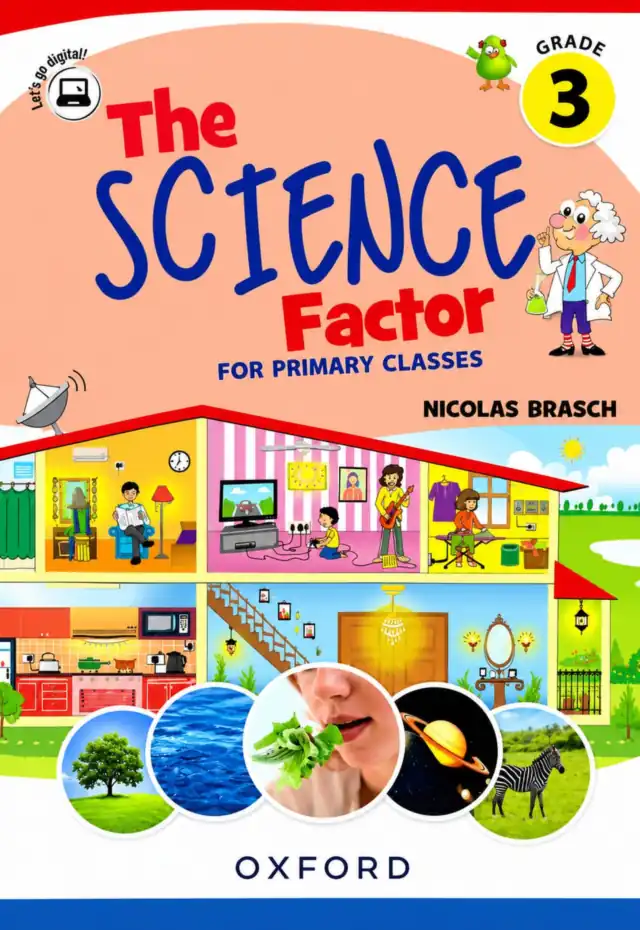
Oxford The Science Factor 3 by Nicolas Brasch, the Grade 3 primary science book for session 2027-28: 11 units with learning outcomes, from the human body and plants to matter, energy, electricity and the solar system.
Oxford The Science Factor 3 by Nicolas Brasch is the Grade 3 primary science book on this site. The peach cover shows a cut-away house, plants and a cartoon scientist, and says "for primary classes". The contents page lists eleven units, each with learning outcomes written as "Students should be able to". This page is written for the 2027-28 session and shows every unit, outcome and page number.
Exams Book House, Shop Number 4, Al Fazal Market, Urdu Bazar, Lahore, supplies it with cash on delivery across Pakistan and delivery to the Gulf countries.
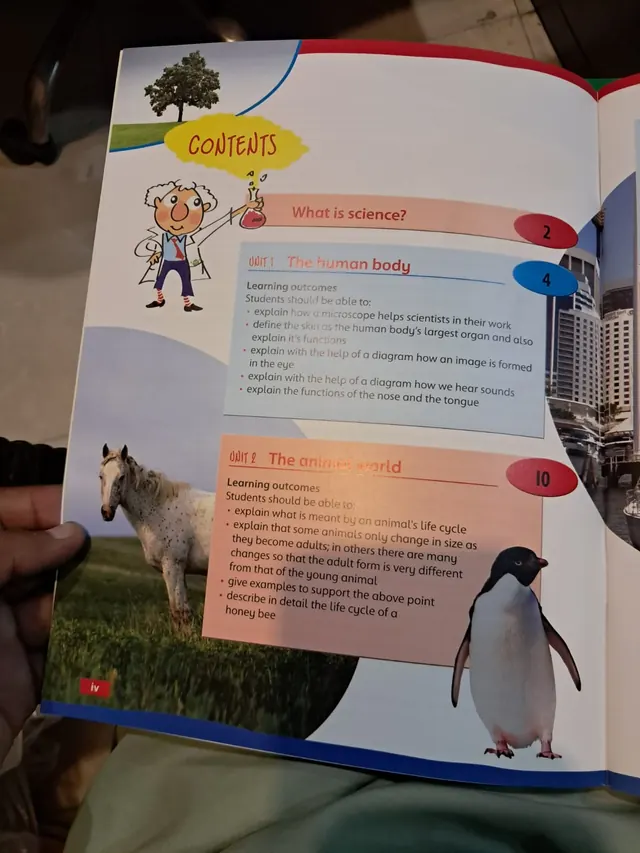
Class 3 science asks a child to learn how the body works, how animals and plants live and grow, what matter is made of, and why there are day and night. The book covers a very wide field in 74 pages by keeping each unit short and clear. It opens with a section called What is science? that explains what scientists do and how a microscope helps them.
The outcomes are specific and ambitious: Newton's laws in simple words, the water cycle and its four stages, photosynthesis, the types of teeth, and the difference between potential and kinetic energy. A Class 3 child can reach them with good pictures, simple experiments and patient explanation.
| Unit | Starts on page |
|---|---|
| What is science? | 2 |
| Unit 1: The human body | 4 |
| Unit 2: The animal world | 10 |
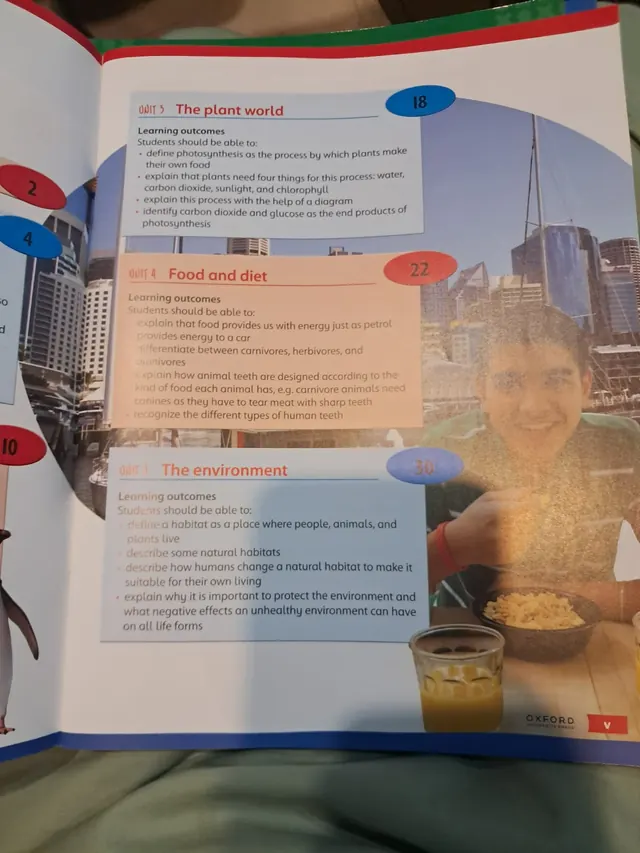
| Unit 3: The plant world | 18 |
| Unit 4: Food and diet | 22 |
| Unit 5: The environment | 30 |
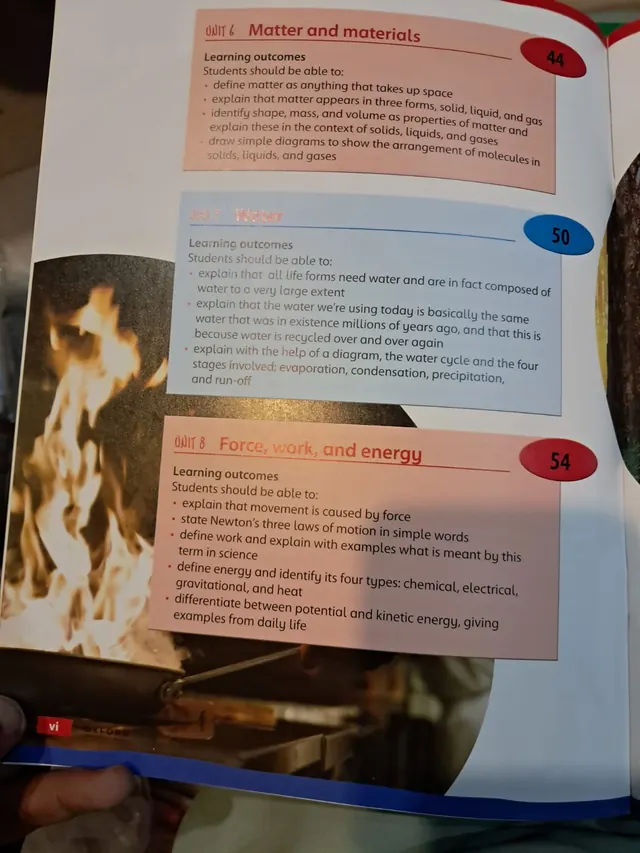
| Unit 6: Matter and materials | 44 |
| Unit 7: Water | 50 |
| Unit 8: Force, work and energy | 54 |
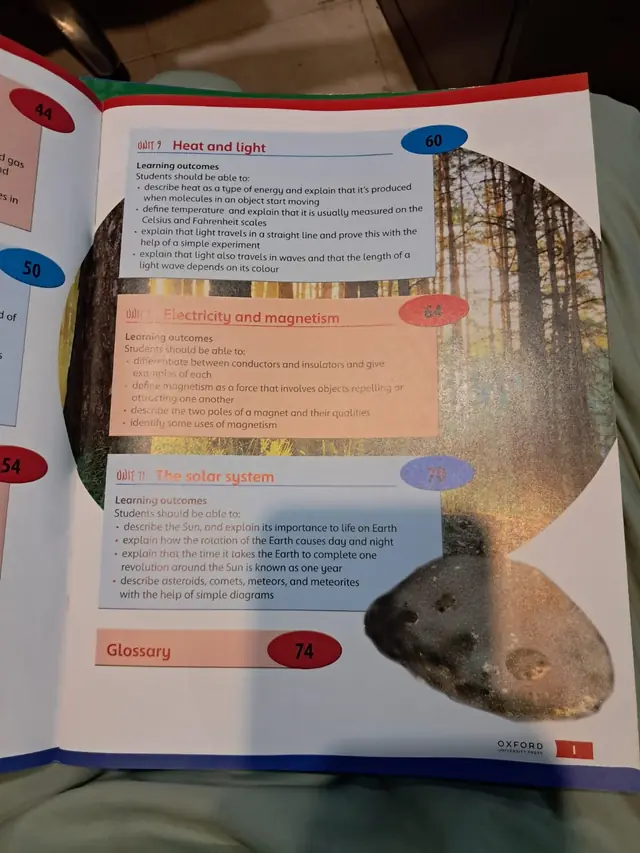
| Unit 9: Heat and light | 60 |
| Unit 10: Electricity and magnetism | 64 |
| Unit 11: The solar system | 70 |
| Glossary | 74 |
The contents page states what students should be able to do after each unit:
Unit 1: The human body (p. 4). Students should be able to: explain how a microscope helps scientists in their work; define the skin as the human body’s largest organ and explain its functions; explain with the help of a diagram how an image is formed in the eye; explain with the help of a diagram how we hear sounds; explain the functions of the nose and the tongue.
Unit 2: The animal world (p. 10). Students should be able to: explain what is meant by an animal’s life cycle; explain that some animals only change in size as they become adults, while in others the changes are so many that the adult looks very different from the young animal; give examples to support this point; describe in detail the life cycle of a honey bee.
Unit 3: The plant world (p. 18). Students should be able to: define photosynthesis as the process by which plants make their own food; explain that plants need four things for this process: water, carbon dioxide, sunlight and chlorophyll; explain the process with the help of a diagram; identify carbon dioxide and glucose as the end products of photosynthesis.
Unit 4: Food and diet (p. 22). Students should be able to: explain that food gives us energy just as petrol gives energy to a car; tell carnivores, herbivores and omnivores apart; explain how animal teeth are designed according to the food each animal eats; recognise the different types of human teeth.
Unit 5: The environment (p. 30). Students should be able to: define a habitat as a place where people, animals and plants live; describe some natural habitats; describe how humans change a natural habitat to make it suitable for their own living; explain why it is important to protect the environment and what negative effects an unhealthy environment can have on all life forms.
Unit 6: Matter and materials (p. 44). Students should be able to: define matter as anything that takes up space; explain that matter appears in three forms: solid, liquid and gas; identify shape, mass and volume as properties of matter; draw simple diagrams to show the arrangement of molecules in solids, liquids and gases.
Unit 7: Water (p. 50). Students should be able to: explain that all life forms need water and are made of water to a very large extent; explain that the water we use today is basically the same water that existed millions of years ago, because water is recycled again and again; explain with a diagram the water cycle and its four stages: evaporation, condensation, precipitation and run-off.
Unit 8: Force, work and energy (p. 54). Students should be able to: explain that movement is caused by force; state Newton’s three laws of motion in simple words; define work and explain with examples what is meant by this term in science; define energy and identify its four types: chemical, electrical, gravitational and heat; tell potential energy from kinetic energy, with examples from daily life.
Unit 9: Heat and light (p. 60). Students should be able to: describe heat as a type of energy, produced when the molecules in an object start moving; define temperature and explain that it is usually measured on the Celsius and Fahrenheit scales; explain that light travels in a straight line and prove it with a simple experiment; explain that light also travels in waves and that the length of a light wave depends on its colour.
Unit 10: Electricity and magnetism (p. 64). Students should be able to: tell conductors from insulators and give examples of each; define magnetism as a force that involves objects repelling or attracting one another; describe the two poles of a magnet and their qualities; identify some uses of magnetism.
Unit 11: The solar system (p. 70). Students should be able to: describe the Sun and explain its importance to life on Earth; explain how the rotation of the Earth causes day and night; explain that the time the Earth takes to complete one revolution around the Sun is known as one year; describe asteroids, comets, meteors and meteorites with the help of simple diagrams.
Read one unit slowly, a few pages at a time. Look at each picture and ask what it shows. Then do something small: look at your skin with a magnifying glass, plant a bean, put a bowl of water in the sun and watch it dry, rub a balloon on your hair, shine a torch at a wall and block it with your hand. Science is understood best when a child sees it happen.
Schools in Pakistan use several different science courses at this level. This book is Oxford's The Science Factor. Another Class 3 science book on this site is the Cambridge Primary Science Learner's Book 3, which is a different course with its own units. Please check your school's list before you order.
It is for Class 3 children, about eight years old, and is used in the science lesson through the year. Parents can use the outcomes as a revision checklist before term tests.
If your school's 2027-28 list names Oxford The Science Factor 3, this is the book. Check the cover and the edition on this page before you order, and send us your list on WhatsApp if you are not sure. We will tell you what we can get for you.
the science factor 3 · oxford science factor grade 3 · nicolas brasch science factor · class 3 science book oxford · class 3 science lahore · class 3 books 2027-28 · urdu bazar lahore school books · دی سائنس فیکٹر 3
The cover names Nicolas Brasch, and the publisher is Oxford University Press.
Eleven units, and a glossary.
Yes. Each unit's outcomes are printed on the contents page.
Yes. The cover says Grade 3.
Send your school's book list on WhatsApp and we will confirm.
Yes, all over Pakistan with cash on delivery, and to the Gulf countries. WhatsApp 0317 4846676.