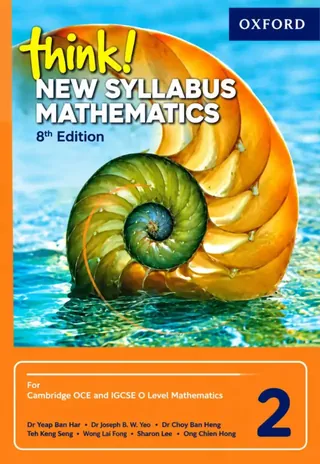
Class 7 Think! New Syllabus Mathematics 2, 8th Ed. (2027-28)
Oxford University Press
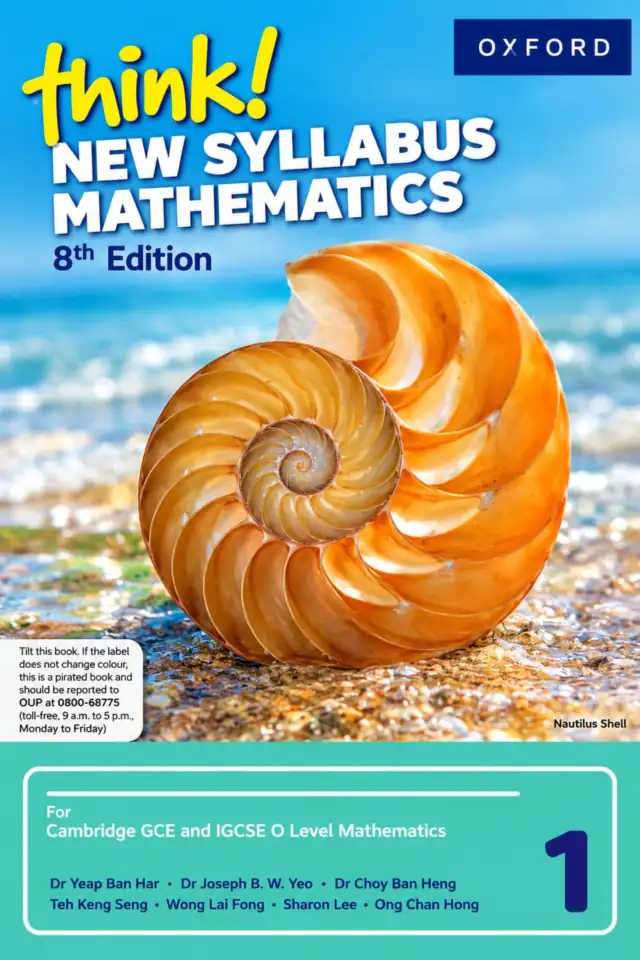
Think! New Syllabus Mathematics 1 (8th Edition, Oxford) for Class 6, session 2027-28: 13 chapters on primes, fractions, decimals, integers, algebra, percentage, ratio, geometry, area and statistics, written for Cambridge O Level Mathematics.
Think! New Syllabus Mathematics 1 (8th Edition) is the Class 6 maths book on this site. It is published by Oxford University Press and is the first book of a series written for Cambridge O Level and IGCSE Mathematics, so it is a demanding book for Class 6. The cover shows a nautilus shell, and its authors include Dr Yeap Ban Har and Dr Joseph B. W. Yeo. This page is written for the 2027-28 session and shows every chapter and lesson with the page numbers we can read.
Exams Book House, Shop Number 4, Al Fazal Market, Urdu Bazar, Lahore, supplies it with cash on delivery across Pakistan and delivery to the Gulf countries.
The series is designed to take a student from the first years of secondary school to the O Level or IGCSE exam. Book 1 therefore starts with the main number ideas, not just revision: prime numbers, square roots and cube roots, highest common factor and lowest common multiple, then all the operations on fractions and decimals, negative numbers, rounding and estimation, basic algebra and linear equations, percentage, ratio and rate, geometry, area and statistics.
Every chapter ends with a Summary, and the book finishes with Answer Keys, so a student can check their own work.
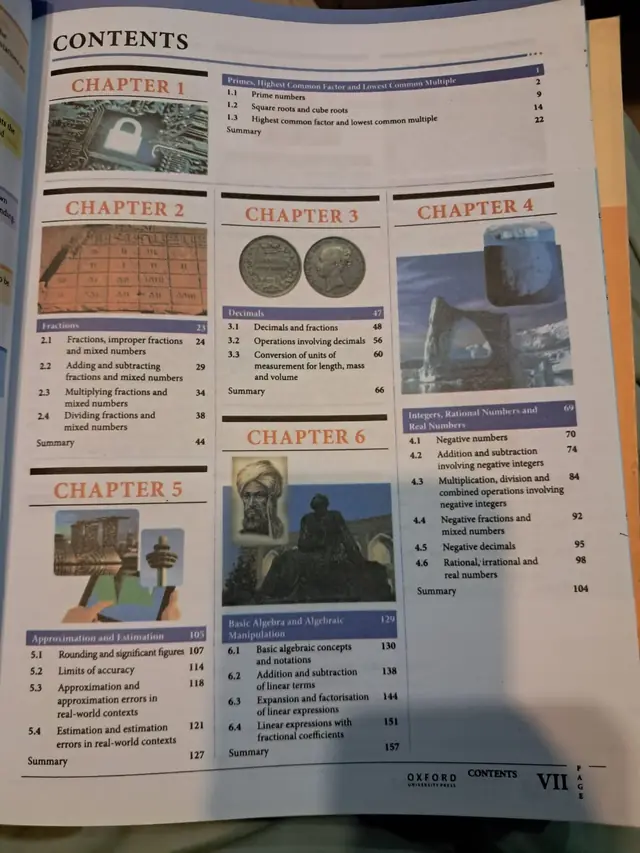
| Chapter | Topic | Starts on page |
|---|---|---|
| 1 Primes, Highest Common Factor and Lowest Common Multiple | 1 | |
| 1.1 Prime numbers | 2 | |
| 1.2 Square roots and cube roots | 9 | |
| 1.3 Highest common factor and lowest common multiple | 14 | |
| Summary | 22 | |
| 2 Fractions | 23 | |
| 2.1 Fractions, improper fractions and mixed numbers | 24 | |
| 2.2 Adding and subtracting fractions and mixed numbers | 29 | |
| 2.3 Multiplying fractions and mixed numbers | 34 | |
| 2.4 Dividing fractions and mixed numbers | 38 | |
| Summary | 44 | |
| 3 Decimals | 47 | |
| 3.1 Decimals and fractions | 48 | |
| 3.2 Operations involving decimals | 56 | |
| 3.3 Conversion of units of measurement for length, mass and volume | 60 | |
| Summary | 66 | |
| 4 Integers, Rational Numbers and Real Numbers | 69 | |
| 4.1 Negative numbers | 70 | |
| 4.2 Addition and subtraction involving negative integers | 74 | |
| 4.3 Multiplication, division and combined operations involving negative integers | 84 | |
| 4.4 Negative fractions and mixed numbers | 92 | |
| 4.5 Negative decimals | 95 | |
| 4.6 Rational, irrational and real numbers | 98 | |
| Summary | 104 | |
| 5 Approximation and Estimation | 105 | |
| 5.1 Rounding and significant figures | 107 | |
| 5.2 Limits of accuracy | 114 | |
| 5.3 Approximation and approximation errors in real-world contexts | 118 | |
| 5.4 Estimation and estimation errors in real-world contexts | 121 | |
| Summary | 127 | |
| 6 Basic Algebra and Algebraic Manipulation | 129 | |
| 6.1 Basic algebraic concepts and notations | 130 | |
| 6.2 Addition and subtraction of linear terms | 138 | |
| 6.3 Expansion and factorisation of linear expressions | 144 | |
| 6.4 Linear expressions with fractional coefficients | 151 | |
| Summary | 157 | |
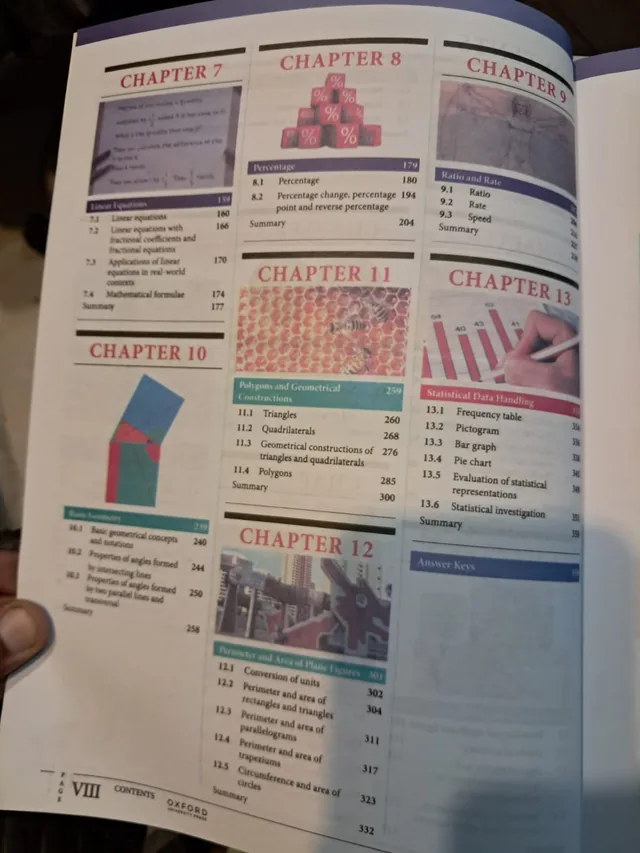
| 7 Linear Equations | 159 | |
| 7.1 Linear equations | 160 | |
| 7.2 Linear equations with fractional coefficients and fractional equations | 166 | |
| 7.3 Applications of linear equations in real-world contexts | 170 | |
| 7.4 Mathematical formulae | 174 | |
| Summary | 177 | |
| 8 Percentage | 179 | |
| 8.1 Percentage | 180 | |
| 8.2 Percentage change, percentage point and reverse percentage | 194 | |
| Summary | 204 | |
| 9 Ratio and Rate | — | |
| 9.1 Ratio; 9.2 Rate; 9.3 Speed; Summary | — | |
| 10 Basic Geometry | 239 | |
| 10.1 Basic geometrical concepts and notations | 240 | |
| 10.2 Properties of angles formed by intersecting lines | 244 | |
| 10.3 Properties of angles formed by two parallel lines and a transversal | 250 | |
| Summary | 258 | |
| 11 Polygons and Geometrical Constructions | 259 | |
| 11.1 Triangles | 260 | |
| 11.2 Quadrilaterals | 268 | |
| 11.3 Geometrical constructions of triangles and quadrilaterals | 276 | |
| 11.4 Polygons | 285 | |
| Summary | 300 | |
| 12 Perimeter and Area of Plane Figures | 301 | |
| 12.1 Conversion of units | 302 | |
| 12.2 Perimeter and area of rectangles and triangles | 304 | |
| 12.3 Perimeter and area of parallelograms | 311 | |
| 12.4 Perimeter and area of trapeziums | 317 | |
| 12.5 Circumference and area of circles | 323 | |
| Summary | 332 | |
| 13 Statistical Data Handling | — | |
| 13.1 Frequency table; 13.2 Pictogram; 13.3 Bar graph; 13.4 Pie chart; 13.5 Evaluation of statistical representations; 13.6 Statistical investigation; Summary | — | |
| Answer Keys | — |
A dash means that the page number is hidden in the curve of the page on our photograph. Please look at the printed book for those.
This book is written for O Level Mathematics, so it is more demanding than a typical Class 6 textbook. Many schools that follow a Cambridge route use it from the start of secondary school. If your school lists it for Class 6, expect longer explanations, more algebra and more exam-style questions than in a primary book. Short, regular practice is better than long sessions the night before a test.
Book 2, for Class 7, continues with linear graphs, simultaneous equations, inequalities, algebraic expansion and factorisation, number patterns, financial transactions, proportion, Pythagoras' theorem, trigonometry, solids, sets and probability, and histograms. Both books are on this site.
It is for Class 6 children on a Cambridge route, about eleven years old. It is the main maths textbook of the year and is used for classwork and homework. Parents can use the page numbers above to follow the class.
If your school's 2027-28 list names Think! New Syllabus Mathematics 1 (8th Edition), this is the book. Check the cover and the edition on this page before you order, and send us your list on WhatsApp if you are not sure. We will tell you what we can get for you.
think new syllabus mathematics 1 · think maths 8th edition book 1 · oxford new syllabus mathematics class 6 · yeap ban har joseph yeo maths · class 6 maths o level oxford lahore · class 6 books 2027-28 · urdu bazar lahore school books · تھنک نیو سلیبس میتھمیٹکس 1
The 8th Edition, as printed on the cover.
The cover names Dr Yeap Ban Har, Dr Joseph B. W. Yeo, Dr Choy Ban Heng, Teh Keng Seng, Wong Lai Fong, Sharon Lee and one more co-author.
The cover says it is for Cambridge GCE and IGCSE O Level Mathematics.
Yes. The contents list Answer Keys at the end.
Send your school's book list on WhatsApp and we will confirm.
Yes, all over Pakistan with cash on delivery, and to the Gulf countries. WhatsApp 0317 4846676.