Allied School Class 4 – Science Nature Lab Book 4 (2027-28)
AEP | Arvo Education Press
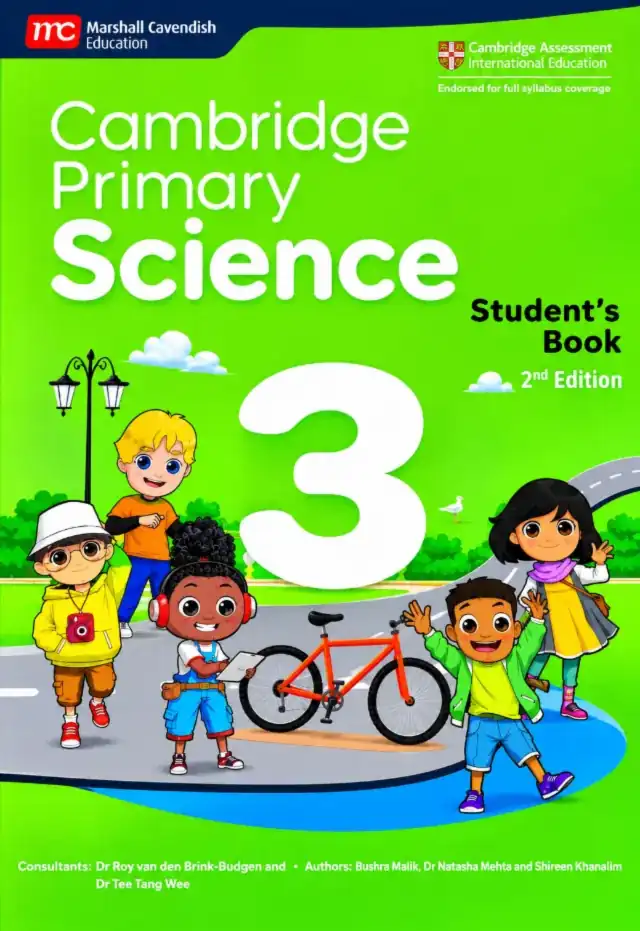
Cambridge Primary Science Student's Book 3 (2nd Edition) from Marshall Cavendish Education, for Class 3 in session 2027-28: eight chapters from Things Around Us to Properties of Magnets, with thinking and working scientifically skills and science in context.
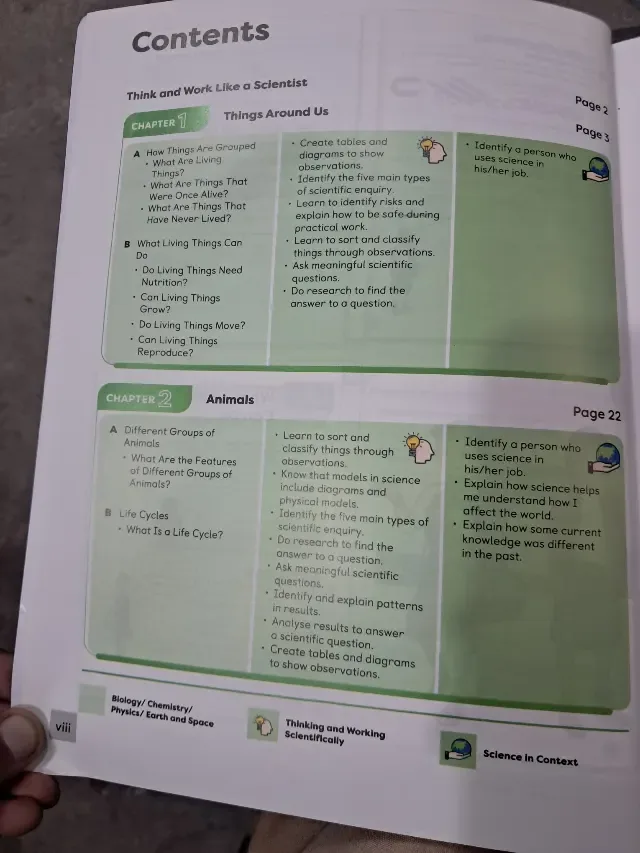
Cambridge Primary Science Student's Book 3 (2nd Edition) from Marshall Cavendish Education is the Class 3 (Stage 3) science course book endorsed by Cambridge Assessment International Education. Its authors are Bushra Malik, Dr Natasha Mehta and Shireen Khanalim, with consultants Dr Roy van den Brink-Budgen and Dr Tee Tang Wee. The contents list eight chapters, from Things Around Us (page 3) to Properties of Magnets (page 123), and each chapter lists the questions it answers and the thinking skills it trains. This page is written for the 2027-28 session. Exams Book House, Shop Number 4, Al Fazal Market, Urdu Bazar, Lahore, supplies it with cash on delivery across Pakistan and delivery to the Gulf countries.
This is a different book from the Cambridge Primary Science Learner's Books (by Hodder and Cambridge University Press) that some schools use. It is a Student's Book from Marshall Cavendish Education, so make sure your school's list names this publisher.
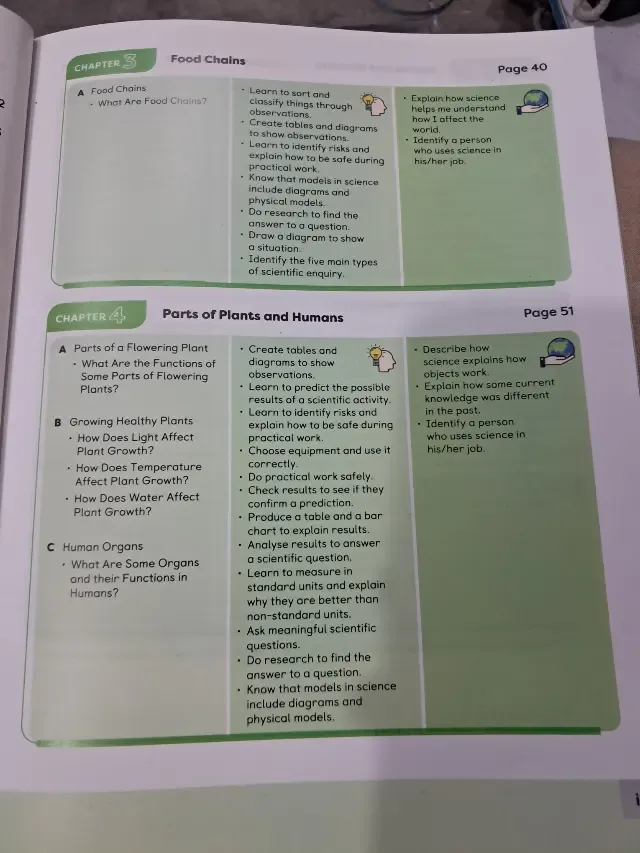
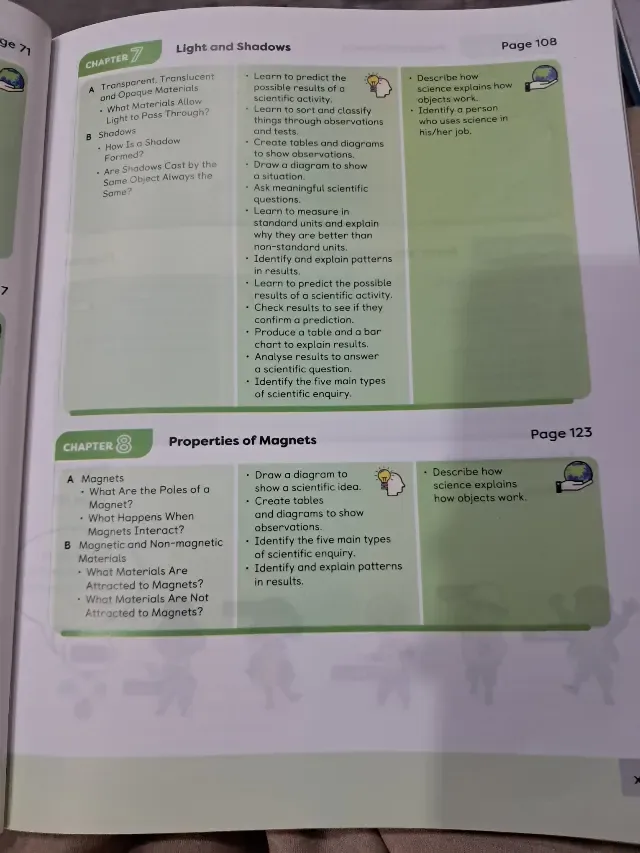
The contents page is written as questions. Every chapter has parts (A, B, C) and every part has a question the child can answer: What are living things?, What are the features of different groups of animals?, What are food chains?, What are the functions of some parts of flowering plants?, How are solids and liquids different?, What is friction?, What is gravity?, How is a shadow formed?, What happens when magnets interact?.
Next to the questions, each chapter lists two kinds of learning: Thinking and Working Scientifically (create tables and diagrams, identify risks, do research, ask meaningful questions, learn to predict, check results, analyse results) and Science in Context (identify a person who uses science in his or her job, explain how science helps me understand how I affect the world, describe how science explains how objects work).
| Chapter | Title | Page | Parts and questions (as printed) |
|---|---|---|---|
| Think and Work Like a Scientist | 2 | ||
| 1 | Things Around Us | 3 | A How things are grouped: what are living things; what are things that were once alive; what are things that have never lived. B What living things can do: do living things need nutrition, can they grow, move and reproduce |
| 2 | Animals | 22 | A Different groups of animals: what are the features of the different groups. B Life cycles: what is a life cycle |
| 3 | Food Chains | 40 | what are food chains |
| 4 | Parts of Plants and Humans | 51 | A Parts of a flowering plant and their functions. B Growing healthy plants: how light, temperature and water affect plant growth. C Human organs and their functions |
| 5 | Matter and Mixtures | 71 | A Solid, liquid and gas. B Solid / solid mixtures: how can we separate them. C Solid / liquid mixtures: separating an insoluble solid; what happens when a solid dissolves in a liquid |
| 6 | Friction and Gravity | 87 | A Measuring forces: how can force be measured. B Friction and surfaces: what is friction, how surfaces affect it, when it helps and when it does not. C Gravity |
| 7 | Light and Shadows | 108 | A Transparent, translucent and opaque materials. B Shadows: how a shadow is formed; are shadows cast by the same object always the same |
| 8 | Properties of Magnets | 123 | A Magnets: the poles of a magnet and what happens when magnets interact. B Magnetic and non-magnetic materials |
Chapters 1 to 4 (pages 3–70). Life science: living and non-living things, animals and life cycles, food chains, and the parts of plants and the human body. Chapter 4 is the biggest of the four, with plant parts, plant growth and human organs.
Chapters 5 to 8 (pages 71–end). Physical science: matter and mixtures, forces (friction and gravity), light and shadows and magnets. Chapter 6 on friction and gravity is the longest of these (21 pages).
Skills in every chapter. The contents lists the same skills again and again: sort and classify, create tables and diagrams, identify risks and stay safe, make predictions, do practical work and choose equipment correctly. This is the "think and work like a scientist" idea that opens the book on page 2.
Who: Class 3 (Stage 3) students in schools that use Marshall Cavendish Cambridge Primary Science. When: through the school year. Chapters 1 to 3 are usually the first term, chapters 4 and 5 the middle and chapters 6 to 8 the last term. Page numbers: food chains start on page 40, matter and mixtures on page 71, light and shadows on page 108 and magnets on page 123.
If your school's 2027-28 Class 3 list names Cambridge Primary Science Student's Book 3 by Marshall Cavendish Education, this is the book: look for the green cover with the big white 3, the words "Student's Book 3", "2nd Edition" and the Marshall Cavendish Education logo. Lists can change from year to year, so send yours on WhatsApp and we will match it. We supply the newest edition; ask us which edition is current.
cambridge primary science student's book 3 · primary science stage 3 marshall cavendish · bushra malik natasha mehta · cambridge science class 3 · کیمبرج پرائمری سائنس 3 · class 3 science book lahore · urdu bazar lahore school books · session 2027-28
It is Cambridge Primary Science Student's Book 3 (2nd Edition) from Marshall Cavendish Education. If your school's 2027-28 Class 3 list names it, this is the right book. Send the list on WhatsApp and we will check it.
Eight chapters, from Things Around Us (page 3) to Properties of Magnets (page 123).
No. This is the Student's Book from Marshall Cavendish Education. The Learner's Book 3 comes from other publishers. Use the one named on your list.
Yes. Each chapter lists practical skills such as creating tables and diagrams, identifying risks, predicting results and choosing equipment.
Yes. We deliver all over Pakistan with cash on delivery, and to the Gulf countries. Send your name, address and the book name on WhatsApp at 0317 4846676, or call the shop in Urdu Bazar, Lahore (Monday to Saturday, 9 AM – 9 PM).