Allied School Class 4 – Science Nature Lab Book 4 (2027-28)
AEP | Arvo Education Press
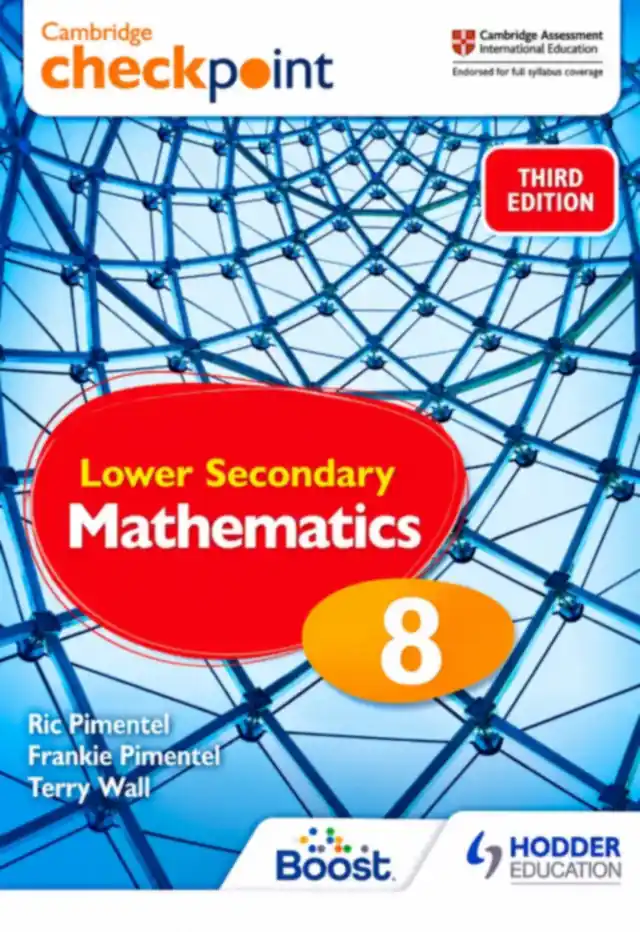
Cambridge Checkpoint Lower Secondary Mathematics 8 (Third Edition) by Ric Pimentel, Frankie Pimentel and Terry Wall (Hodder Education) for Class 8 in session 2027-28: thirty units in three sections, from multiplication and division to ratio and reading graphs.
Cambridge Checkpoint Lower Secondary Mathematics 8 (Third Edition) by Ric Pimentel, Frankie Pimentel and Terry Wall is a Class 8 maths course book from Hodder Education, endorsed by Cambridge Assessment International Education for full syllabus coverage. Its contents list thirty units in three sections, from Multiplication and division on page 2 to Reading and interpreting graphs on page 256, with a glossary on page 264 and an index on page 269. This page is written for the 2027-28 session. Exams Book House, Shop Number 4, Al Fazal Market, Urdu Bazar, Lahore, supplies it with cash on delivery across Pakistan and delivery to the Gulf countries.
This is the Class 8 (Stage 8) book of the Checkpoint maths series and it is built to match the Cambridge Lower Secondary Mathematics curriculum framework. The contents page says so and adds a useful colour key: red for Number, purple for Geometry and Measure, green for Statistics and Probability and blue for Algebra. A parent can see at once which topics are algebra and which are statistics.
The units are short and each has one clear idea. Section 1 begins with multiplication and division and the hierarchy of quadrilaterals, passes through data collection and sampling methods, parallelograms, trapezia and circles, order of operations, expressions, formulae and equations and properties of three-dimensional shapes, and ends with factors and multiples and complementary events. Section 2 covers decimals and place value, comparing and interpreting data, transformation of 2D shapes, fractions and decimals, algebraic expressions, combined events, constructions, lines and angles, probability experiments and equations and inequalities. Section 3 covers sequences, percentage increases and decreases, 2D representations of 3D shapes, functions, geometry and translations, squares, cubes and roots, straight-line graphs, distances and bearings, ratio and graphs.
Each section ends with a Section Review (pages 93, 192 and 261), which is a built-in revision test.
| Unit | Title | Page | Strand |
|---|---|---|---|
| Section 1 | |||
| 1 | Multiplication and division | 2 | Number |
| 2 | Hierarchy of quadrilaterals | 15 | Geometry & Measure |
| 3 | Data collection and sampling methods | 19 | Statistics & Probability |
| 4 | Parallelograms, trapezia and circles | 25 | Geometry & Measure |
| 5 | Order of operations | 36 | Number |
| 6 | Expressions, formulae and equations | 41 | Algebra |
| 7 | Recording, organising and representing data | 48 | Statistics & Probability |
| 8 | Properties of three-dimensional shapes | 73 | Geometry & Measure |
| 9 | Factors and multiples | 83 | Number |
| 10 | Complementary events | 90 | Statistics & Probability |
| Section 1 Review | 93 | ||
| Section 2 | |||
| 11 | Decimals and place value | 96 | Number |
| 12 | Comparing and interpreting data | 105 | Statistics & Probability |
| 13 | Transformation of 2D shapes | 115 | Geometry & Measure |
| 14 | Fractions and decimals | 129 | Number |
| 15 | Manipulating algebraic expressions | 141 | Algebra |
| 16 | Combined events | 148 | Statistics & Probability |
| 17 | Constructions, lines and angles | 153 | Geometry & Measure |
| 18 | Algebraic expressions and formulae | 175 | Algebra |
| 19 | Probability experiments | 181 | Statistics & Probability |
| 20 | Equations and inequalities | 184 | Algebra |
| Section 2 Review | 192 | ||
| Section 3 | |||
| 21 | Describing sequences | 196 | Algebra |
| 22 | Percentage increases and decreases | 204 | Number |
| 23 | 2D representations of 3D shapes | 209 | Geometry & Measure |
| 24 | Functions | 214 | Algebra |
| 25 | Geometry and translations | 221 | Geometry & Measure |
| 26 | Squares, square roots, cubes and cube roots | 229 | Number |
| 27 | Graphs and equations of straight lines | 234 | Algebra |
| 28 | Distances and bearings | 244 | Geometry & Measure |
| 29 | Ratio | 249 | Number |
| 30 | Reading and interpreting graphs | 256 | Statistics & Probability |
| Section 3 Review | 261 | ||
| Glossary | 264 | ||
| Index | 269 |
The strand of each unit is taken from the colour of its label on the contents page. A few labels are faint in our photograph, so the strand column is for guidance only.
Section 1 (pages 2–94). Ten units. The first half of the year is about number work (multiplication and division, order of operations, factors and multiples), the shapes of geometry (quadrilaterals, circles, 3D shapes) and the first data and probability topics.
Section 2 (pages 96–193). Ten units. Decimals and fractions, data comparison, transformations, algebraic expressions and equations, probability experiments and constructions. Unit 17 (constructions, lines and angles) is the longest at 22 pages.
Section 3 (pages 196–262). Ten units. Sequences, percentage change, functions, translations, roots, straight-line graphs, bearings, ratio and graph reading.
The book closes with a glossary (page 264) and an index (page 269), which makes revision easier.
Who: Class 8 (Grade 8) students in schools that follow Cambridge Lower Secondary Mathematics, and their parents. When: through the school year. Section 1 is usually the first term, section 2 the second and section 3 the last term. Page numbers: section 2 starts on page 96, section 3 on page 196 and the index on page 269.
If your school's 2027-28 Class 8 list names Cambridge Checkpoint Lower Secondary Mathematics 8 by Hodder Education, this is the book: look for the red oval with "Lower Secondary Mathematics", the orange number 8, the words "Third Edition" and the authors Ric Pimentel, Frankie Pimentel and Terry Wall on the cover. Lists can change from year to year, so send yours on WhatsApp and we will match it. We supply the newest edition; ask us which edition is current.
cambridge checkpoint maths 8 · checkpoint lower secondary mathematics 8 · pimentel maths 8 · hodder maths class 8 · کیمبرج چیک پوائنٹ میتھس 8 · class 8 maths book lahore · urdu bazar lahore school books · session 2027-28
It is Cambridge Checkpoint Lower Secondary Mathematics 8 (Third Edition) by Ric Pimentel, Frankie Pimentel and Terry Wall. If your school's 2027-28 Class 8 list names it, this is the right book. Send the list on WhatsApp and we will check it.
Thirty units in three sections, from Multiplication and division (page 2) to Reading and interpreting graphs (page 256).
Yes. Section 1 Review is on page 93, Section 2 Review on page 192 and Section 3 Review on page 261.
No. The number on the cover is the class. Use the book named on your child's list.
Yes. We deliver all over Pakistan with cash on delivery, and to the Gulf countries. Send your name, address and the book name on WhatsApp at 0317 4846676, or call the shop in Urdu Bazar, Lahore (Monday to Saturday, 9 AM – 9 PM).