A Level Physics Paper 2 (Structured) Topical Workbook 9702 – 2027-28
Read & Write Publications
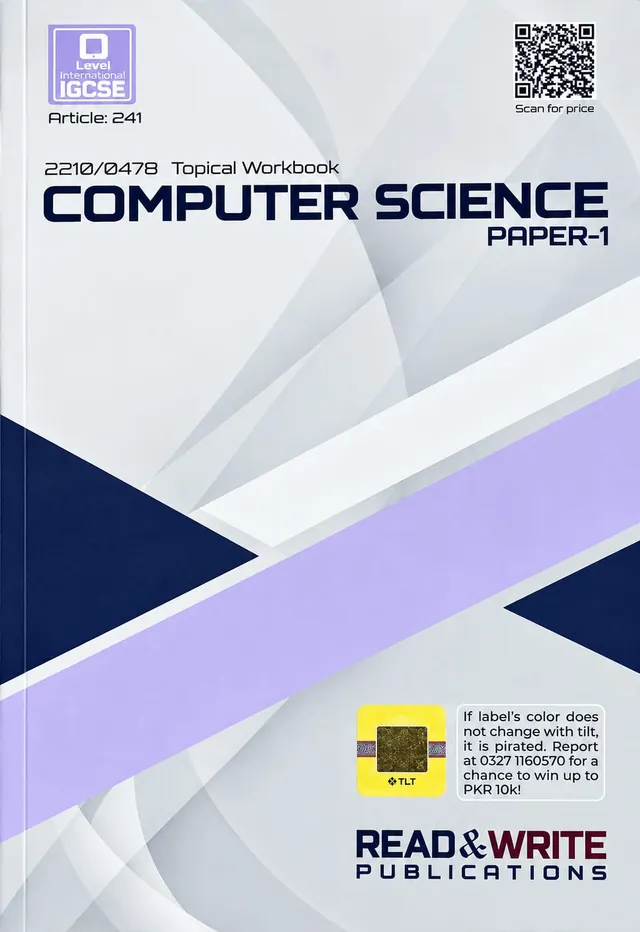
O Level Computer Science Paper 1 Topical Workbook (2210/0478) by Read & Write Publications, for 2027-28: 6 units from data representation to emerging technologies, answers after every unit.
The O Level Computer Science Paper 1 Topical Workbook (2210/0478) by Read & Write Publications is a topic-by-topic practice book for the theory paper of Cambridge O Level and International IGCSE Computer Science. It covers six units — data representation, data transmission, hardware, software, the internet, and automated and emerging technologies — and puts an answers section after every topic, so students can mark their own work. Cambridge uses one 2210/0478 syllabus for the 2026, 2027 and 2028 exams, so it serves the whole 2027-28 session.
Exams Book House, Shop Number 4, Al Fazal Market, Urdu Bazar, Lahore, stocks this workbook for O Level and IGCSE students all over Pakistan. Collect it from the shop or order it on WhatsApp with cash on delivery.
It is a practice workbook. On the cover it is called Computer Science Paper-1, 2210/0478 Topical Workbook. “Topical” means the questions are grouped by syllabus topic instead of by exam year: a student practises one idea at a time — binary numbers, error detection, the CPU, cyber security — until it feels easy, and only then moves on.
The six units follow the same order as the Cambridge Computer Science topics for Paper 1: data representation, data transmission, hardware, software, the internet and its uses, and automated and emerging technologies. Each unit is divided into numbered sections such as 1.1, 3.4 or 6.2, and after each unit the book prints a separate answers section (pages 88, 181, 323, 425, 521 and 600 are where the answers for Units 1 to 6 begin). The paper itself is a 75-mark written paper; Cambridge lists about 1 hour 45 minutes for it, but please check the syllabus for your exam year.
It is not a programming book. Algorithms, programming, databases and Boolean logic belong to Paper 2, which is a different paper (ask us on WhatsApp if you also need the Paper 2 workbook).
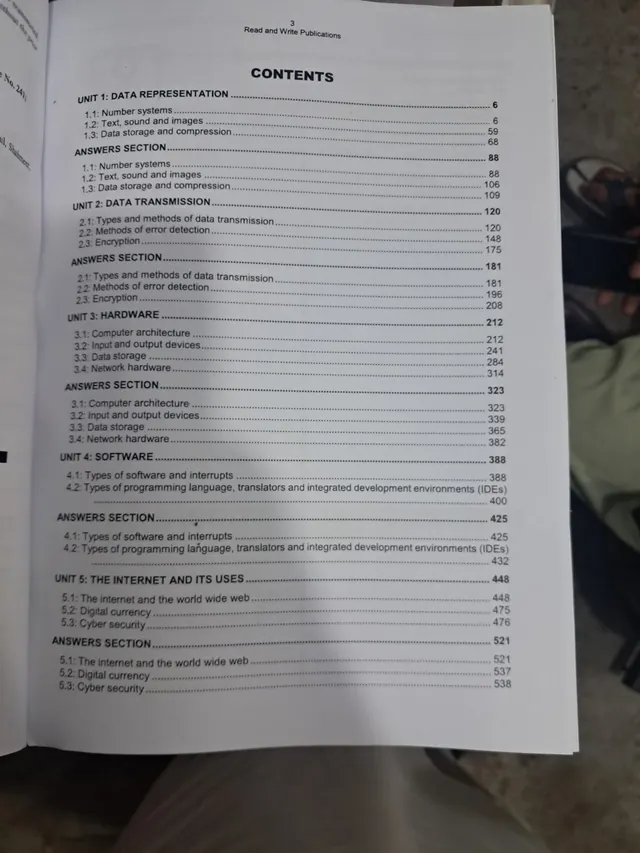
Every unit, section and page number below is as printed on the contents pages of the book. “Questions” is the page where the section starts; “Answers” is the page where its answers start.
| Unit / section | Topic | Questions (page) | Answers (page) |
|---|---|---|---|
| Unit 1: Data Representation | 6 | 88 | |
| 1.1 | Number systems | 6 | 88 |
| 1.2 | Text, sound and images | 59 | 106 |
| 1.3 | Data storage and compression | 68 | 109 |
| Unit 2: Data Transmission | 120 | 181 | |
| 2.1 | Types and methods of data transmission | 120 | 181 |
| 2.2 | Methods of error detection | 148 | 196 |
| 2.3 | Encryption | 175 | 208 |
| Unit 3: Hardware | 212 | 323 | |
| 3.1 | Computer architecture | 212 | 323 |
| 3.2 | Input and output devices | 241 | 339 |
| 3.3 | Data storage | 284 | 365 |
| 3.4 | Network hardware | 314 | 382 |
| Unit 4: Software | 388 | 425 | |
| 4.1 | Types of software and interrupts | 388 | 425 |
| 4.2 | Types of programming language, translators and integrated development environments (IDEs) | 400 | 432 |
| Unit 5: The Internet and its Uses | 448 | 521 | |
| 5.1 | The internet and the world wide web | 448 | 521 |
| 5.2 | Digital currency | 475 | 537 |
| 5.3 | Cyber security | 476 | 538 |
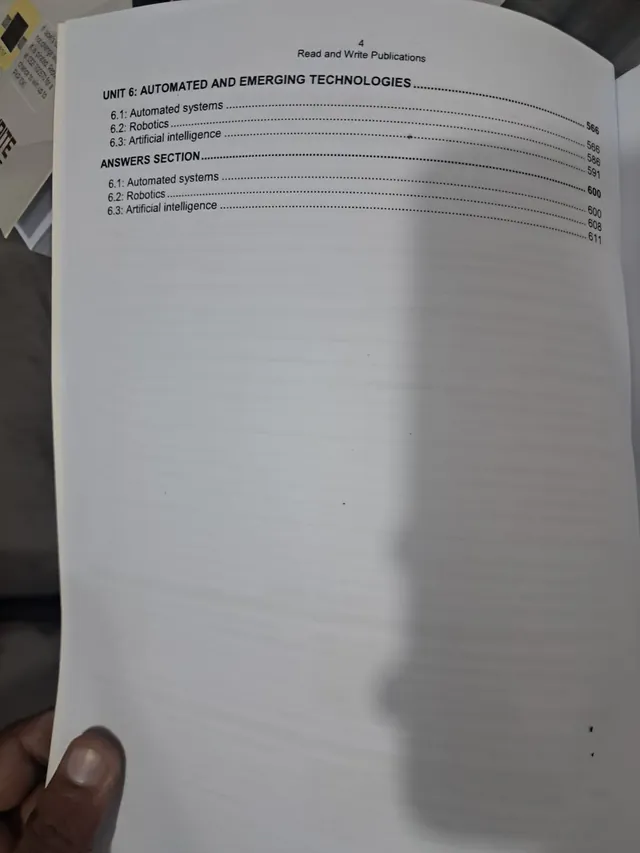
| Unit 6: Automated and Emerging Technologies | 566 | 600 | |
| 6.1 | Automated systems | 566 | 600 |
| 6.2 | Robotics | 586 | 608 |
| 6.3 | Artificial intelligence | 591 | 611 |
Unit 1 — Data Representation (1.1 Number systems, 1.2 Text, sound and images, 1.3 Data storage and compression). This is where Paper 1 starts and where many marks are easy to win. Under these headings the Cambridge syllabus puts binary, denary and hexadecimal numbers and the conversions between them, binary addition and shifts, how computers store text with character sets, sound with sampling, and images with resolution and colour depth, plus file-size calculations and lossy and lossless compression. The number-systems section alone runs from page 6 to page 58.
Unit 2 — Data Transmission (2.1 Types and methods of data transmission, 2.2 Methods of error detection, 2.3 Encryption). How data travels between devices: packets and packet switching, serial and parallel transmission, simplex, half-duplex and full-duplex, USB, then the checks that find mistakes in received data (parity, checksum, check digit, echo check, automatic repeat query) and the idea of encryption.
Unit 3 — Hardware (3.1 Computer architecture, 3.2 Input and output devices, 3.3 Data storage, 3.4 Network hardware). The CPU and the fetch–decode–execute cycle, input and output devices and sensors, primary and secondary storage (RAM, ROM, magnetic, optical, solid-state and cloud storage) and the hardware that connects a network, such as the network interface card, router and the MAC and IP addresses. Input and output devices (pages 241 to 283) is one of the longest sections in the book.
Unit 4 — Software (4.1 Types of software and interrupts, 4.2 Types of programming language, translators and integrated development environments). System software and application software, what an operating system does, utility software and interrupts; then high-level and low-level languages, compilers, interpreters and assemblers, and the tools an IDE gives a programmer.
Unit 5 — The Internet and its Uses (5.1 The internet and the world wide web, 5.2 Digital currency, 5.3 Cyber security). URLs, web browsers, HTTP and HTTPS, DNS and cookies; digital currency and the blockchain idea; and cyber security — threats such as malware, phishing and brute-force attacks and the protections against them.
Unit 6 — Automated and Emerging Technologies (6.1 Automated systems, 6.2 Robotics, 6.3 Artificial intelligence). Sensors, microprocessors and actuators in automated systems, robots and what they are used for, and the basics of artificial intelligence. This is the newest part of the syllabus and a favourite for short “explain” questions.
Cambridge O Level Computer Science (2210) and IGCSE (0478) have one syllabus for exams in 2026, 2027 and 2028, examined in the June and November series, and this workbook’s six units include the newer topic Automated and emerging technologies. A student of the 2027-28 session therefore works to the same Paper 1 syllabus in both years. Ask us on WhatsApp for the newest print before you order.
The cover carries a colour-changing security label, and the publisher says that a label which does not change colour when you tilt it means a pirated copy. There is also a “Scan for price” QR code on the cover. Ask us to show you the label when you collect your copy.
If you are looking for O Level and IGCSE books in Urdu Bazar, Lahore, Exams Book House keeps Computer Science, Mathematics, Physics and other Cambridge titles in the shop. Visit us, or order from anywhere in Pakistan. Prices change with each print run, so message us for today’s price.
Message us on WhatsApp with the book name to check current stock and price — اردو بازار لاہور میں کتابوں کی دکان، ایگزامز بک ہاؤس۔
Yes. Cambridge uses the same 2210/0478 syllabus for the 2026, 2027 and 2028 exams, and the workbook covers all six Paper 1 units of it.
It is for Paper 1 of Cambridge O Level Computer Science (2210). The cover also shows the code 0478 and the International IGCSE badge, so it suits IGCSE Computer Science Paper 1 students as well.
No. This book covers the six Paper 1 units: data representation, data transmission, hardware, software, the internet and automated and emerging technologies. Programming, algorithms, databases and Boolean logic are part of Paper 2.
Yes. After each unit there is an answers section, listed in the contents with its own page numbers (for example Unit 1 answers start on page 88 and Unit 6 answers start on page 600).
The last answers section starts on page 611, so the book is more than 610 pages long.
The price depends on the current print run, so please message us on WhatsApp or call 0317 4846676 and we will tell you today’s price and confirm that the book is in stock.
Yes. We deliver all over Pakistan with cash on delivery. Send us the book name and your address on WhatsApp.