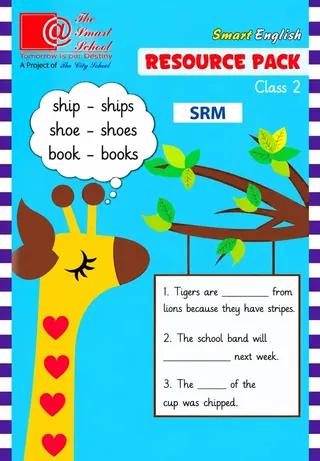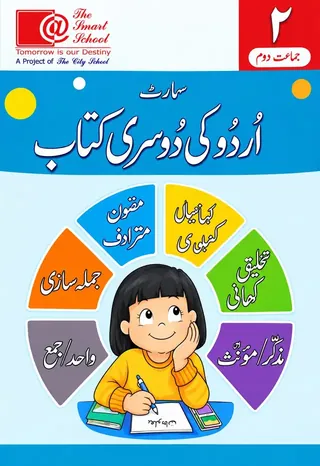
The Smart School Class 2 – Smart Urdu ki Doosri Kitab (2027-28)
The Smart School (A Project of The City School)
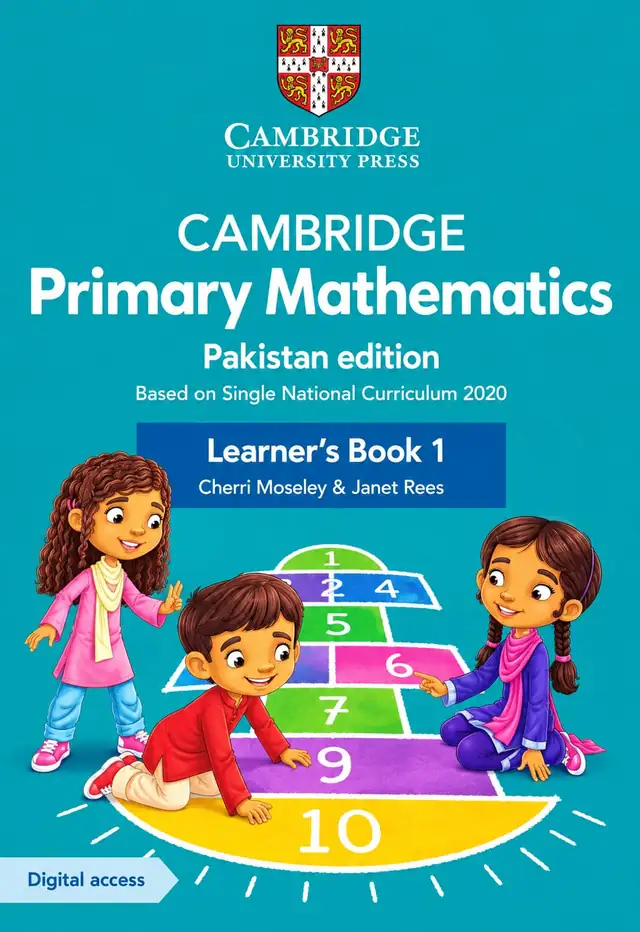
Cambridge Primary Mathematics Learner's Book 1, Pakistan Edition (Cherri Moseley and Janet Rees), on the LACAS Class 1 list for session 2027-28: 14 units, 6 projects, a glossary, 244 pages.
On the LACAS Class 1 book list — see the full LACAS Class 1 book pack and booksCambridge Primary Mathematics Learner's Book 1 (Pakistan Edition) is the Class 1 maths coursebook on the LACAS Class 1 list on this site. It is published by Cambridge University Press and written by Cherri Moseley and Janet Rees, and the cover says it is based on the Single National Curriculum 2020. It is the first book of the Cambridge Primary Mathematics series that the other LACAS maths books on this site continue. This page is written for the 2027-28 session and shows the whole printed contents list with page numbers.
Exams Book House, Shop Number 4, Al Fazal Market, Urdu Bazar, Lahore, supplies it with cash on delivery across Pakistan and delivery to the Gulf countries.
A Class 1 child arrives at school counting a few objects and knowing some shapes. This book turns that into a full year of number sense, simple geometry and measuring. It begins with counting sets of objects and numbers to 10, then moves through shapes, halves, length, adding and taking away, position, time, numbers to 20 and finally numbers to 100 and money.
The 14 units are grouped under two strands, Number and Geometry and measure, and a section called "Thinking and Working Mathematically" at the front shows how children are expected to talk, test ideas and explain answers, not only to give the right number. Six projects, from Snakes to Finding drawers, give a break from the units and let a six-year-old use what they know in a small investigation.
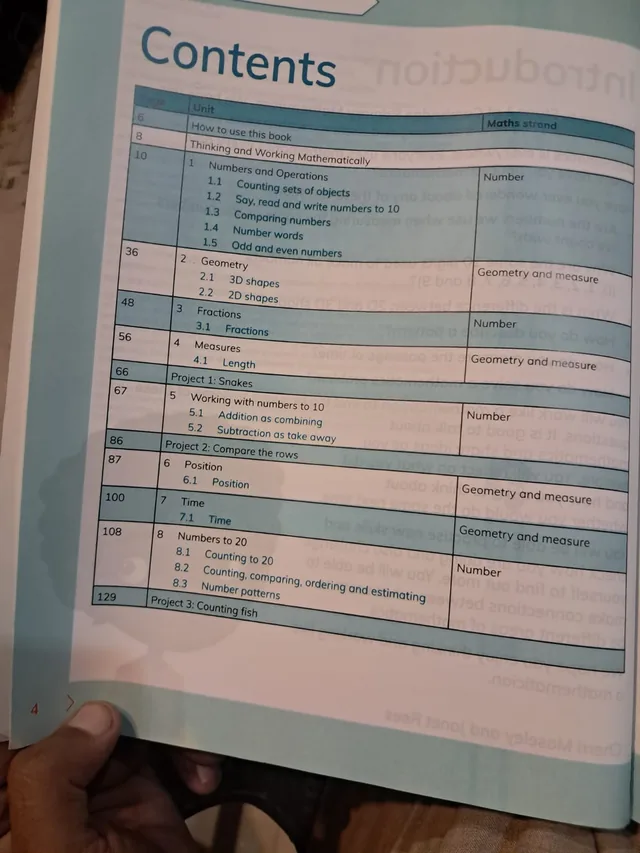
Here is the printed contents list in order, with the page on which each unit or project starts.
| Unit | Lessons | Starts on page |
|---|---|---|
| How to use this book | — | 6 |
| Thinking and Working Mathematically | — | 8 |
| 1 Numbers and Operations | 1.1 Counting sets of objects; 1.2 Say, read and write numbers to 10; 1.3 Comparing numbers; 1.4 Number words; 1.5 Odd and even numbers | 10 |
| 2 Geometry | 2.1 3D shapes; 2.2 2D shapes | 36 |
| 3 Fractions | 3.1 Fractions | 48 |
| 4 Measures | 4.1 Length | 56 |
| Project 1: Snakes | — | 66 |
| 5 Working with numbers to 10 | 5.1 Addition as combining; 5.2 Subtraction as take away | 67 |
| Project 2: Compare the rows | — | 86 |
| 6 Position | 6.1 Position | 87 |
| 7 Time | 7.1 Time | 100 |
| 8 Numbers to 20 | 8.1 Counting to 20; 8.2 Counting, comparing, ordering and estimating; 8.3 Number patterns | 108 |
| Project 3: Counting fish | — | 129 |
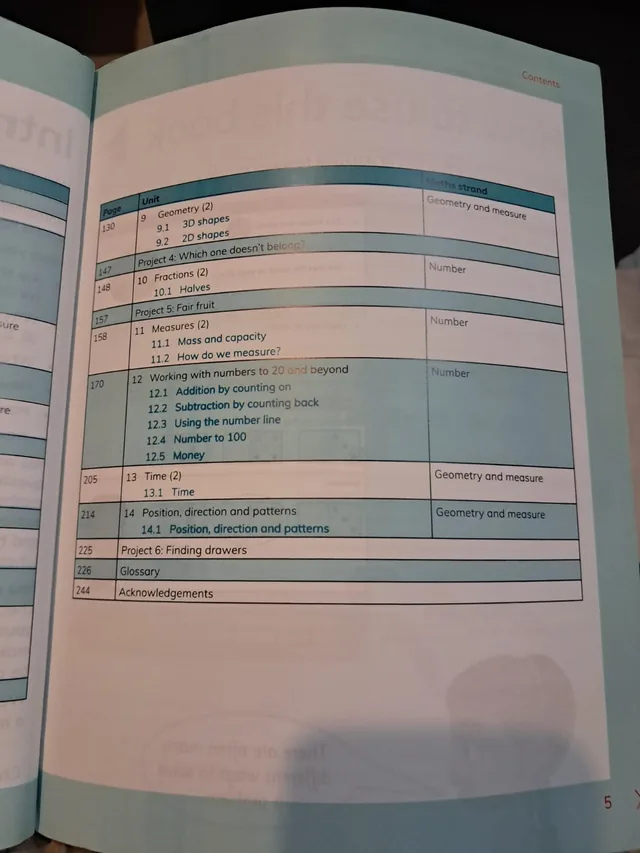
| 9 Geometry (2) | 9.1 3D shapes; 9.2 2D shapes | 130 |
| Project 4: Which one doesn't belong? | — | 147 |
| 10 Fractions (2) | 10.1 Halves | 148 |
| Project 5: Fair fruit | — | 157 |
| 11 Measures (2) | 11.1 Mass and capacity; 11.2 How do we measure? | 158 |
| 12 Working with numbers to 20 and beyond | 12.1 Addition by counting on; 12.2 Subtraction by counting back; 12.3 Using the number line; 12.4 Number to 100; 12.5 Money | 170 |
| 13 Time (2) | 13.1 Time | 205 |
| 14 Position, direction and patterns | 14.1 Position, direction and patterns | 214 |
| Project 6: Finding drawers | — | 225 |
| Glossary | — | 226 |
| Acknowledgements | — | 244 |
Each project is a short activity that links several ideas, and the titles show the everyday settings: Snakes, Compare the rows, Counting fish, Which one doesn't belong?, Fair fruit and Finding drawers. A project gives a six-year-old a reason to use counting, shapes, measuring or position words together. Projects are the best place for a parent to ask "why do you think so?".
The glossary starts on page 226 and runs to page 243. For a six-year-old it works as a picture-and-word reminder of maths words such as more, fewer, above and halves. Reading it together builds the language that the later books (Learner's Books 2 to 5 on this site) rely on.
It is for Class 1 children on the LACAS list, about six years old, and for their parents and teachers. It is used in class during the whole session. At home, it is the book to open when you want to see what the next topic is or to revise before a test.
On this site it is shown under LACAS Class 1. If your school's 2027-28 list names Cambridge Primary Mathematics Learner's Book 1 (Pakistan Edition), this is the book. Send us your list on WhatsApp and we will tell you what we can get for you.
cambridge primary mathematics learner's book 1 · lacas class 1 maths · cambridge primary maths pakistan edition class 1 · cherri moseley janet rees · class 1 maths book lahore · کیمبرج پرائمری میتھمیٹکس لرنرز بک 1
The cover names Cherri Moseley and Janet Rees.
Fourteen units and six projects.
Yes. The cover says Pakistan edition and Based on Single National Curriculum 2020.
Yes. The glossary starts on page 226.
It is shown there on this site. Send your school list on WhatsApp so we can confirm.
Yes, all over Pakistan with cash on delivery, and to the Gulf countries. WhatsApp 0317 4846676.