Allied School Class 4 – Science Nature Lab Book 4 (2027-28)
AEP | Arvo Education Press
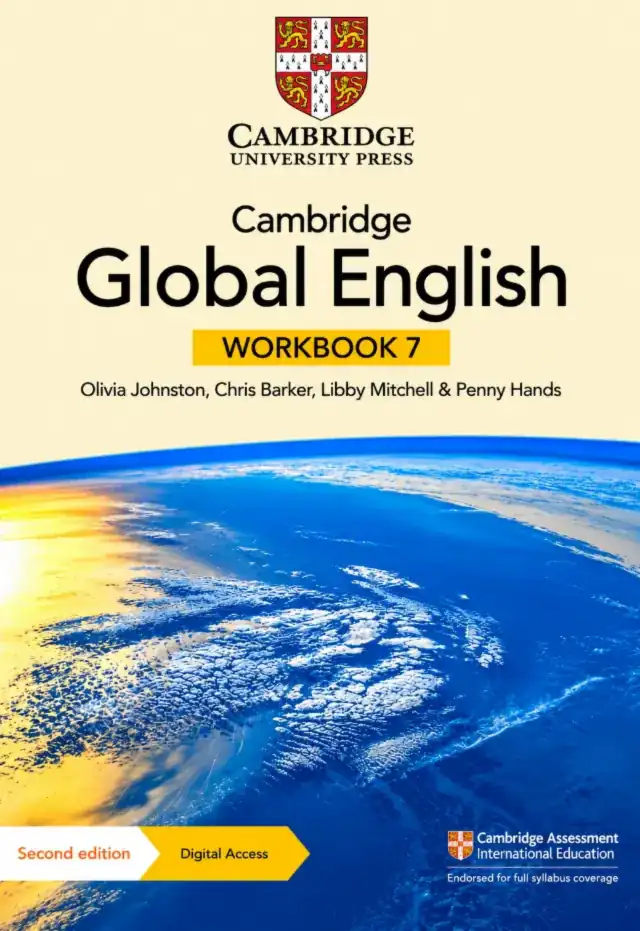
Cambridge Global English Workbook 7 (Second Edition) by Olivia Johnston, Chris Barker, Libby Mitchell and Penny Hands (Cambridge University Press) for Class 7 in session 2027-28: nine units of practice, with every lesson and Use of English page listed.
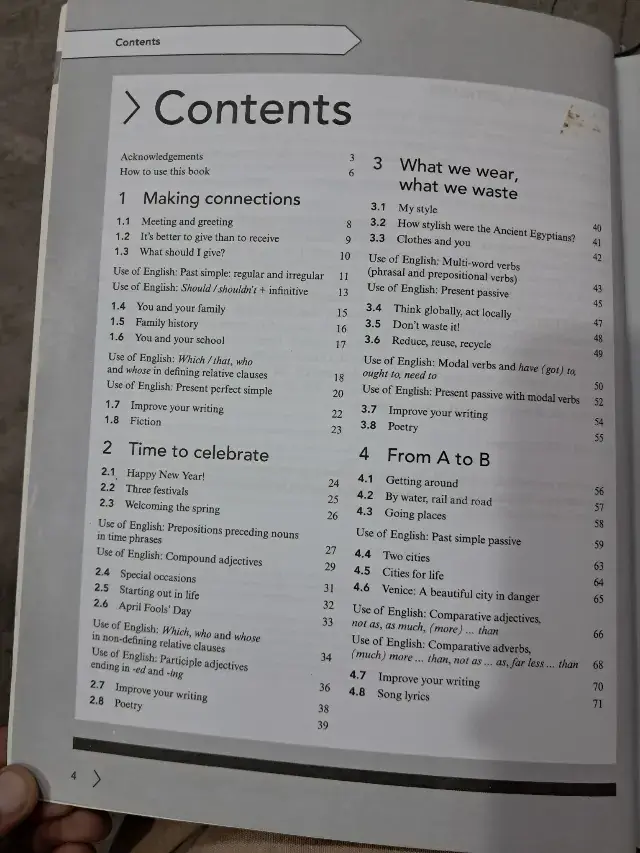
Cambridge Global English Workbook 7 (Second Edition) by Olivia Johnston, Chris Barker, Libby Mitchell and Penny Hands is the practice book that goes with the Class 7 Global English Learner's Book from Cambridge University Press. Its contents list nine units with every lesson numbered (for example 1.1 Meeting and greeting on page 8), the Use of English pages and a closing list of common irregular verbs on page 151. This page is written for the 2027-28 session. Exams Book House, Shop Number 4, Al Fazal Market, Urdu Bazar, Lahore, supplies it with cash on delivery across Pakistan and delivery to the Gulf countries.
A workbook is where English is learned by writing, and this one is very well organised. Every unit has the same pattern of lessons: eight numbered lessons (for example 1.1 to 1.8) plus two or three Use of English pages for grammar. The last two lessons of each unit are always Improve your writing and a creative lesson (Fiction, Poetry, Song lyrics, Autobiography or Non-fiction).
The nine themes are the same as in the Learner's Book: Making connections, Time to celebrate, What we wear, what we waste, From A to B, The great outdoors, Sports and games, Success, In the news and The digital world. The grammar list is practical: past simple, present perfect, relative clauses, compound adjectives, participle adjectives, present passive, modal verbs, comparatives, -ing forms, expressing the future, abstract nouns, adverbs, adjective + preposition, quantifiers, past continuous, questions and requests, indefinite pronouns, multi-word verbs and if clauses.
The book is designed to be used lesson by lesson with the Learner's Book 7, so each exercise has a matching page in the course book.
| Unit | Title | Pages | Lessons and Use of English pages (as printed) |
|---|---|---|---|
| Acknowledgements; How to use this book | 3; 6 | ||
| 1 | Making connections | 8–23 | 1.1 Meeting and greeting (8); 1.2 It's better to give than to receive (9); 1.3 What should I give? (10); Past simple: regular and irregular (11); Should / shouldn't + infinitive (13); 1.4 You and your family (15); 1.5 Family history (16); 1.6 You and your school (17); which / that, who and whose in defining relative clauses (18); Present perfect simple (20); 1.7 Improve your writing (22); 1.8 Fiction (23) |
| 2 | Time to celebrate | 24–39 | 2.1 Happy New Year! (24); 2.2 Three festivals (25); 2.3 Welcoming the spring (26); Prepositions preceding nouns in time phrases (27); Compound adjectives (29); 2.4 Special occasions (31); 2.5 Starting out in life (32); 2.6 April Fools' Day (33); which, who and whose in non-defining relative clauses (34); Participle adjectives ending in -ed and -ing (36); 2.7 Improve your writing (38); 2.8 Poetry (39) |
| 3 | What we wear, what we waste | 40–55 | 3.1 My style (40); 3.2 How stylish were the Ancient Egyptians? (41); 3.3 Clothes and you (42); Multi-word verbs (43); Present passive (45); 3.4 Think globally, act locally (47); 3.5 Don't waste it! (48); 3.6 Reduce, reuse, recycle (49); Modal verbs and have (got) to, ought to, need to (50); Present passive with modal verbs (52); 3.7 Improve your writing (54); 3.8 Poetry (55) |
| 4 | From A to B | 56–71 | 4.1 Getting around (56); 4.2 By water, rail and road (57); 4.3 Going places (58); Past simple passive (59); 4.4 Two cities (63); 4.5 Cities for life (64); 4.6 Venice: A beautiful city in danger (65); Comparative adjectives (66); Comparative adverbs (68); 4.7 Improve your writing (70); 4.8 Song lyrics (71) |
| 5 | The great outdoors | 72–86 | 5.1 A school trip (72); 5.2 The power of nature (73); 5.3 Finding your way (74); -ing forms (75); 5.4 The land of adventure (78); 5.5 The land of the long white cloud (79); 5.6 Alana goes to New Zealand (80); Expressing the future (81); 5.7 Improve your writing (85); 5.8 Fiction (86) |
| 6 | Sports and games | 87–102 | 6.1 The language of sport (87); 6.2 Getting to the top (88); 6.3 Sport for all (89); Abstract nouns (90); Pronouns everyone, anyone, no one, everything, anything, nothing (92); 6.4 The final score (94); 6.5 The ancient Olympics (95); 6.6 Racing to win (96); Comparative adverbs including irregular adverbs (97); 6.7 Improve your writing (101); 6.8 Fiction (102) |
| 7 | Success | 103–118 | 7.1 At work (103); 7.2 Making science work (104); 7.3 A young entrepreneur (105); Adjective + preposition (106); Adjective + infinitive (108); 7.4 What are you like? (110); 7.5 Making history (111); 7.6 Personality quiz (112); Verb + -ing (113); Verb + infinitive, verb + object + infinitive (115); 7.7 Improve your writing (117); 7.8 Autobiography (118) |
| 8 | In the news | 119–134 | 8.1 A school magazine (119); 8.2 What's in the news? (120); 8.3 Can it be true? (121); Present perfect for events in the recent past (122); Connectives: because, so that, as, therefore, however, although (124); 8.4 A human interest story (126); 8.5 What are the facts? (127); 8.6 A dramatic event (128); Quantifiers: both (of), either (of), neither of, each other / one another (129); Past continuous (131); 8.7 Improve your writing (133); 8.8 Autobiography (134) |
| 9 | The digital world | 135–150 | 9.1 Keeping in touch (135); 9.2 A restaurant with a difference (136); 9.3 Time well spent? (137); Questions and requests (138); Indefinite and quantifying pronouns (140); 9.4 Zoom in! (142); 9.5 Farming for the future (143); 9.6 Doing without digital (144); Multi-word verbs (145); If clauses (146); 9.7 Improve your writing (149); 9.8 Non-fiction (150) |
| Common irregular verbs | 151 | a reference list |
Each of the nine units has the same shape, so a student always knows what comes next:
Every unit is 15 or 16 pages long, so the workbook is easy to plan: one unit takes three to four weeks.
Who: Class 7 (Grade 7) students in schools that use Cambridge Global English, and parents who help with homework. When: through the school year. Units 1 to 3 are usually the first term, units 4 to 6 the middle and units 7 to 9 the last term. Page numbers: unit 4 starts on page 56, unit 7 on page 103 and unit 9 on page 135.
If your school's 2027-28 Class 7 list names Cambridge Global English Workbook 7 by Cambridge University Press, this is the book: look for the Earth-from-space cover, the label "Workbook 7" and the authors Olivia Johnston, Chris Barker, Libby Mitchell and Penny Hands. Lists can change from year to year, so send yours on WhatsApp and we will match it. We supply the newest edition; ask us which edition is current.
cambridge global english workbook 7 · global english grade 7 workbook · olivia johnston chris barker · cambridge english workbook class 7 · کیمبرج گلوبل انگلش ورک بک 7 · class 7 english workbook lahore · urdu bazar lahore school books · session 2027-28
It is Cambridge Global English Workbook 7 (Second Edition). If your school's 2027-28 Class 7 list names it, this is the right book. Send the list on WhatsApp and we will check it.
Nine units from page 8 to page 150, with a list of common irregular verbs on page 151.
The workbook is made to be used with the Global English Learner's Book 7. Send us your school list and we will tell you which books are needed.
No. Cambridge Global English and Cambridge Lower Secondary English are two different courses. Use the one named on your list.
Yes. We deliver all over Pakistan with cash on delivery, and to the Gulf countries. Send your name, address and the book name on WhatsApp at 0317 4846676, or call the shop in Urdu Bazar, Lahore (Monday to Saturday, 9 AM – 9 PM).