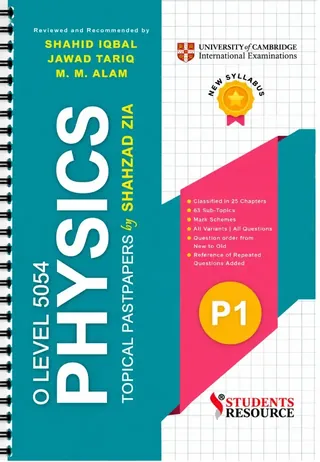
O Level Physics 5054 Topical Past Papers Paper 1 (2027-28)
Rs 1,480 Rs 1,650

Chemistry for Cambridge O Level by Derek McMonagle, Third Edition, Peak Publishing, for the June and November 2027 and 2028 exam series: 13 chapters, each with key points and past-paper questions.
ISBN: 1845221877
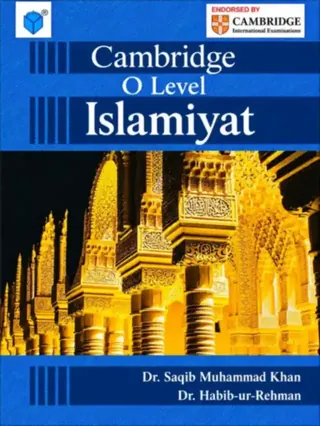
Chemistry for Cambridge O Level, Third Edition by Derek McMonagle (Peak Publishing) is a full O Level Chemistry textbook. The cover carries the Cambridge Assessment International Education mark "Endorsed for full syllabus coverage". It has 13 chapters, from States of matter to Experimental techniques and chemical analysis, and each chapter ends with key points and past-paper questions. This page is written for students sitting the June and November 2027 and 2028 exam series. Exams Book House, Shop Number 4, Al Fazal Market, Urdu Bazar, Lahore, supplies it with cash on delivery across Pakistan and delivery to the Gulf countries.
The book teaches the Cambridge O Level Chemistry course (syllabus code 5070) in the order of the usual classroom year: first the physical chemistry (states of matter, atoms, bonding, the mole, electrochemistry, energy changes and reaction rates), then inorganic chemistry (acids, bases and salts, the Periodic Table, metals) and then the chemistry of the environment, organic chemistry and the practical skills a candidate needs.
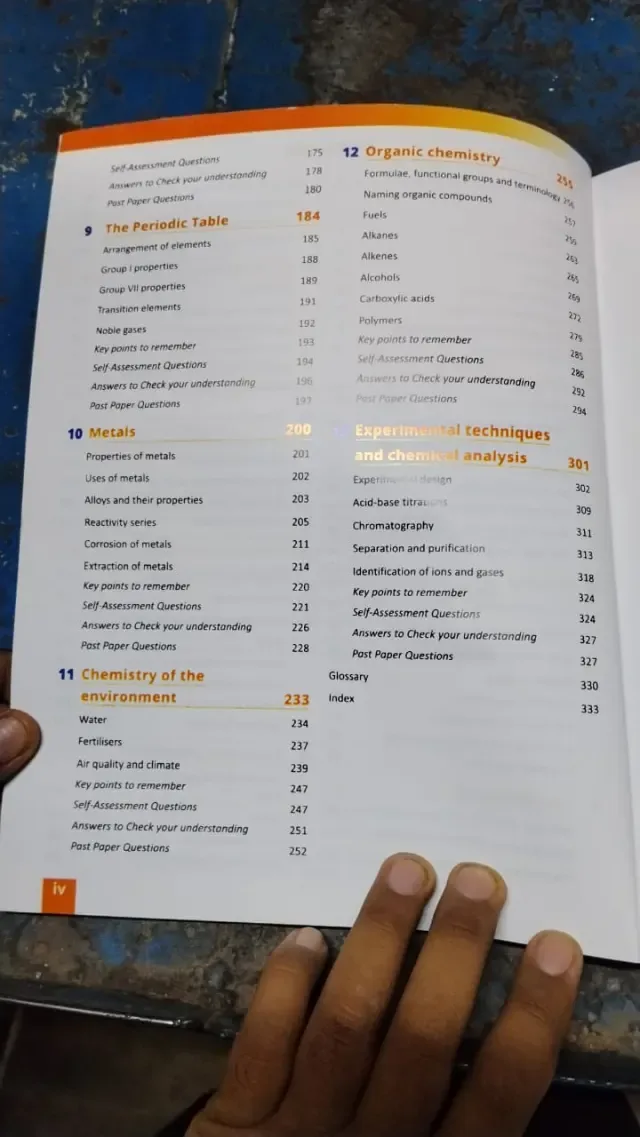
Every chapter follows one pattern, which the contents page shows clearly: the teaching sections, then Key points to remember, Self-Assessment Questions, Answers to Check your understanding and Past Paper Questions. A student can read, test himself or herself, check the answers and then try real exam questions in one place.
The page numbers below are copied from our photographs. A dash means the number is faded or hidden in the curve of the page.
| Ch. | Chapter and sections | Page |
|---|---|---|
| Information about this book for the students | iv | |
| 1 | States of matter | 1 |
| States of matter | 2 | |
| Diffusion | 12 | |
| Key points to remember | 18 | |
| Self-Assessment Questions | 18 | |
| Answers to Check your understanding | 22 | |
| Past Paper Questions | 24 | |
| 2 | Atoms, elements and compounds | 25 |
| Elements, compounds and mixtures | 26 | |
| Atomic structure and the Periodic Table | 28 | |
| Isotopes | 33 | |
| Key points to remember | 35 | |
| Self-Assessment Questions | 35 | |
| Answers to Check your understanding | 38 | |
| Past Paper Questions | 39 | |
| 3 | Bonding | — |
| Ion and ionic bonds | — | |
| Simple molecules and covalent bonds | — | |
| Giant covalent structures | — | |
| Metallic bonding | — | |
| Key points to remember | 51 | |
| Self-Assessment Questions | 52 | |
| Answers to Check your understanding | 53 | |
| Past Paper Questions | 54 | |
| 4 | Stoichiometry | 57 |
| Formulae | 58 | |
| Relative masses of atoms and molecules | 64 | |
| The mole and the Avogadro constant | 65 | |
| 5 | Electrochemistry (electrolysis; hydrogen-oxygen fuel cells; key points, questions, answers, past papers) | — |
| 6 | Chemical energetics (exothermic and endothermic reactions; key points, questions, answers, past papers) | — |
| 7 | Chemical reactions (physical and chemical changes; rate of reaction; reversible reactions and equilibrium) | — |
| 8 | Acids, bases and salts (the characteristic properties of acids and bases; oxides; preparation of salts) | — |
| 8 | Self-Assessment Questions / Answers / Past Paper Questions (end of chapter) | 175 / 178 / 180 |
| 9 | The Periodic Table | 184 |
| Arrangement of elements | 185 | |
| Group I properties | 188 | |
| Group VII properties | 189 | |
| Transition elements | 191 | |
| Noble gases | 192 | |
| Key points to remember | 193 | |
| Self-Assessment Questions | 194 | |
| Answers to Check your understanding | 196 | |
| Past Paper Questions | 197 | |
| 10 | Metals | 200 |
| Properties of metals | 201 | |
| Uses of metals | 202 | |
| Alloys and their properties | 203 | |
| Reactivity series | 205 | |
| Corrosion of metals | 211 | |
| Extraction of metals | 214 | |
| Key points to remember | 220 | |
| Self-Assessment Questions | 221 | |
| Answers to Check your understanding | 226 | |
| Past Paper Questions | 228 | |
| 11 | Chemistry of the environment | 233 |
| Water | 234 | |
| Fertilisers | 237 | |
| Air quality and climate | 239 | |
| Key points to remember | 247 | |
| Self-Assessment Questions | 247 | |
| Answers to Check your understanding | 251 | |
| Past Paper Questions | 252 | |
| 12 | Organic chemistry (formulae, functional groups and terminology; naming organic compounds; fuels; alkanes; alkenes; alcohols; carboxylic acids; polymers; key points, questions, answers, past papers) | — |
| 13 | Experimental techniques and chemical analysis | 301 |
| Experimental design | 302 | |
| Acid-base titrations | 309 | |
| Chromatography | 311 | |
| Separation and purification | 313 | |
| Identification of ions and gases | 318 | |
| Key points to remember | 324 | |
| Self-Assessment Questions | 324 | |
| Answers to Check your understanding | 327 | |
| Past Paper Questions | 327 | |
| Glossary | 330 | |
| Index | 333 |
Part 1 – Particles and bonding (chapters 1 to 4). Solids, liquids and gases, diffusion, atoms and isotopes, ionic, covalent and metallic bonding, formulae and the mole. These chapters are the base for every calculation later, so students who are weak in the mole usually struggle in electrolysis and titrations too.
Part 2 – Reactions (chapters 5 to 8). Electrolysis and fuel cells, heat changes, rate and equilibrium, and acids, bases and salts. The contents list "Preparation of salts" and "Oxides" in chapter 8, which are favourite exam topics.
Part 3 – The elements (chapters 9 to 11). The Periodic Table with Group I, Group VII, the transition elements and the noble gases; the reactivity series, corrosion and extraction of metals; water, fertilisers and air quality.
Part 4 – Carbon and practicals (chapters 12 and 13). Organic chemistry from alkanes to polymers, then experimental design, titrations, chromatography, separation and the tests for ions and gases, which prepare candidates for the practical paper and for Paper 6-style questions.
Who: O Level students who study Chemistry, in schools or privately, and teachers who need a clear class textbook. When: from the first year of the course until the exam. Many students read one chapter a week and then test with the past-paper pages. How to use the page numbers: use the numbers above to plan a revision timetable. For example, the whole Periodic Table chapter is pages 184 to 199, and Metals is pages 200 to 232.
Cambridge lists O Level Chemistry 5070 with a syllabus for the 2026–2028 exams, so this course covers the June and November 2027 and 2028 series. The cover says "Endorsed for full syllabus coverage", but syllabuses can change from one cycle to the next, so candidates for 2028 should check the syllabus changes with their teacher and on the Cambridge International website. We supply the newest edition; ask us which edition is current.
chemistry for cambridge o level third edition · derek mcmonagle o level chemistry · o level chemistry 5070 book · peak publishing chemistry · او لیول کیمسٹری · urdu bazar lahore o level books · o level 2027 2028 exams
It is a full course book for Cambridge O Level Chemistry (5070) with an "Endorsed for full syllabus coverage" mark on the cover. If your teacher names Derek McMonagle's Third Edition, this is the book. Candidates for 2028 should check syllabus changes with their teacher.
Yes. Each chapter ends with a Past Paper Questions section, after the Self-Assessment Questions and their answers.
Thirteen chapters, from States of matter to Experimental techniques and chemical analysis, plus a glossary and an index.
No. Both cover O Level Chemistry, but they are different books by different authors. Use the one your school or teacher asks for.
Yes. We deliver all over Pakistan with cash on delivery, and to the Gulf countries. Send your name, address and the book name on WhatsApp at 0317 4846676, or call the shop in Urdu Bazar, Lahore (Monday to Saturday, 9 AM – 9 PM).