Class 7 Suraj Mukhi Urdu Ka Guldasta (Oxford 3rd Ed.) (2027-28)
Oxford University Press
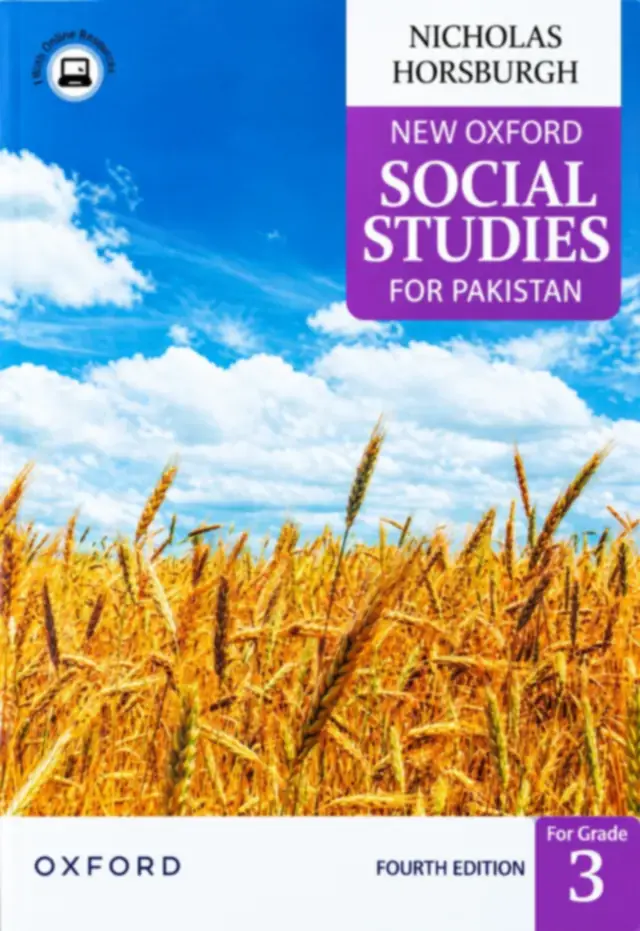
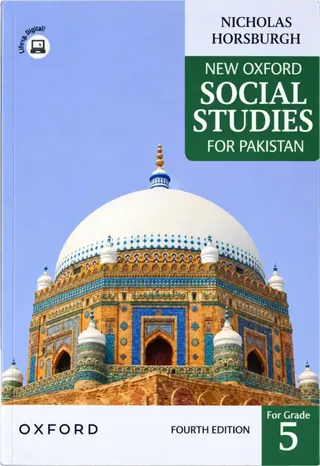
"New Oxford Social Studies for Pakistan 3 (Fourth Edition) by Nicholas Horsburgh, the primary social studies textbook for Class 3 for session 2027-28: six comprehensive units covering geography, citizenship, work and money, culture, settlements, and history."
New Oxford Social Studies for Pakistan Book 3 (Fourth Edition) by Nicholas Horsburgh is the primary social studies textbook for Class 3 (Grade 3) students in English-medium schools across Pakistan. Published by Oxford University Press, it introduces intermediate primary learners to planetary geography, Pakistani climate, citizenship duties, public services, economic fundamentals, cultural celebrations, civic communities, and historical leaders. This page is written for the 2027-28 session.
Exams Book House, Shop Number 4, Al Fazal Market, Urdu Bazar, Lahore, supplies it with cash on delivery across Pakistan and delivery to the Gulf countries.
New Oxford Social Studies for Pakistan Book 3 marks an important transition from early personal awareness to formal social sciences. Nicholas Horsburgh structures the Class 3 textbook to introduce children to wider geographical, economic, and civic concepts while keeping explanations clear and visual. Students discover how our planet orbits within the solar system, how atmospheric climate differs from daily weather, how public utilities operate in Pakistani cities, and why economic resources must be managed carefully.
The curriculum is organized into six in-depth units. In Unit 1 (Geography), students learn about globes, continents, map keys, scales, and weather recording instruments. Unit 2 (Citizenship) explores public services, conflict resolution, traffic safety, and civic responsibilities. Unit 3 (Work and Money) introduces the evolution of money, banking, and the concept of economic scarcity. Unit 4 (Culture) investigates Gregorian and Lunar calendars alongside Pakistani festivals. Unit 5 (Where We Live) examines cityscapes, village communities, and pollution control (the Three Rs). Finally, Unit 6 (History and Rights) explores early human civilizations, the founding leaders of Pakistan (Quaid-e-Azam and Allama Iqbal), world religions, and fundamental human rights.
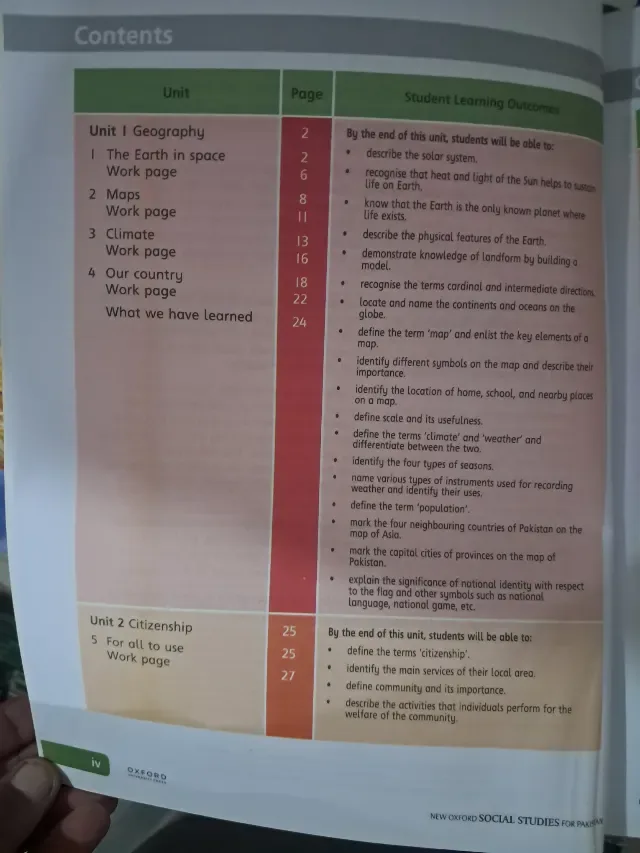
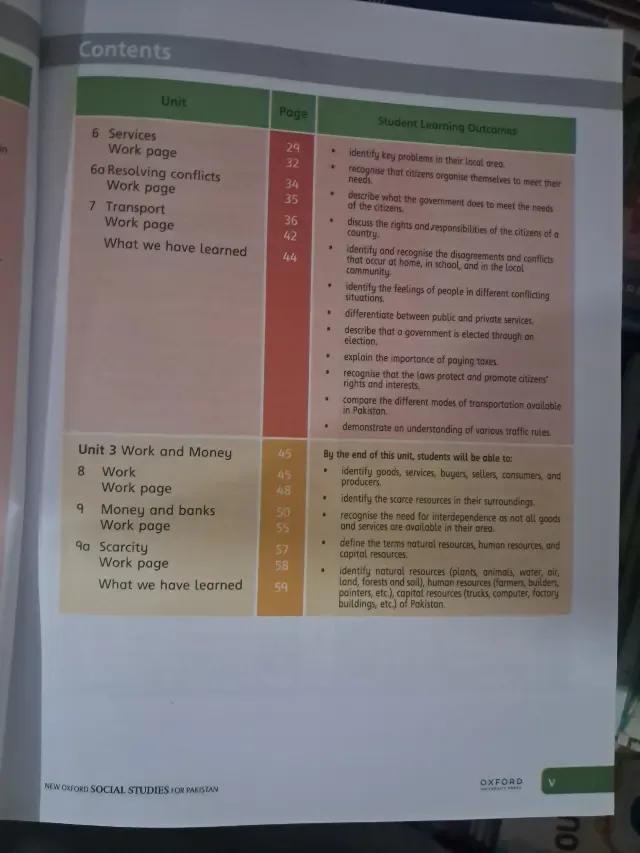
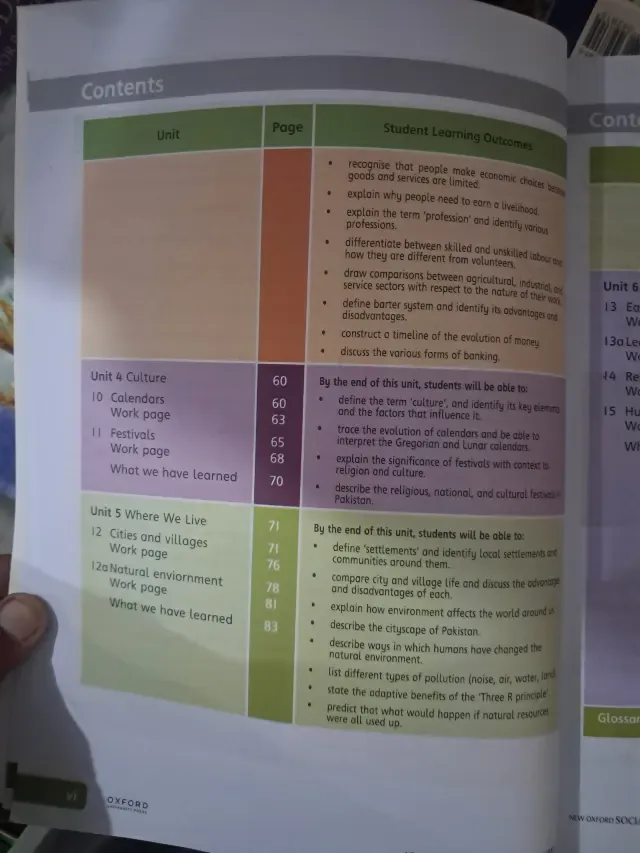
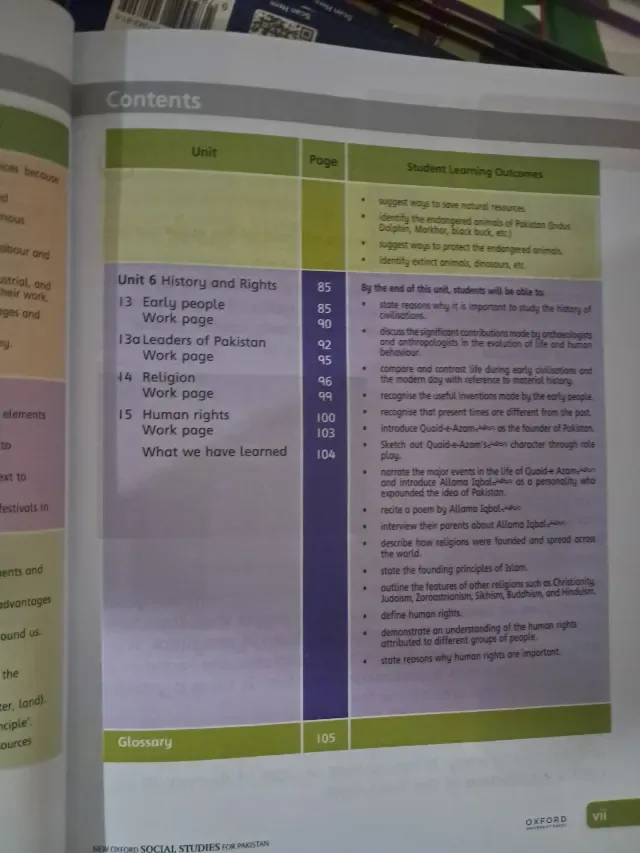
The table below transcribes every unit, lesson title, work page, review section, and reference page directly from the four printed contents pages photographed from the Fourth Edition book.
| Unit No. | Unit Title / Lesson Title | Page |
|---|---|---|
| Unit 1 | Geography | 2 |
| Lesson 1 | The Earth in space | 2 |
| — | Work page | 6 |
| Lesson 2 | Maps | 8 |
| — | Work page | 11 |
| Lesson 3 | Climate | 13 |
| — | Work page | 16 |
| Lesson 4 | Our country | 18 |
| — | Work page | 22 |
| Review | What we have learned | 24 |
| Unit 2 | Citizenship | 25 |
| Lesson 5 | For all to use | 25 |
| — | Work page | 27 |
| Lesson 6 | Services | 29 |
| — | Work page | 32 |
| Lesson 6a | Resolving conflicts | 34 |
| — | Work page | 35 |
| Lesson 7 | Transport | 36 |
| — | Work page | 42 |
| Review | What we have learned | 44 |
| Unit 3 | Work and Money | 45 |
| Lesson 8 | Work | 45 |
| — | Work page | 48 |
| Lesson 9 | Money and banks | 50 |
| — | Work page | 55 |
| Lesson 9a | Scarcity | 57 |
| — | Work page | 58 |
| Review | What we have learned | 59 |
| Unit 4 | Culture | 60 |
| Lesson 10 | Calendars | 60 |
| — | Work page | 63 |
| Lesson 11 | Festivals | 65 |
| — | Work page | 68 |
| Review | What we have learned | 70 |
| Unit 5 | Where We Live | 71 |
| Lesson 12 | Cities and villages | 71 |
| — | Work page | 76 |
| Lesson 12a | Natural environment | 78 |
| — | Work page | 81 |
| Review | What we have learned | 83 |
| Unit 6 | History and Rights | 85 |
| Lesson 13 | Early people | 85 |
| — | Work page | 90 |
| Lesson 13a | Leaders of Pakistan | 92 |
| — | Work page | 95 |
| Lesson 14 | Religion | 96 |
| — | Work page | 99 |
| Lesson 15 | Human rights | 100 |
| — | Work page | 103 |
| Review | What we have learned | 104 |
| Reference | Glossary | 105 |
Unit 1 establishes formal geography fundamentals. Students learn the structure of the solar system, understand how the Earth rotates on its axis and orbits the Sun, identify continents and oceans on world globes, and learn how to interpret map symbols, keys, and cardinal scales. They also explore weather recording devices (thermometer, barometer, rain gauge, wind vane) and differentiate between short-term weather and long-term regional climate.
Units 2 and 3 provide practical civic education. Students explore municipal services (clean drinking water, electricity, sanitation, emergency rescue), practice conflict mediation strategies, review road transit safety laws, and study financial basics including the barter system, currency notes, commercial banking functions, and resource scarcity.
Units 4, 5, and 6 examine the human story. Children study how solar Gregorian and lunar Hijri calendars track seasons and religious occasions (Eid-ul-Fitr, Eid-ul-Azha, Independence Day). They analyze urban versus rural living conditions, learn environmental conservation strategies (Reduce, Reuse, Recycle), explore Stone Age civilization tools, study the biographical contributions of Quaid-e-Azam Muhammad Ali Jinnah and Allama Muhammad Iqbal, and understand foundational human rights principles.
This book is intended for Class 3 (Grade 3) children aged 7 to 9 years in English-medium private schools, army public schools, semi-government academies, and Cambridge primary campuses throughout Pakistan.
Schools typically teach Units 1, 2, and 3 during the first school term (April to September), focusing on planetary geography, citizenship rules, public transport, and economics. Units 4, 5, and 6 are studied during the second term (October to March), covering culture, environmental conservation, early civilizations, Quaid-e-Azam, and human rights in preparation for annual examinations.
Yes. If your school's prescribed booklist for Class 3 specifies Nicholas Horsburgh's New Oxford Social Studies for Pakistan Book 3 (Fourth Edition), this is the accurate and prescribed textbook for the 2027-28 academic session. Oxford University Press maintains this Fourth Edition as the current publication standard. If you want to verify your school's requirements, send a photo of your booklist to our Urdu Bazar bookshop on WhatsApp at 0317 4846676.
new oxford social studies 3 · nicholas horsburgh class 3 social studies · oxford social studies grade 3 fourth edition · class 3 sst book oxford · urdu bazar lahore school books · primary school books lahore
Yes. New Oxford Social Studies for Pakistan Book 3 (Fourth Edition) is completely valid and recommended for the 2027-28 academic session in English-medium private schools nationwide.
The book contains 6 major units: Geography, Citizenship, Work and Money, Culture, Where We Live, and History and Rights, spanning 18 lessons and 105 pages with a comprehensive glossary.
Yes. Unit 6 (Lesson 13a, pages 92-95) covers the leaders of Pakistan, focusing on Quaid-e-Azam Muhammad Ali Jinnah and Allama Muhammad Iqbal, their character, role in the founding of Pakistan, and poetry recitation.
If your school's 2027-28 booklist prescribes New Oxford Social Studies Book 3 Fourth Edition by Nicholas Horsburgh, this is the exact textbook. Send your list to our WhatsApp number 0317 4846676 to verify.
Yes, all over Pakistan with cash on delivery, and to the Gulf countries. Contact Exams Book House on WhatsApp at 0317 4846676.\n