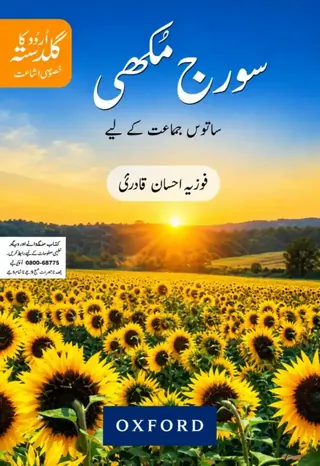
Class 7 Suraj Mukhi Urdu Ka Guldasta (Oxford 3rd Ed.) (2027-28)
Oxford University Press
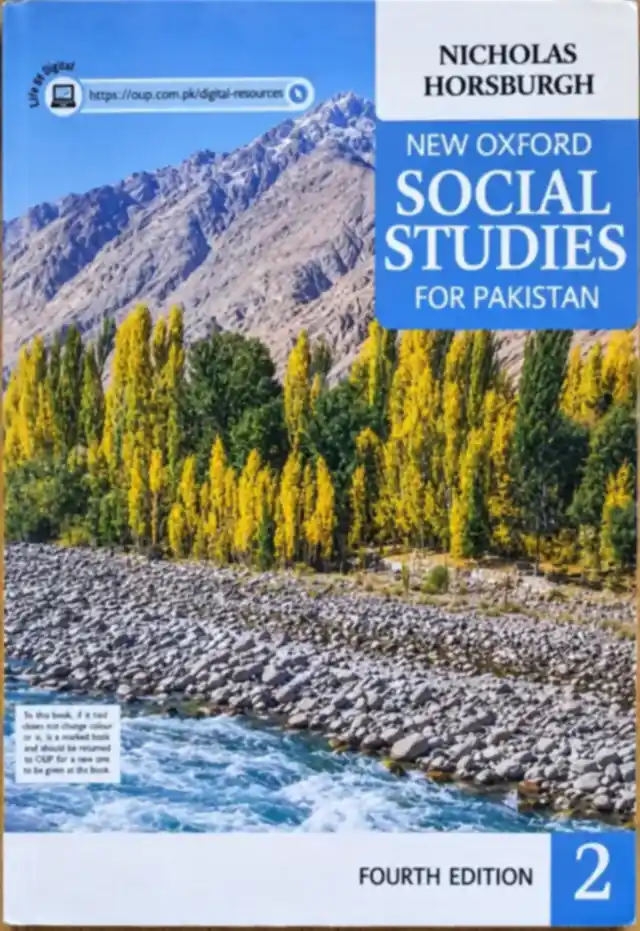
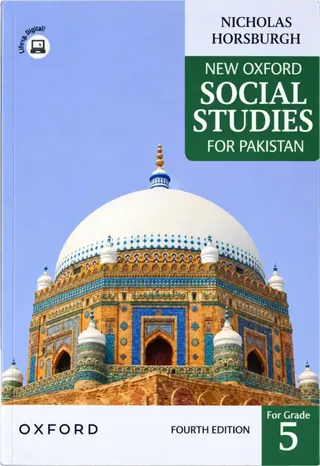
"New Oxford Social Studies for Pakistan 2 (Fourth Edition) by Nicholas Horsburgh, the primary social studies textbook for Class 2 for session 2027-28: eight core units covering family, habits, food, buildings, time, places, plants, and geography."
New Oxford Social Studies for Pakistan Book 2 (Fourth Edition) by Nicholas Horsburgh is the primary social studies textbook for Class 2 (Grade 2) students in English-medium schools across Pakistan. Published by Oxford University Press, it guides seven-year-old learners through family routines, school community rules, food sources, building construction, clocks and directions, civic institutions, habitats, and Pakistani geography. This page is written for the 2027-28 session.
Exams Book House, Shop Number 4, Al Fazal Market, Urdu Bazar, Lahore, supplies it with cash on delivery across Pakistan and delivery to the Gulf countries.
New Oxford Social Studies for Pakistan Book 2 builds seamlessly on the foundational skills acquired in Class 1. Nicholas Horsburgh expands the young student's horizons from personal identity into community systems, time management, spatial geography, and environmental stewardship. The textbook blends accessible English text, detailed full-color illustrations, and realistic photographic scenes depicting daily life in Pakistani towns, villages, and natural landscapes.
The syllabus is divided into eight clearly defined units. In Book 2, children learn to interpret chronological timelines through family narratives (such as Mr. Raza Ali's daily work schedule), understand rules that keep school communities orderly, trace where food crops and clothing fabrics originate, examine building materials used to construct houses, and learn fundamental navigation concepts like reading a clock and identifying cardinal directions. Each lesson concludes with an activity-rich work page that tests comprehension, spatial reasoning, and creative expression.
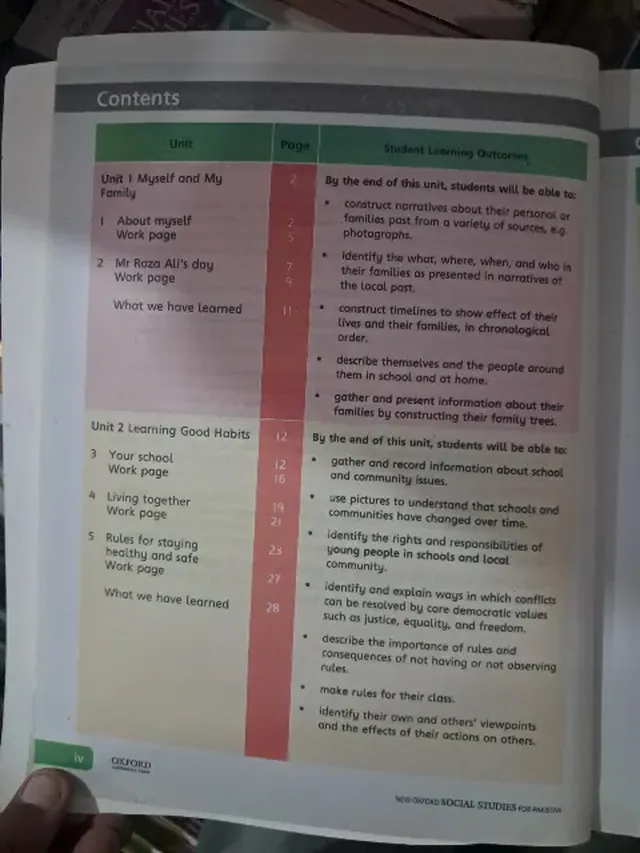
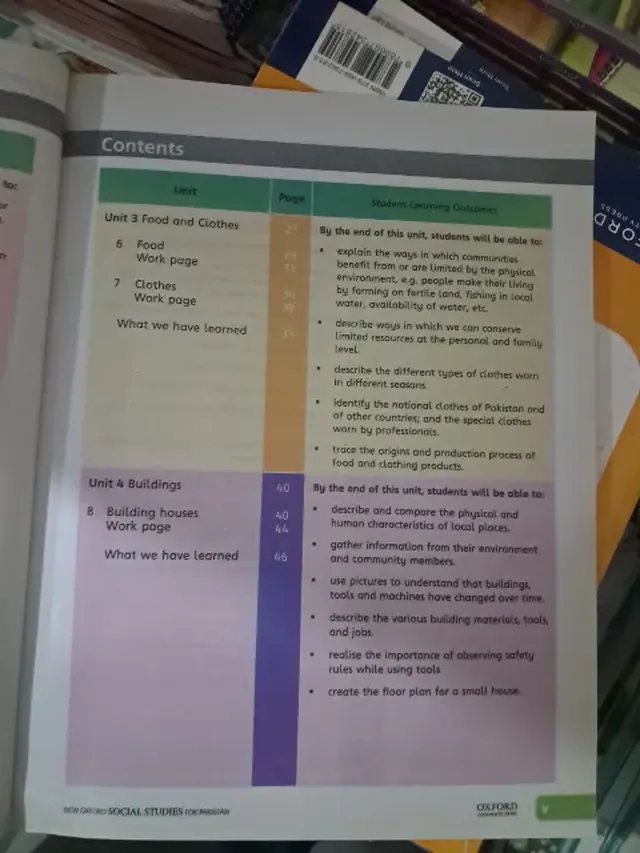
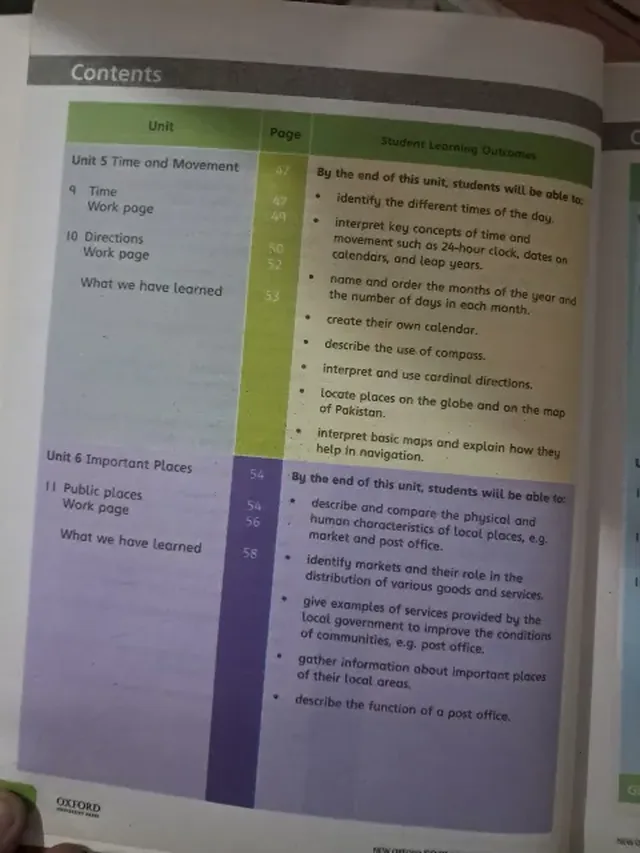
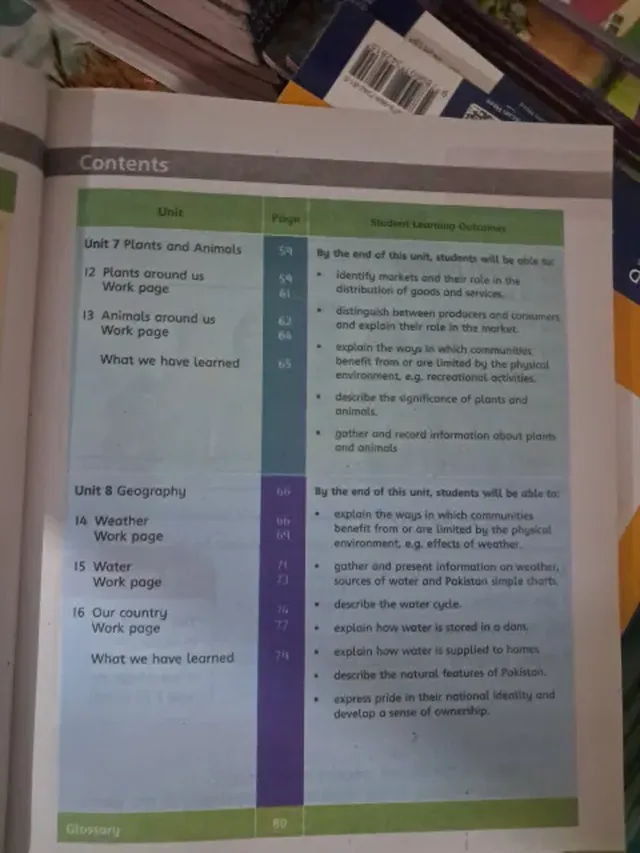
The table below transcribes every unit, lesson title, work page, summary review, and reference section directly from the four printed contents pages photographed from the Fourth Edition book.
| Unit No. | Unit Title / Lesson Title | Page |
|---|---|---|
| Unit 1 | Myself and My Family | 2 |
| Lesson 1 | About myself | 2 |
| — | Work page | 5 |
| Lesson 2 | Mr Raza Ali's day | 7 |
| — | Work page | 9 |
| Review | What we have learned | 11 |
| Unit 2 | Learning Good Habits | 12 |
| Lesson 3 | Your school | 12 |
| — | Work page | 16 |
| Lesson 4 | Living together | 19 |
| — | Work page | 21 |
| Lesson 5 | Rules for staying healthy and safe | 23 |
| — | Work page | 27 |
| Review | What we have learned | 28 |
| Unit 3 | Food and Clothes | 29 |
| Lesson 6 | Food | 29 |
| — | Work page | 33 |
| Lesson 7 | Clothes | 34 |
| — | Work page | 38 |
| Review | What we have learned | 39 |
| Unit 4 | Buildings | 40 |
| Lesson 8 | Building houses | 40 |
| — | Work page | 44 |
| Review | What we have learned | 46 |
| Unit 5 | Time and Movement | 47 |
| Lesson 9 | Time | 47 |
| — | Work page | 49 |
| Lesson 10 | Directions | 50 |
| — | Work page | 52 |
| Review | What we have learned | 53 |
| Unit 6 | Important Places | 54 |
| Lesson 11 | Public places | 54 |
| — | Work page | 56 |
| Review | What we have learned | 58 |
| Unit 7 | Plants and Animals | 59 |
| Lesson 12 | Plants around us | 59 |
| — | Work page | 61 |
| Lesson 13 | Animals around us | 62 |
| — | Work page | 64 |
| Review | What we have learned | 65 |
| Unit 8 | Geography | 66 |
| Lesson 14 | Weather | 66 |
| — | Work page | 69 |
| Lesson 15 | Water | 71 |
| — | Work page | 73 |
| Lesson 16 | Our country | 74 |
| — | Work page | 77 |
| Review | What we have learned | 79 |
| Reference | Glossary | 80 |
In Lesson 2 ('Mr Raza Ali's day'), pupils examine how a working professional schedules his hours from morning until night. This practical narrative introduces seven-year-olds to the concept of time passage, hourly sequences, and career responsibility, preparing them for the formal time and clock units in Unit 5.
Units 3 and 4 teach children where everyday essentials come from. In 'Food', students trace agricultural crops from farms to dining tables. In 'Clothes', they learn about seasonal fabrics like cotton in summer and wool in winter. In 'Building houses', children discover construction materials including bricks, cement, wood, steel, and the skilled tradesmen who construct secure buildings.
Unit 5 ('Time and Movement') and Unit 8 ('Geography') introduce basic cartography and directional orientation. Students learn to read analog clock faces, identify calendar months, use cardinal directions (North, South, East, West), understand weather charts, trace the water cycle, and locate the key geographical regions of Pakistan.
This textbook is written for Class 2 (Grade 2) students typically aged 6 to 8 years in English-medium private schools across Pakistan.
Academic terms are usually structured with Units 1 through 4 covered in the first semester (April to September), focusing on family, school habits, nutrition, and home construction. Units 5 through 8 follow in the second semester (October to March), covering clock time, directions, public facilities, flora and fauna, weather systems, and national geography before annual school examinations.
Yes. If your school's prescribed syllabus for Class 2 lists Nicholas Horsburgh's New Oxford Social Studies for Pakistan Book 2 (Fourth Edition), this is the authentic, current edition for the 2027-28 academic session. Oxford University Press provides this edition to meet the latest Single National Curriculum requirements. To double-check edition requirements against your school's booklist, reach out to Exams Book House via WhatsApp at 0317 4846676.
new oxford social studies 2 · nicholas horsburgh class 2 social studies · oxford social studies grade 2 fourth edition · class 2 sst book oxford · urdu bazar lahore school books · primary school textbooks lahore
Yes. New Oxford Social Studies for Pakistan Book 2 Fourth Edition is the official, current edition for Class 2 during the 2027-28 academic session.
The textbook contains 8 units and 16 lessons, accompanied by 16 full work pages, 8 unit review pages, and a comprehensive picture glossary on page 80.
Yes. Unit 5 (Lesson 10) explicitly teaches cardinal directions (North, South, East, West) and basic navigation, while Unit 8 covers weather maps, water resources, and the physical geography of Pakistan.
If your school's 2027-28 booklist lists New Oxford Social Studies 2 Fourth Edition by Nicholas Horsburgh, this is the exact textbook prescribed. You can confirm by sending your booklist on WhatsApp to 0317 4846676.
Yes, all over Pakistan with cash on delivery, and to the Gulf countries. Contact Exams Book House via WhatsApp on 0317 4846676 to place your order.\n