Class 9 Unique Notes Biology – Federal Board (2027-28)
Unique Publications (Unique Group of Institutions, Lahore)
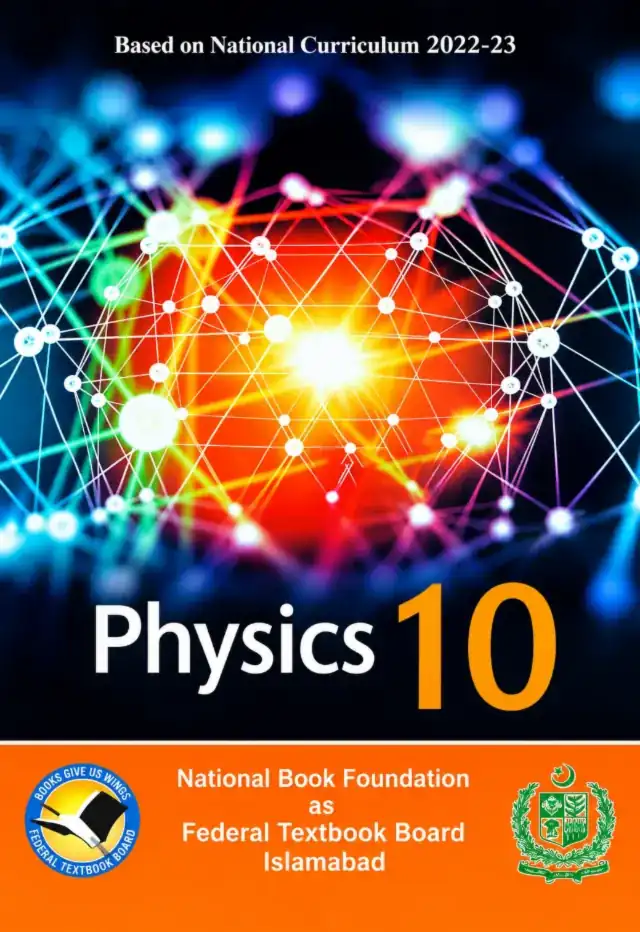
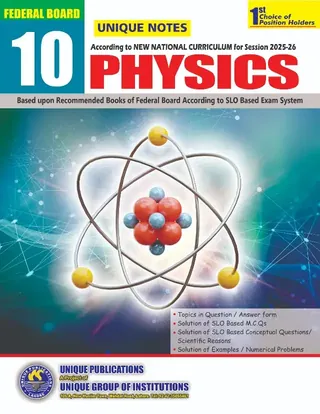
Physics 10, the National Book Foundation textbook for Federal Board Class 10 (National Curriculum 2022-23) for session 2027-28: twelve units from heat transfer and waves to electronics and nuclear physics, 111 numbered topics, glossary and index.
Physics 10 is the National Book Foundation textbook for Federal Board Class 10 students, printed "as Federal Textbook Board, Islamabad" and "based on National Curriculum 2022-23". Its twelve units are numbered 10 to 21 and run from Heat Capacity and Modes of Heat Transfer (page 11) to Nuclear Physics (page 309), followed by a glossary, index, bibliography and authors' profile. This page is for the 2027-28 session. Exam Book House, Shop Number 4, Al Fazal Market, Urdu Bazar, Lahore, supplies it with cash on delivery across Pakistan and delivery to the Gulf countries.
A Federal Board science textbook is not a guide or a set of notes. It is the official course text that the class teacher teaches from, and the one that the chapter exercises, the board's paper makers and the school tests all follow. This one is the Class 10 physics book built on the 2022-23 National Curriculum. Its units are numbered 10 to 21, so the first unit you meet is Unit 10, not Unit 1.
The topics are the ones a Class 10 science student needs for the second year of the secondary stage: heat, waves and sound, light, the whole of electricity from static charge to household wiring, electronics, magnetism and the structure of the nucleus. A student who prefers a short reminder can use the Summary at the end of each unit; the Exercise after it is where the practice lives.
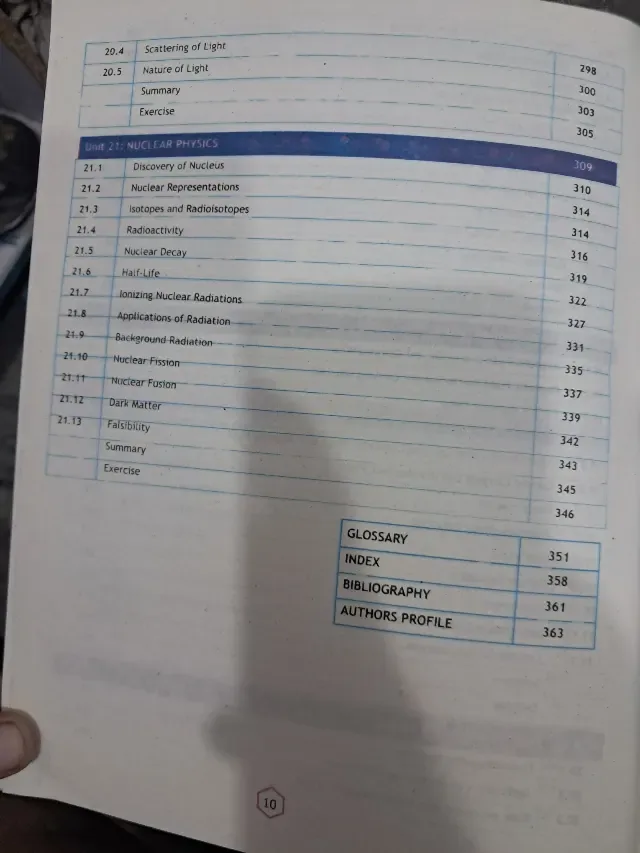
Each line gives the section number, its title and the page where it begins. Where a Summary and an Exercise are listed they close the unit.
| Section | Title | Page |
|---|---|---|
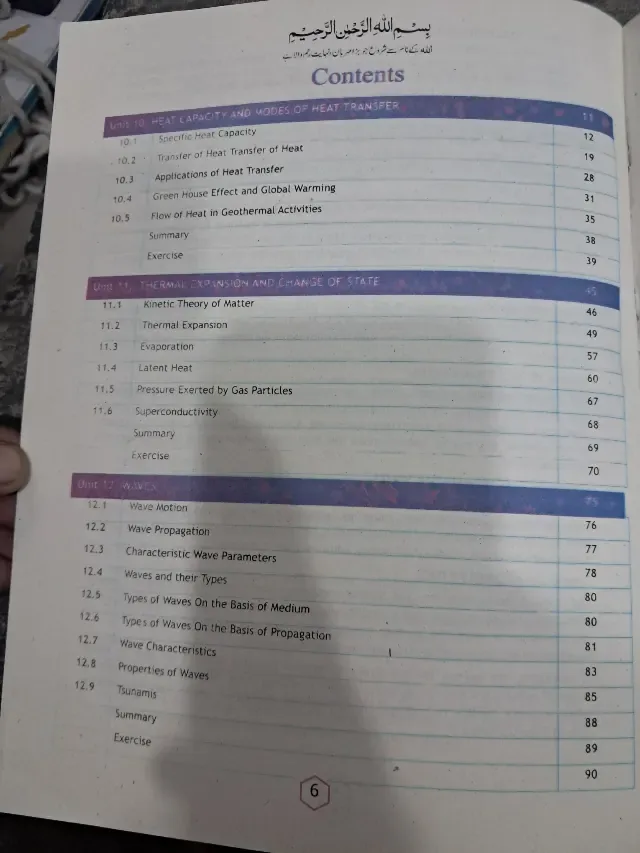
| Unit 10 | Heat Capacity and Modes of Heat Transfer | 11 |
| 10.1 | Specific Heat Capacity | 12 |
| 10.2 | Transfer of Heat | 19 |
| 10.3 | Applications of Heat Transfer | 28 |
| 10.4 | Green House Effect and Global Warming | 31 |
| 10.5 | Flow of Heat in Geothermal Activities | 35 |
| Summary | 38 | |
| Exercise | 39 | |
| Unit 11 | Thermal Expansion and Change of State | 45 |
| 11.1 | Kinetic Theory of Matter | 46 |
| 11.2 | Thermal Expansion | 49 |
| 11.3 | Evaporation | 57 |
| 11.4 | Latent Heat | 60 |
| 11.5 | Pressure Exerted by Gas Particles | 67 |
| 11.6 | Superconductivity | 68 |
| Summary | 69 | |
| Exercise | 70 | |
| Unit 12 | Waves | 75 |
| 12.1 | Wave Motion | 76 |
| 12.2 | Wave Propagation | 77 |
| 12.3 | Characteristic Wave Parameters | 78 |
| 12.4 | Waves and their Types | 80 |
| 12.5 | Types of Waves on the Basis of Medium | 80 |
| 12.6 | Types of Waves on the Basis of Propagation | 81 |
| 12.7 | Wave Characteristics | 83 |
| 12.8 | Properties of Waves | 85 |
| 12.9 | Tsunamis | 88 |
| Summary | 89 | |
| Exercise | 90 | |
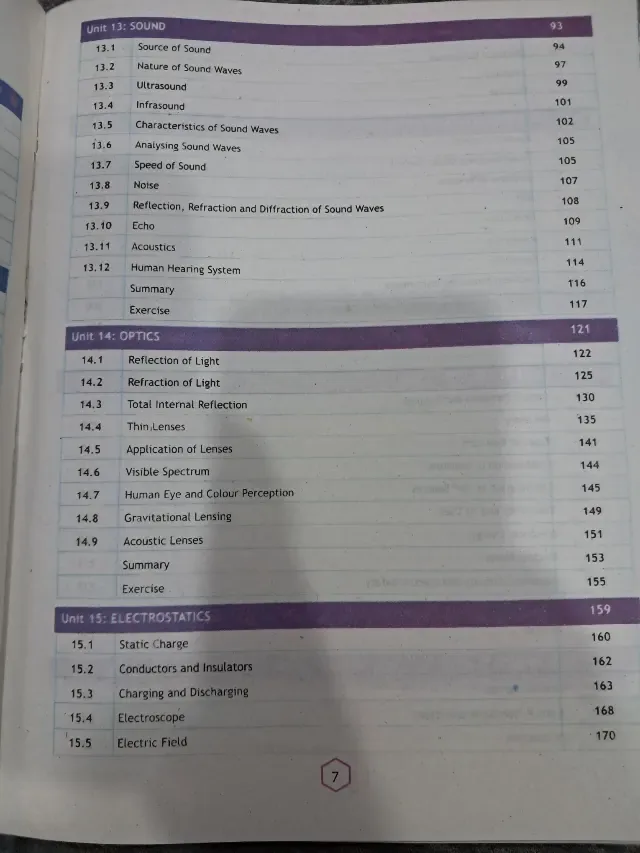
| Unit 13 | Sound | 93 |
| 13.1 | Source of Sound | 94 |
| 13.2 | Nature of Sound Waves | 97 |
| 13.3 | Ultrasound | 99 |
| 13.4 | Infrasound | 101 |
| 13.5 | Characteristics of Sound Waves | 102 |
| 13.6 | Analysing Sound Waves | 105 |
| 13.7 | Speed of Sound | 105 |
| 13.8 | Noise | 107 |
| 13.9 | Reflection, Refraction and Diffraction of Sound Waves | 108 |
| 13.10 | Echo | 109 |
| 13.11 | Acoustics | 111 |
| 13.12 | Human Hearing System | 114 |
| Summary | 116 | |
| Exercise | 117 | |
| Unit 14 | Optics | 121 |
| 14.1 | Reflection of Light | 122 |
| 14.2 | Refraction of Light | 125 |
| 14.3 | Total Internal Reflection | 130 |
| 14.4 | Thin Lenses | 135 |
| 14.5 | Application of Lenses | 141 |
| 14.6 | Visible Spectrum | 144 |
| 14.7 | Human Eye and Colour Perception | 145 |
| 14.8 | Gravitational Lensing | 149 |
| 14.9 | Acoustic Lenses | 151 |
| Summary | 153 | |
| Exercise | 155 | |
| Unit 15 | Electrostatics | 159 |
| 15.1 | Static Charge | 160 |
| 15.2 | Conductors and Insulators | 162 |
| 15.3 | Charging and Discharging | 163 |
| 15.4 | Electroscope | 168 |
| 15.5 | Electric Field | 170 |
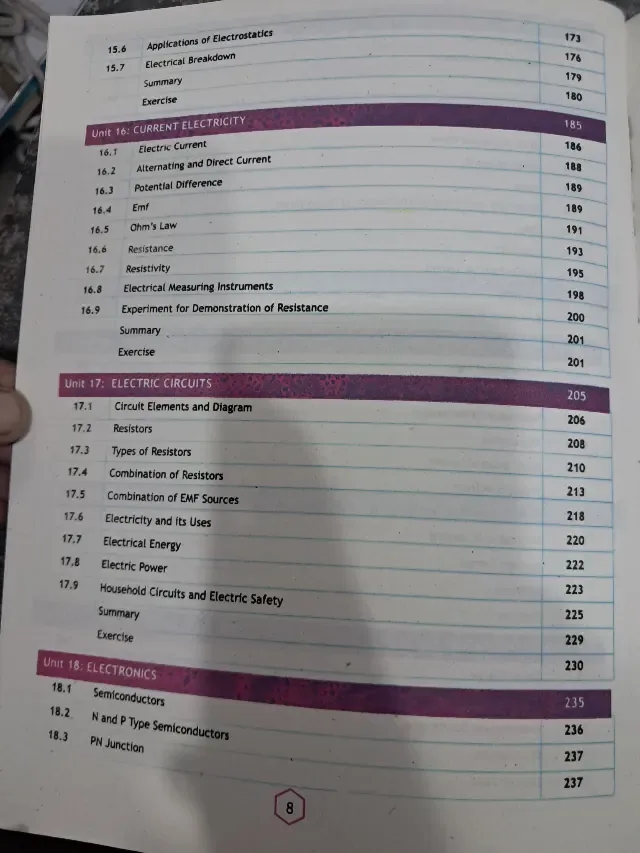
| 15.6 | Applications of Electrostatics | 173 |
| 15.7 | Electrical Breakdown | 176 |
| Summary | 179 | |
| Exercise | 180 | |
| Unit 16 | Current Electricity | 185 |
| 16.1 | Electric Current | 186 |
| 16.2 | Alternating and Direct Current | 188 |
| 16.3 | Potential Difference | 189 |
| 16.4 | Emf | 189 |
| 16.5 | Ohm's Law | 191 |
| 16.6 | Resistance | 193 |
| 16.7 | Resistivity | 195 |
| 16.8 | Electrical Measuring Instruments | 198 |
| 16.9 | Experiment for Demonstration of Resistance | 200 |
| Summary | 201 | |
| Exercise | 201 | |
| Unit 17 | Electric Circuits | 205 |
| 17.1 | Circuit Elements and Diagram | 206 |
| 17.2 | Resistors | 208 |
| 17.3 | Types of Resistors | 210 |
| 17.4 | Combination of Resistors | 213 |
| 17.5 | Combination of EMF Sources | 218 |
| 17.6 | Electricity and its Uses | 220 |
| 17.7 | Electrical Energy | 222 |
| 17.8 | Electric Power | 223 |
| 17.9 | Household Circuits and Electric Safety | 225 |
| Summary | 229 | |
| Exercise | 230 | |
| Unit 18 | Electronics | 235 |
| 18.1 | Semiconductors | 236 |
| 18.2 | N and P Type Semiconductors | 237 |
| 18.3 | PN Junction | 237 |
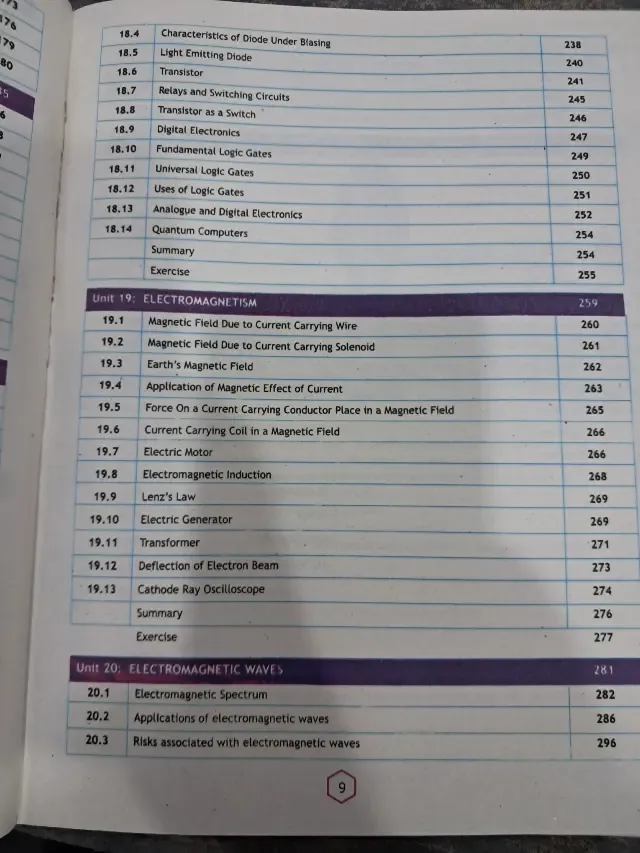
| 18.4 | Characteristics of Diode Under Biasing | 238 |
| 18.5 | Light Emitting Diode | 240 |
| 18.6 | Transistor | 241 |
| 18.7 | Relays and Switching Circuits | 245 |
| 18.8 | Transistor as a Switch | 246 |
| 18.9 | Digital Electronics | 247 |
| 18.10 | Fundamental Logic Gates | 249 |
| 18.11 | Universal Logic Gates | 250 |
| 18.12 | Uses of Logic Gates | 251 |
| 18.13 | Analogue and Digital Electronics | 252 |
| 18.14 | Quantum Computers | 254 |
| Summary | 254 | |
| Exercise | 255 | |
| Unit 19 | Electromagnetism | 259 |
| 19.1 | Magnetic Field Due to Current Carrying Wire | 260 |
| 19.2 | Magnetic Field Due to Current Carrying Solenoid | 261 |
| 19.3 | Earth's Magnetic Field | 262 |
| 19.4 | Application of Magnetic Effect of Current | 263 |
| 19.5 | Force on a Current Carrying Conductor Placed in a Magnetic Field | 265 |
| 19.6 | Current Carrying Coil in a Magnetic Field | 266 |
| 19.7 | Electric Motor | 266 |
| 19.8 | Electromagnetic Induction | 268 |
| 19.9 | Lenz's Law | 269 |
| 19.10 | Electric Generator | 269 |
| 19.11 | Transformer | 271 |
| 19.12 | Deflection of Electron Beam | 273 |
| 19.13 | Cathode Ray Oscilloscope | 274 |
| Summary | 276 | |
| Exercise | 277 | |
| Unit 20 | Electromagnetic Waves | 281 |
| 20.1 | Electromagnetic Spectrum | 282 |
| 20.2 | Applications of Electromagnetic Waves | 286 |
| 20.3 | Risks Associated with Electromagnetic Waves | 296 |
| 20.4 | Scattering of Light | 298 |
| 20.5 | Nature of Light | 300 |
| Summary | 303 | |
| Exercise | 305 | |
| Unit 21 | Nuclear Physics | 309 |
| 21.1 | Discovery of Nucleus | 310 |
| 21.2 | Nuclear Representations | 314 |
| 21.3 | Isotopes and Radioisotopes | 314 |
| 21.4 | Radioactivity | 316 |
| 21.5 | Nuclear Decay | 319 |
| 21.6 | Half-Life | 322 |
| 21.7 | Ionizing Nuclear Radiations | 327 |
| 21.8 | Applications of Radiation | 331 |
| 21.9 | Background Radiation | 335 |
| 21.10 | Nuclear Fission | 337 |
| 21.11 | Nuclear Fusion | 339 |
| 21.12 | Dark Matter | 342 |
| 21.13 | Falsifiability | 343 |
| Summary | 345 | |
| Exercise | 346 | |
| Glossary | 351 | |
| Index | 358 | |
| Bibliography | 361 | |
| Authors Profile | 363 |
The twelve units fall into four natural blocks, and it helps to study them as blocks.
Heat, matter and waves (units 10 to 12, pages 11–92). Heat capacity and the three ways heat moves, then how solids and liquids expand and change state, then the general idea of a wave. The section on the greenhouse effect and global warming (page 31) and the one on tsunamis (page 88) connect school physics to things children read in the news.
Sound and light (units 13 and 14, pages 93–158). Sound is treated from its source to the human ear, with separate sections on ultrasound, infrasound, noise, echo and acoustics. Optics covers reflection, refraction, total internal reflection, thin lenses and the eye. Two of its sections have unusual names, Gravitational Lensing and Acoustic Lenses, so read those with the teacher's notes.
Electricity (units 15 to 19, pages 159–280). The largest block. Static charge and the electroscope come first, then current, potential difference, resistance and Ohm's law, then circuits and household safety, then semiconductors, diodes, transistors and logic gates, and finally magnetic effects, motors, generators, the transformer and the cathode ray oscilloscope.
Light's nature and the nucleus (units 20 and 21, pages 281–350). The electromagnetic spectrum, its uses and risks, scattering and the nature of light, then the discovery of the nucleus, isotopes, radioactivity, half-life, fission and fusion, dark matter and falsifiability.
Federal Board books are reprinted regularly, and a new printing may carry corrections. We supply the newest printing we can get; the cover shown on this page says "Based on National Curriculum 2022-23". If your school asks for a particular printing, send a photo of your class teacher's list on WhatsApp and we will match it.
physics 10 federal board · class 10 physics nbf book · federal board physics book 2027-28 · ssc part 2 physics · national curriculum 2022-23 physics grade 10 · فیڈرل بورڈ فزکس دسویں جماعت · federal board books urdu bazar lahore · session 2027-28
If your child studies in a Federal Board school, Physics 10 from the National Book Foundation is the textbook for Class 10. Send your school's 2027-28 list on WhatsApp and we will check it against this cover.
Twelve units, numbered 10 to 21: heat transfer, thermal expansion, waves, sound, optics, electrostatics, current electricity, electric circuits, electronics, electromagnetism, electromagnetic waves and nuclear physics.
The contents list an Exercise at the end of every unit. We cannot say from the contents page whether answers are printed; ask your teacher for a key if you need one.
No. The 2nd Year Physics textbook is a separate, intermediate-level book. This one is for Class 10.
Yes. We deliver all over Pakistan with cash on delivery, and to the Gulf countries. Send your name, address and the book name on WhatsApp at 0317 4846676, or call the shop in Urdu Bazar, Lahore (Monday to Saturday, 9 AM – 9 PM).