Class 9 Unique Notes Biology – Federal Board (2027-28)
Unique Publications (Unique Group of Institutions, Lahore)
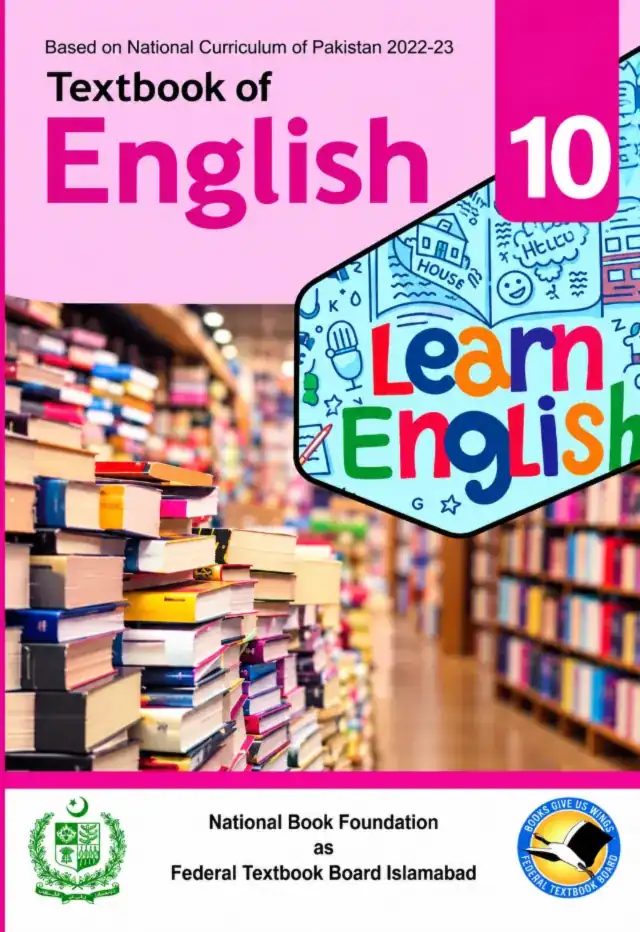
Textbook of English 10, the National Book Foundation course book for Federal Board Class 10 (National Curriculum of Pakistan 2022-23) for session 2027-28: 13 units that mix essays, stories, poems and a play with grammar, speaking and writing tasks.
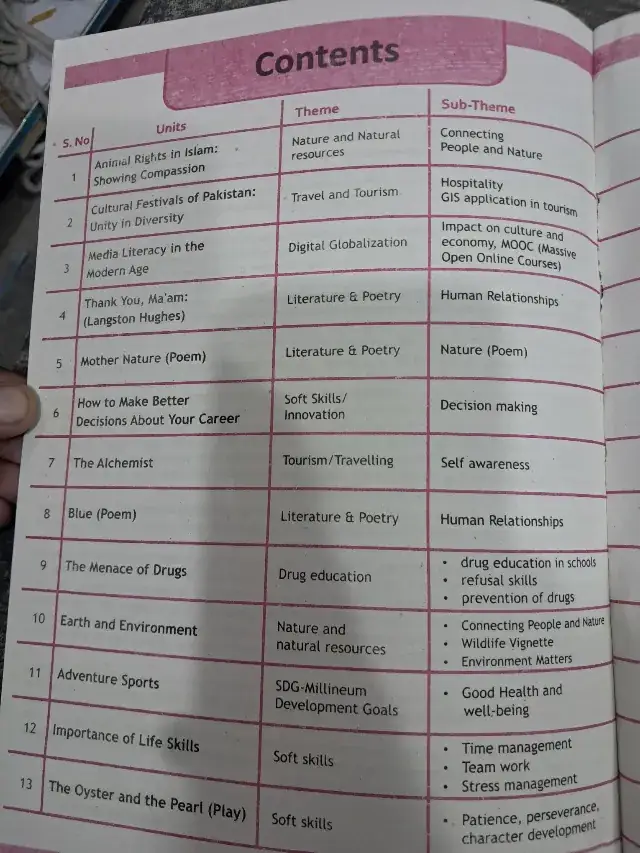
Textbook of English 10 is the National Book Foundation course book for Federal Board Class 10, printed "as Federal Textbook Board Islamabad" and "based on National Curriculum of Pakistan 2022-23". The contents list 13 units. They begin with Animal Rights in Islam: Showing Compassion on page 07 and end with the play The Oyster and the Pearl on page 154. This page is for the 2027-28 session. Exam Book House, Shop Number 4, Al Fazal Market, Urdu Bazar, Lahore, supplies it with cash on delivery across Pakistan and delivery to the Gulf countries.
Many older English textbooks are a bundle of chapters followed by a block of grammar. This one is organised the other way round. Every unit has a theme (for example Nature and Natural Resources, Digital Globalization or Soft Skills), a sub-theme, and then four strands that all grow out of the same unit: reading and critical thinking, vocabulary and grammar, oral communication and creative writing. In practice a student reads a text, learns the language points that the text uses, speaks about it and then writes something of their own.
The thirteen units mix kinds of writing. There are informative texts (animal rights, cultural festivals, media literacy, drugs, the environment, adventure sports), personal-development texts (career decisions, life skills), a short story, two poems and a play. That variety matters for exam preparation, because the board paper tests reading, grammar and writing, and a student who has met every kind of text in the book is more comfortable on the day.
| Unit | Title | Theme | Sub-theme | Starts on page |
|---|---|---|---|---|
| 1 | Animal Rights in Islam: Showing Compassion | Nature and Natural Resources | Connecting People and Nature | 07 |
| 2 | Cultural Festivals of Pakistan: Unity in Diversity | Travel and Tourism | Hospitality; GIS application in tourism | 22 |
| 3 | Media Literacy in the Modern Age | Digital Globalization | Impact on culture and economy; MOOC (Massive Open Online Courses) | 37 |
| 4 | Thank You, Ma'am (Langston Hughes) | Literature and Poetry | Human Relationships | 49 |
| 5 | Mother Nature (Poem) | Literature and Poetry | Nature (Poem) | 65 |
| 6 | How to Make Better Decisions About Your Career | Soft Skills / Innovation | Decision making | 77 |
| 7 | The Alchemist | Tourism / Travelling | Self awareness | 91 |
| 8 | Blue (Poem) | Literature and Poetry | Human Relationships | 100 |
| 9 | The Menace of Drugs | Drug education | Drug education in schools; refusal skills; prevention of drugs | 112 |
| 10 | Earth and Environment | Nature and Natural Resources | Connecting People and Nature; Wildlife Vignette; Environment Matters | 125 |
| 11 | Adventure Sports | SDG – Millennium Development Goals | Good Health and Well-being | 134 |
| 12 | Importance of Life Skills | Soft Skills | Time management; Team work; Stress management | 146 |
| 13 | The Oyster and the Pearl (Play) | Soft Skills | Patience, perseverance, character development | 154 |
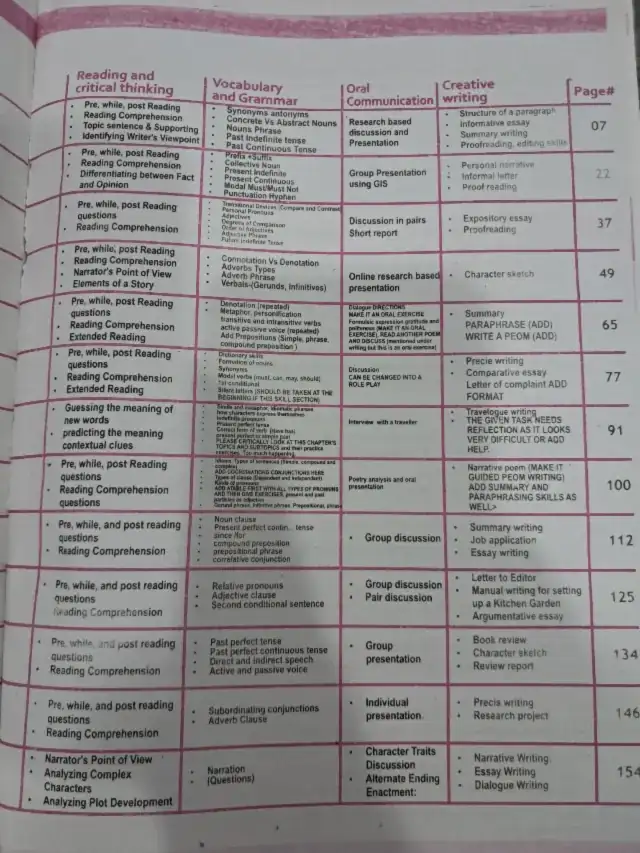
The second contents page lists the language work that goes with every unit. The most clearly printed items are these.
| Unit (page) | Reading and critical thinking | Vocabulary and grammar | Oral communication | Creative writing |
|---|---|---|---|---|
| 1 (07) | Pre, while and post reading; reading comprehension; topic sentence and supporting details; identifying the writer's viewpoint | Synonyms and antonyms; concrete and abstract nouns; noun phrase; past indefinite and past continuous tense | Research-based discussion and presentation | Structure of a paragraph; informative essay; summary writing; proofreading and editing |
| 2 (22) | Pre, while and post reading; comprehension; telling fact from opinion | Prefix and suffix; collective nouns; present indefinite and present continuous; modals must / must not; hyphen | Group presentation using GIS | Personal narrative; informal letter; proofreading |
| 3 (37) | Pre, while and post reading; comprehension questions | Transitional devices (compare and contrast); personal pronouns; adjectives, degrees of comparison and order of adjectives; adjective phrase; future indefinite tense | Discussion in pairs; short report | Expository essay; proofreading |
| 4 (49) | Pre, while and post reading; comprehension; narrator's point of view; elements of a story | Connotation and denotation; types of adverbs; adverb phrase; verbals (gerunds and infinitives) | Online-research-based presentation | Character sketch |
| 5 (65) | Pre, while and post reading questions; comprehension; extended reading | Denotation; metaphor and personification; transitive and intransitive verbs; active and passive voice; prepositions (simple, phrase, compound) | Dialogue practice | Summary; paraphrase; writing a poem |
| 6 (77) | Pre, while and post reading questions; comprehension; extended reading | Dictionary skills; formation of nouns; synonyms; modal verbs (must, can, may, should); first conditional; silent letters | Discussion; role play | Precis writing; comparative essay; letter of complaint |
| 7 (91) | Guessing the meaning of new words; predicting meaning; contextual clues | Simile and metaphor; idiomatic phrases; indefinite pronouns; present perfect tense | Interview with a traveller | Travelogue writing |
| 8 (100) | Pre, while and post reading questions; comprehension questions | Idioms; types of sentences (simple, compound, complex); coordinating conjunctions; kinds of pronouns | Poetry analysis and oral presentation | Narrative poem |
| 9 (112) | Pre, while and post reading questions; comprehension | Noun clause; present perfect continuous tense; since and for; prepositional phrase; correlative conjunctions | Group discussion | Summary writing; job application; essay writing |
| 10 (125) | Pre, while and post reading questions; comprehension | Relative pronouns; adjective clause; second conditional | Group discussion; pair discussion | Letter to the editor; manual for setting up a kitchen garden; argumentative essay |
| 11 (134) | Pre, while and post reading questions; comprehension | Past perfect and past perfect continuous tense; direct and indirect speech; active and passive voice | Group presentation | Book review; character sketch; review report |
| 12 (146) | Pre, while and post reading questions; comprehension | Subordinating conjunctions; adverb clause | Individual presentation | Precis writing; research project |
| 13 (154) | Narrator's point of view; analysing complex characters; analysing plot development | Narration (questions) | Character traits discussion; enacting an alternate ending | Narrative writing; essay writing; dialogue writing |
Class 10 students of the 2027-28 session sit their board examination in 2028, so use the last months for past-style essays and for tenses, voice and speech, which appear in several units.
Federal Board books can be reprinted with small corrections. We supply the newest printing we can get. The cover on this page says "Based on National Curriculum of Pakistan 2022-23". If your teacher names a specific printing, send a photo of the list on WhatsApp and we will match it.
english 10 federal board · class 10 english nbf book · learn english grade 10 federal · federal board english textbook 2027-28 · ssc part 2 english · انگریزی دسویں جماعت وفاقی بورڈ · federal board books urdu bazar lahore · session 2027-28
If your child is in a Federal Board school, the National Book Foundation's Textbook of English 10 is the Class 10 English course book. Send your school's 2027-28 list on WhatsApp and we will check it.
Thirteen units with essays, a story, two poems and a play, each followed by grammar, speaking and writing tasks. The list of units with page numbers is on this page.
Yes, inside the units. Tenses, active and passive voice, direct and indirect speech, conditionals, clauses and conjunctions are listed unit by unit in the contents.
No. It is the official textbook. Ask us if you also need a separate guide for this class.
Yes. We deliver all over Pakistan with cash on delivery, and to the Gulf countries. Send your name, address and the book name on WhatsApp at 0317 4846676, or call the shop in Urdu Bazar, Lahore (Monday to Saturday, 9 AM – 9 PM).